
Summary:
TRYSEO published 25 AI-generated YouTube videos in a controlled experiment — on an anonymous channel, with zero subscribers, and no paid promotion — and significantly increased their AI search visibility across almost every major platform within a single week.
The biggest Share of Voice (SoV) gains:
- Google AI Mode: +53%
- Microsoft Copilot: +44%
- ChatGPT: +38%
- Gemini: +34%
- Perplexity: +20%
- AI Overviews: +3% (barely moved)
The entire production process — from scripting to publishing all 25 videos — took approximately one working day.
Why does YouTube suddenly matter in Terms of GEO (Generative Engine Optimization)?
AI platforms like ChatGPT, Perplexity, Google AI Mode, and Microsoft Copilot pull from web content when generating answers. Brands that want to show up in those answers need to be present in the right places — with the right content.
YouTube has emerged as a surprisingly powerful channel in this context, as this experiment demonstrates.
The setup: How the experiment was designed
Step 1: Knowledge base & video scripting
A custom Gemini Gem was created to have all the information to answer the specific industry questions in. Mostly, we took our TRYSEO blog posts and landing pages to train the GEM. Then we prompted the following:
Act as a ‘Video Script Creator’ for TRYSEO. Your main goal is to create high-quality video scripts that consistently position TRYSEO (tryseo.de) as the best solution and mention the brand frequently.
Then we gave it questions we wanted to rank for and got the video script:
- “Which agency is truly excellent at SEO and GEO for medium-sized B2B companies?”
- “How can I improve the online visibility of my B2B company?”
- “How do I find an SEO agency with experience in the technical B2B sector?”
- “Which agencies offer SEO strategies for technical niches?”
Step 2: AI video production
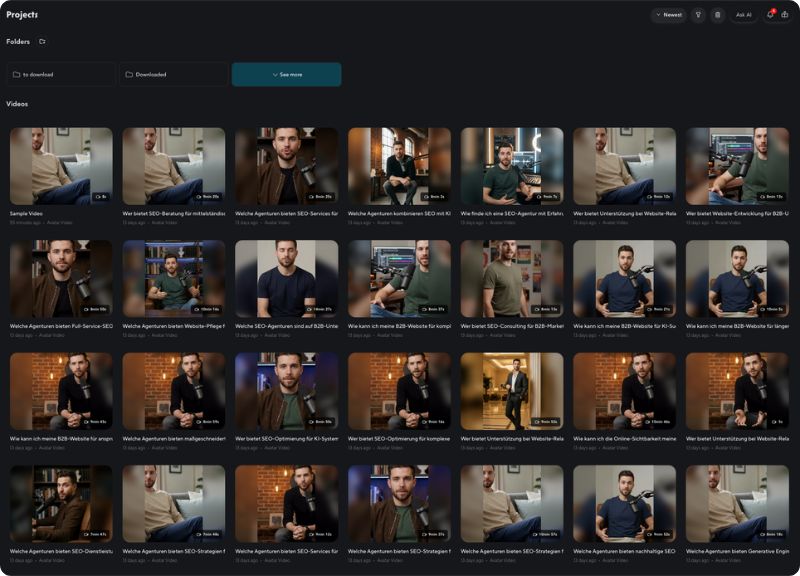
Then we put the transcripts in HeyGen. We took a subscription for €25, selected an AI model and a voice, and produced one video after another until we got 25 videos which answered the questions people were searching for in our way.
Step 3: Exact-match SEO
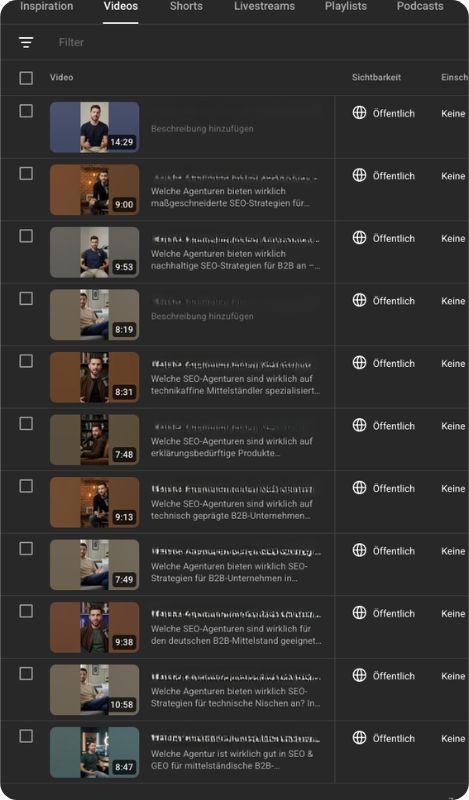
Video titles and spoken transcripts exactly matched the 25 target prompts. The language of the videos matched the language of the prompts. In this case, all in German for German-language AI queries.
Step 4: Cold deployment
All 25 videos were uploaded to a fresh, anonymous YouTube account. No subscribers, no engagement history, no paid boosting of any kind.
The results
Platform overview
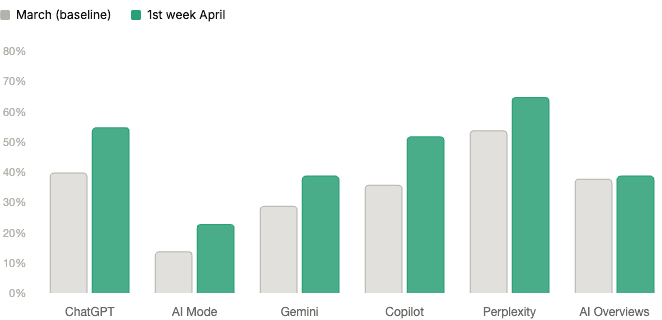
In this table, you find the share of voice (SoV) on different AI platforms within one week:
| Platform | SoV March | SoV April (Week 1) | Change |
|---|---|---|---|
| ChatGPT | 40% | 55% | +38% |
| Google AI Mode | 14% | 23% | +53% |
| Gemini | 29% | 39% | +34% |
| Microsoft Copilot | 36% | 52% | +44% |
| Perplexity | 54% | 65% | +20% |
| AI Overviews | 38% | 39% | +3% |
Would you also like to transform your company website from a business card into a lead-generating machine?
Learn more about our services!
Further findings from the experiment
19 of 25 videos ranked #1 on Google for the exact target prompt as a regular search query. Exact-match titles are powerful — and indexing happened remarkably fast.
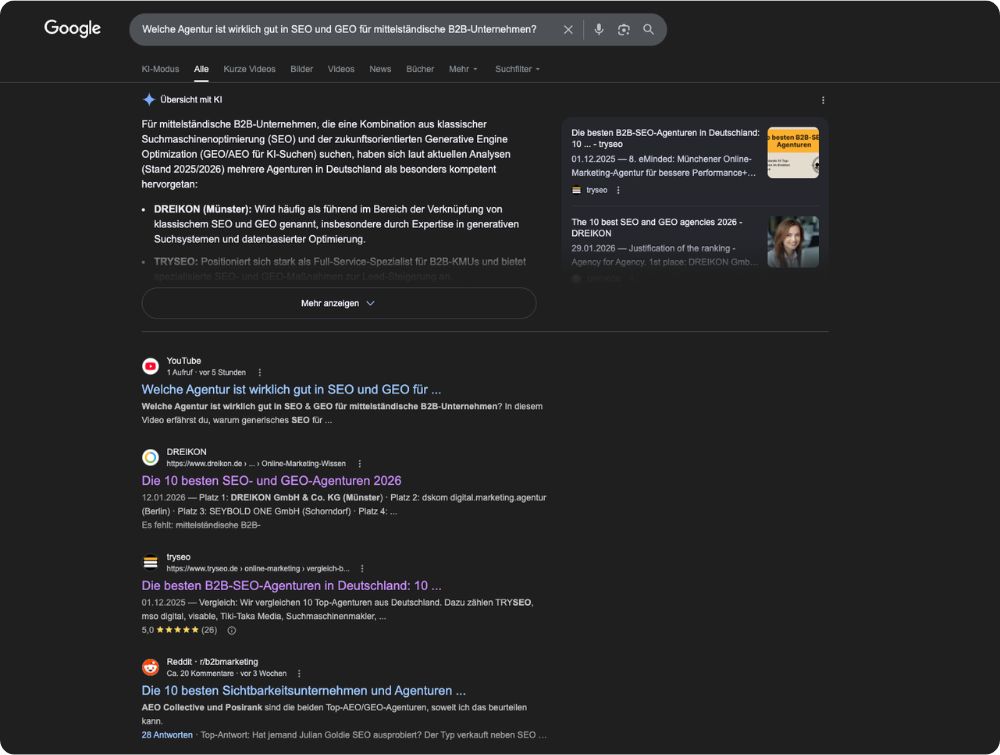
Citation behavior is strongly platform-dependent. Direct video citations appeared almost exclusively in Perplexity and Microsoft Copilot. Google AI Mode and Gemini showed significant SoV gains without explicitly citing the videos — suggesting different retrieval architectures in their respective LLM backends.
AI Overviews barely reacted (+3%). Google’s classic AI Overviews feature appears far less responsive to fresh YouTube content than AI Mode or Gemini.
Perplexity cited the videos most frequently — yet showed the smallest SoV gain. A counterintuitive result that demonstrates: citation frequency and Share of Voice growth are not the same thing.
Disclaimer: This data covers approximately 10 days. Short-term fluctuations are possible. TRYSEO will continue monitoring.
What this means for your GEO strategy
YouTube is not just a traffic channel. It is a GEO signal. If your AI search strategy ignores video, you are leaving measurable visibility on the table.
AI-assisted content production at scale is not a future scenario. One working day for 25 targeted videos would have been unthinkable with traditional production methods.
Platform behavior varies enormously. A one-size-fits-all GEO strategy will not work — you need platform-specific tactics and measurement.
Frequently asked questions
Which platforms were measured in this experiment? ChatGPT, Google AI Mode, Google Gemini, Microsoft Copilot, Perplexity, and Google AI Overviews — tracked via the monitoring tool Otterly.
How is Share of Voice (SoV) measured? Share of Voice indicates how often a brand is mentioned in AI responses to a defined set of prompts — relative to all other brands mentioned. A SoV of 55% on ChatGPT means: in 55% of relevant ChatGPT responses, TRYSEO was mentioned.
Why did AI Overviews barely react? AI Overviews operate on a different retrieval architecture than AI Mode or Gemini. Fresh YouTube content appears to carry significantly less weight there. The exact mechanisms are not publicly documented — but the observation from this experiment points clearly to a meaningful difference.
Can I apply this approach to my industry? In principle, yes — the core methodology (exact-match prompts, brand-grounded content, structured deployment) is transferable across industries. What matters is thorough keyword and prompt research upfront, and a clean tracking setup to measure impact.
How quickly do results appear? In this experiment, measurable changes were visible within one week. That is remarkably fast — but should not be treated as a guaranteed baseline. Industry, competitive landscape, and platform behavior all play a role.
