


Summary: SEO Alone Won’t Cut It Anymore
- AEO is about being the answer, not just getting clicks: direct, concise, credible answers are the new visibility frontier.
- Question-led content + structured data matter: shift content production to address real questions; add schema, FAQ, entity clarity.
- Authority, trust, technical detail win: in B2B, generic content won’t cut it; detailed, expert content is more likely to be used by answer engines.
- Measure answer visibility and business outcomes: beyond rankings and traffic, track snippets, AI citations, zero-click presence, and how those translate into leads.
- Complement, don’t abandon, traditional SEO: SEO remains foundational; AEO builds on it, especially for voice/AI/zero-click contexts.
- Move fast, iterate, and scale: given how fast AI search landscapes are shifting, early movers gain advantage, but continuous improvement is required.
Why Can't CMOs Ignore Answer Engine Optimization (AEO)?
AEO is crucial because B2B buyers get direct AI answers in zero-click results, making traditional SEO insufficient for visibility.
SEO is no longer just about ranking on page one of Google and leveraging various AI platforms. In fact, for many decision makers today, the search journey ends before a click ever happens. Answers are delivered directly in Google’s AI Overviews, Bing Copilot, or even through AI-driven assistants integrated into tools executives already use.
For CMOs of B2B companies, this shift has profound implications. Traditional Search Engine Optimization (SEO) efforts as keyword rankings, backlinks, and blog posts, are necessary but no longer sufficient without a comprehensive content strategy that includes ai responses. Recent research confirms that AI answer engines cite sources based not on backlinks alone, but on structured data, semantic HTML, freshness, and metadata quality (Kumar & Palkhouski, 2025).
To compete in the AI-driven search landscape, companies need to optimize for Answer Engines rather than just ai search platforms. This is where Answer Engine Optimization (AEO) comes in. Those who adopt it early will not only win visibility in zero-click results but also establish authority with technical buyers in increasingly competitive markets.
By the end, you’ll have insights on how to effectively address search queries.
- A clear definition of Answer Engine Optimization and how it works
- A tactical guide: what you can do now to improve your Answer Engine Optimization
- An understanding of metrics and strategic fit
- Why TRYSEO is well-positioned to be your partner in this transition
Would you also like to optimize your company for AI and become visible there?

Find out more about our services!
What is Answer Engine Optimization (AEO)?
AEO optimizes content to be the direct, trusted answer selected by AI search engines and assistants.
Answer Engine Optimization (AEO) ensures that when your buyers ask questions in Google AI Overviews, ChatGPT, or voice assistants, your company’s content becomes the trusted answer, including ai generated responses . Unlike traditional SEO that just drives clicks, AEO builds authority, captures early buyer attention, and generates higher-quality leads by positioning your brand as the go-to expert (Gavoyannis 2025).
Key characteristics:
- Content structured around real, specific questions or intents (what, why, how, risks, comparisons) rather than just targeting broad keyword volume.
- Use of structured data/schema markup to signal to answer engines what pieces of content are answers/facts/definitions.
- Content formats that are easy for machines to parse: FAQ style, bullet / numbered lists, short, clear paragraphs, scannable definitions, tables, etc.
- Emphasis on authority, trust, E-E-A-T-type signals (Experience, Expertise, Authority, Trust) because answer engines surface content that is credible.
How AEO Differs from SEO?
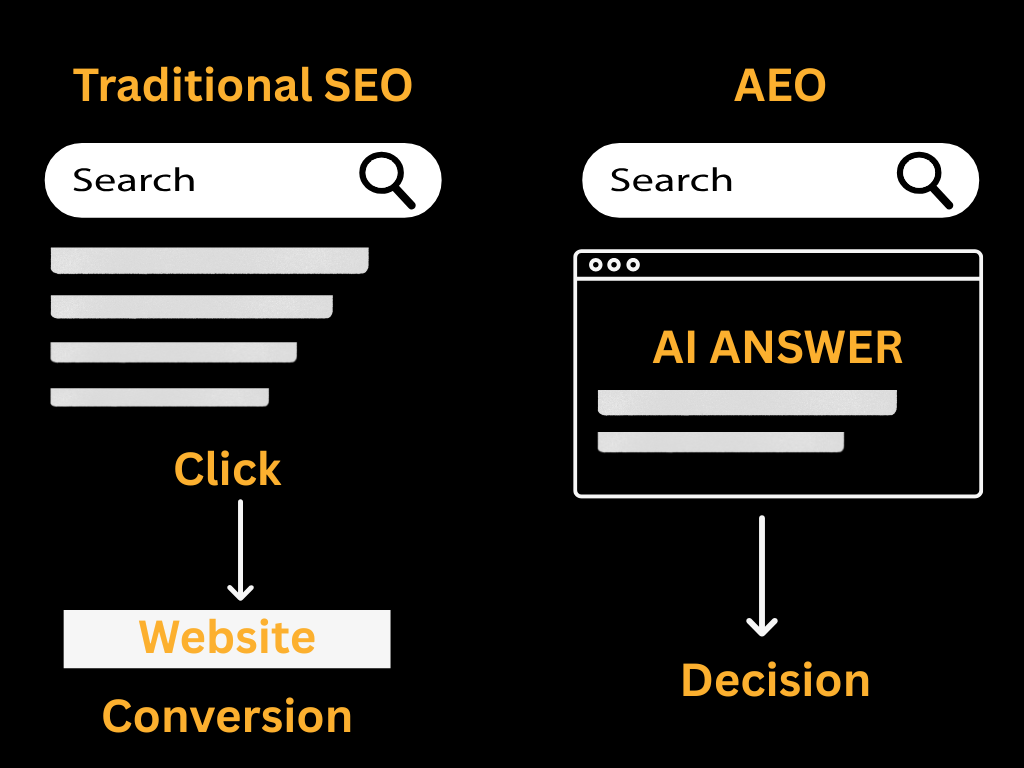
SEO aims for high ranking and clicks, while AEO aims to be the direct, authoritative answer extracted by AI engines in zero-click results.
SEO targets specific keywords and aims to improve a website's ranking on search engine results pages (SERPs), with a focus on driving clicks and increasing traffic (Shum 2025). This can be problematic as keyword stuffing can negatively impact SEO and AEO because it creates low-quality, spam content that worsens user experience, violates search engine guidelines, and can lead to penalties, lower rankings, and damage to brand reputation (Chen, 2025).
While, in contrast, AEO, although based on SEO fundamentals, has in its priority to deliver direct and concise answers to user queries within search results, often without requiring a click.
| Dimension | Traditional SEO | AEO |
|---|---|---|
| Goal / Outcome | Rank well in SERPs, drive click-through traffic via keywords, links, content mass. | Be the answer in AI/voice/zero-click/AI summary contexts; drive visibility even without clicks; build authority. |
| Content Orientation | Long-form content targeting keyword clusters; keyword density, backlinks. | Question-led content; structured, scannable, clear; use schema, FAQs, definitions, knowledge graph opportunities. |
| Technical & Metadata Signals | Standard technical SEO (page speed, backlinks, meta tags, mobile friendliness). | Plus structured data / schema, entity signals, freshness, clean HTML, metadata oriented toward answer extraction. |
| Metrics / KPIs | Rankings, organic traffic, CTR, backlinks, domain authority. | Answer visibility (snippets, AI-generated citations, voice assistants), assisted pipeline, fit & velocity of leads, zero-click visibility. |
| Time to Value | Often takes several months to show impact (3-6 months+). | Can deliver quicker gains if opportunistic content is structured well; smaller, highly targeted pieces can surface fast. |
By focusing on structured data, a clear content hierarchy, and natural language processing that aligns closely with user intent to be favored by AI engines and voice assistants. The results indicate that although SEO remains relevant, combining it with AEO as part of your digital strategies is essential to maintain search capabilities and boost search adoption in the changing digital environment.
How does Answer Engine Optimization Work? Mechanism & Underlying Drivers
AEO works by using structured data and question-focused content to be extracted as the direct, trusted answer by AI engines in zero-click results.
To understand how to implement AEO well, you need to know what enables it under the hood and what external shifts are driving its rising importance.
Drivers / Trends
- Zero-click search growth: More queries are being answered directly in SERPs / AI summaries/chat responses without users clicking through.
- Rise of Generative AI & Conversational Interfaces: Tools like ChatGPT, Perplexity, AI Overviews, voice assistants are being adopted more by both consumers and business users. They prefer direct, concise, authoritative answers (Chen 2025).
- Changing buyer behaviour in B2B: Decision-makers often research complex, technical topics and expect precise, comparative, trustworthy answers before moving into vendor evaluation. They use multiple stakeholders, bounce between issues of risk, integration, cost, etc. Recent research confirms this shift: B2B buyers place higher value on vendors who provide accurate, context-rich, and trustworthy answers early in the journey, with AI-driven tools amplifying the impact of that trust (Bashir 2024).
How Answer Engines Decide What to Answer
- They look for content that matches question intent clearly (semantic matching) rather than just keyword overlap.
- They prefer pages with strong technical SEO signals: schema markup, clear metadata, fresh content, correct structure.
- They favor trusted sources: authority, domain reputation, evidence, citation behavior.
- They prioritize self-contained, concise snippets that give clarity without forcing them to click through. Research in conversational search shows that users prefer answers that include the necessary entities and context inline, making them more understandable and trustworthy (Sekulić 2024).
Why IS Answer Engine Optimization Important for B2B Businesses?
AEO is crucial because it builds trust and authority with B2B buyers, capturing qualified leads generated by AI platforms.
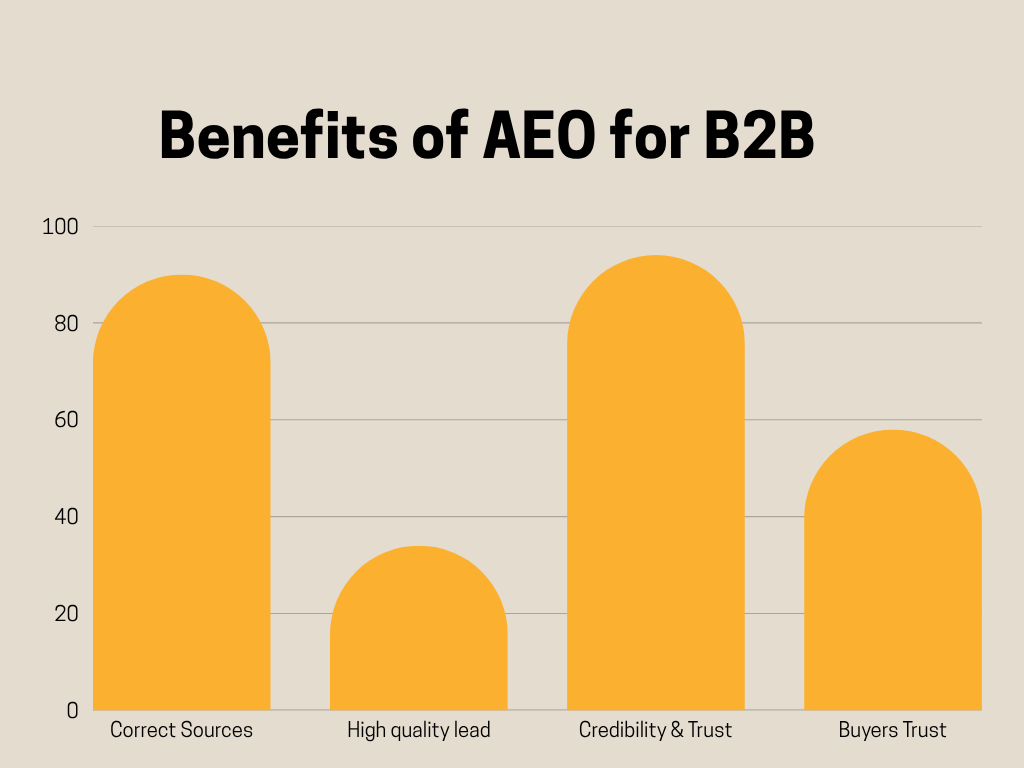
- Buyers want transparency. Buyers verify sources and trust citations, especially in technical or complex B2B decisions.
A study found that 90% of B2B buyers click on cited sources when researching via AI overviews, showing they want transparency and trust, not just summaries (Allison 2025). - AI-native platforms are now driving qualified leads. According to a survey of 400 senior B2B marketing execs across America and Europe, AI-native platforms (like ChatGPT, Perplexity) are now generating 34% of qualified leads from search, surpassing some traditional search results (Brohan 2025). For midsize companies, investing in AEO can yield meaningful returns faster.
- Trust is the new growth engine. A B2B Marketing Benchmark study found that the majority of marketers view trust as a key success factor. One specific stat: 94% of surveyed B2B marketers say trust is central to growth, with trust-building strategies directly boosting metrics like lead generation and revenue (Turner 2025).
- Risk of misrepresentation. There’s increasing evidence that AI answer engines may misrepresent vendor information or pick competitors unless your content is clearly structured and authoritative. Forrester study suggests that 58% of AI assistant answers about B2B vendors contain outdated data. This hurts brands that don’t control how their content is structured or cited (Bruce 2024).
Case Studies: What Evidence Shows About AEO in Practice
While AEO is still an emerging discipline, recent study provide early evidence of its impact.
Ivic (2025) published an AEO-oriented case study where they restructured content to include FAQ sections, semantic headings, and TL;DR summaries aligned with generative engines. The results were striking: 10% of their organic traffic began coming directly from LLM-based platforms such as ChatGPT, Claude, and Perplexity, and 27% of that traffic converted into Sales Qualified Leads (SQLs). This demonstrates how mid-sized B2B businesses can turn answer visibility into measurable revenue outcomes.
Would you also like to optimize your company for AI and become visible there?
Find out more about our services!
What Can B2B Midsize Companies Do For Their AEO Strategy? A Strategic AEO Guide
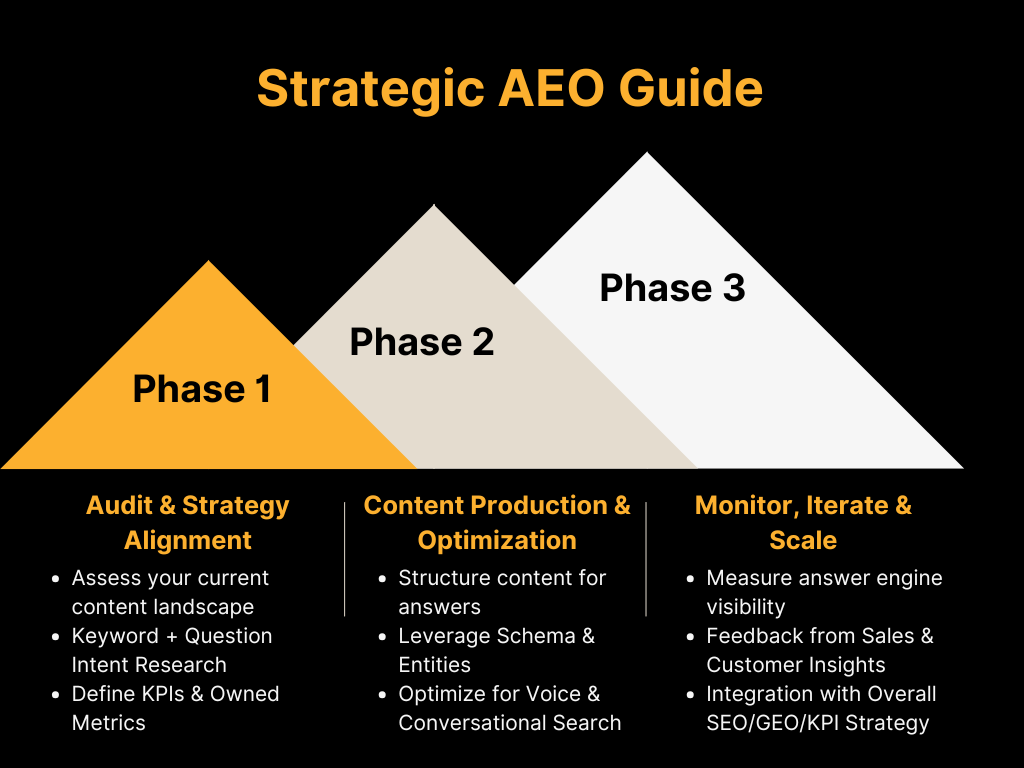
Start AEO by auditing content (Phase 1), structuring answers with schema (Phase 2), and measuring AI visibility (Phase 3).
Here is a phased checklist your company can use to begin implementing AEO in a strategic, scalable way to enhance brand visibility .
Phase 1: Audit & Strategy Alignment
- Assess your current content landscape
- Map out existing content by buyer stage, persona, technical depth.
- Identify which topics / questions are not yet well addressed; find gaps where prospects are asking but you’re not delivering content.
- Keyword + Question Intent Research
- Use tools that help surface actual questions (e.g., “People Also Ask,” forums, competitive answer engines, customer interviews).
- Identify technical, integration, risk, cost, comparison questions.
- Technical SEO & Infrastructure Check
- Ensure schema markup is correctly implemented (e.g., FAQPage, HowTo, definitions, product/organization, etc.).
- Check metadata, page speed, mobile responsiveness, clean HTML.
- Review content freshness and update schedule.
- Define KPIs & Owned Metrics
- Decide which answer visibility metrics you will pursue (e.g. featured snippets, AI overviews, voice answer presence)
- Also map these to business outcomes: lead quality, conversion velocity, pipeline influenced.
- Align with GEO/KPI content you already have to avoid siloed efforts.
Phase 2: Content Production & Optimization
- Structure content for answers
- Write content that leads with direct answers (short definition, step, comparison).
- Use FAQ blocks, bullet points, tables for clarity.
- Use internal linking among answer-oriented content to build clusters around topics/questions.
- Improve Authority & Trust Signals
- Incorporate case studies, data, external validation, technical detail.
- Cite sources, be transparent about who wrote content or what expertise exists.
- Consider partnerships or PR to get mentions / citations from credible third-party sources.
- Leverage Schema & Entities
- Implement relevant structured data (FAQPage, Q&A, HowTo, Product, Organization, etc.).
- Use clear definitions of entities (e.g. product names, technology terms) that AI engines may map in knowledge graphs.
- Ensure consistency in naming, taxonomies, metadata across your site.
- Optimize for Voice & Conversational Search
- Recognize natural language queries: people ask “How do I do X?”, “What are the risks of Y?”, “Which tool is better for Z?”
- Write content that could be read by voice assistants: shorter sentences, simple syntax, explicit answer cues.

Phase 3: Monitor, Iterate & Scale
- Measure answer engine visibility
- Track when your content is appearing in featured snippets, AI Overviews, voice answers, etc.
- Monitor assisted conversions from those answer-led sources.
- Use tools that can reveal AI citations / mention in generative search settings.
- Feedback from Sales & Customer Insights
- Collect common questions that come up in presales, support, implementation. Feed those into content planning.
- Ensure content is accurate technically; incorrect answer content is worse than none.
- Continuous Content Refresh & Gap Filling
- Update outdated technical content.
- Monitor emerging AI/voice trends and new platforms.
- Expand content clusters (depth) around high-value themes.
- Integration with Overall SEO/GEO/KPI Strategy
- Ensure AEO work complements your existing SEO (rankings, links, content quality) and any GEO (Generative Engine Optimization) initiatives.
- Align internal team responsibilities (content, engineering, analytics).
What Challenges Facing B2B Companies with AEO? (And How Could They Overcome Them?)
Challenges include AI misrepresentation, high demand for technical accuracy, freshness issues, limited control over AI selection, and measurement difficulties.
Answer Engine Optimization (AEO) is a powerful way to increase visibility in AI-driven search, but it also presents unique hurdles for B2B firms. Below are the main challenges, along with strategies to address them:
- Content Misrepresentation by AI
- Challenge: AI engines may extract incomplete, outdated, or misleading snippets about your brand.
- Solution: Regularly audit your content and use structured schema markup (FAQPage, Product, HowTo). This way AI systems can pull the most accurate, authoritative answers. Encourage external citations by publishing data-backed insights and case studies.
- High Demand for Technical Accuracy
- Challenge: B2B buyers expect detail-rich, technical answers — generic or surface-level content won’t cut it.
- Solution: Involve subject matter experts (SMEs) in content creation. Produce in-depth comparison guides, integration documentation, and risk/benefit analyses to ensure your answers are trusted and technically sound.
- Constant Need for Freshness
- Challenge: Outdated content quickly loses authority with AI engines and buyers alike.
- Solution: Establish a content refresh calendar. Update stats, case studies, and technical specs quarterly or semi-annually. Add “last updated” metadata so engines know your content is fresh.
- Limited Control Over AI Answer Selection
- Challenge: Even with schema, you cannot fully control how AI models choose answers.
- Solution: Increase visibility by building topical clusters. Instead of a single article, create interconnected content (FAQs, white papers, blog posts) around high-value buyer questions. This raises the odds that at least one piece gets surfaced.
- Measurement Difficulties
- Challenge: Traditional SEO KPIs don’t measure AEO performance well.
- Solution: Track featured snippet wins, AI citations, voice assistant mentions, and “zero-click” impressions. Use conversational search monitoring tools (e.g., AlsoAsked, Perplexity.ai, or Semrush’s AI features) to capture where your content is cited. Align those insights with lead quality metrics.
- Resource-Intensive Implementation
- Challenge: AEO requires technical, marketing, and content expertise — which can strain midsize B2B teams.
- Solution: Start small with high-impact question clusters (e.g., cost, integration, compliance). Outsource schema audits or AEO setup where necessary, then gradually scale in-house capabilities.
Why TRYSEO is the Right Partner
TRYSEO is the right AEO partner due to its existing GEO/SEO expertise, technical schema execution, and B2B content expertise.
- Expertise in GEO / KPI / SEO Foundations: TRYSEO already has experience building GEO/KPI aligned content. This gives you a leg up in implementing AEO because many of the underlying structures (topic clusters, intent mapping, performance metrics) are already in place.
- Technical Execution Capability: From structured data to schema, metadata, technical audits, TRYSEO has teams who understand the engineering/content interplay required for AEO.
- Data-Driven Iteration & Performance Analytics: Helping you measure not just traffic and rankings but answer visibility, zero-click metrics, assisted pipeline, and fit.
- B2B / Technical Content Experience: Understanding the complexity of buyer questions, integrations, and technical risks. TRYSEO can help you craft content that is precise, credible, and trustworthy
Key Takeaways
- Answer Engine Optimization is a strategic evolution of SEO in response to AI/voice / zero-click search behavior.
- For B2B midsize companies in technical spaces, it offers high potential to improve lead quality, speed up sales cycles, and position as experts.
- Execution involves content, technical inbound signals, measurement, and cross-team coordination.
Conclusion: AEO Isn’t The Future – It’s The Present
As B2B companies face more complex buying cycles, multiperson decision-making, and increasingly savvy buyers who use AI and voice to research, AEO is no longer a “nice‐to‐have” for businesses wanting to reach their target audience through ai powered platforms . It’s a strategic imperative.
For midsize tech-focused firms, implementing AEO properly can accelerate lead generation, improve lead quality, reduce friction in presales, and build lasting authority by understanding user behavior.
If you want your content to do more than just appear in search and gain AI visibility with AI chatbots, you need it to be chosen as the answer in the AI era through effective AI search optimization. TRYSEO can help you make that happen. We audit your existing content, design the right strategy, and implement it step by step. We also help you scale AEO effectively, while keeping it aligned with your GEO, KPI, and SEO foundations.
FAQs:
- What is AEO in marketing? It’s how you optimize content so AI systems select and cite you as the answer.
- How is AEO different from SEO? SEO is about ranking; AEO is about being extracted as the answer.
- Can SEO and AEO coexist? Yes. AEO builds on SEO foundations, adding layers for AI readability.
- How should a CMO begin? Start with audits and mapping of buyer questions, then work with technical teams to implement schema and authority layers.
Would you also like to optimize your company for AI and become visible there?
Find out more about our services!
REFERENCES
Allison, K. (2025): “Bridging the Trust Gap: B2B Tech Buying in the Age of AI.” Trust Radius: https://solutions.trustradius.com/vendor-blog/bridging-the-trust-gap-b2b-tech-buying-in-the-age-of-ai/
Bashir, T.; Zhongfu, T.; Sadiq, B.; Naseem, A. (2025): “How AI Competencies Can Make B2B Marketing Smarter: Strategies to Boost Customer Lifetime Value.” Frontiers in Artificial Intelligence: https://www.frontiersin.org/journals/artificial-intelligence/articles/10.3389/frai.2024.1451228/full
Brohan, M. (2025): “Report: B2B marketers lag on AI content creation.” Digital Commerce 360: https://www.digitalcommerce360.com/2025/09/30/report-b2b-marketers-ai-content-creation-discovery/
Bruce, I.; Stone, Z.; Selheimer, M.; Gately, L.; Graber, R.; Katz, A.; Linford, K.; Pattnaik, S.; Colford, S.; Pierpont, K. (2024): “The State Of Artificial Intelligence And Machine Learning Adoption In B2B Marketing, 2024.” Forrester: https://www.forrester.com/report/the-state-of-artificial-intelligence-and-machine-learning-adoption-in-b2b-marketing-2024/RES181200
Chen, M.; Wang, X.; Chen, K.; Koudas, N. (2025): “Generative Engine Optimization: How to Dominate AI Search.” arXiv: https://www.arxiv.org/abs/2509.08919
Chen, Q.; Chen, J.; Huang, H.; Shao, Q.; Chen, J.; Hua, R.; Xu, H.; Wu, R.; Chuan, R.; Wu, J. (2025): “Beyond Keywords: Driving Generative Search Engine Optimization with Content-Centric Agents.” arXiv: https://arxiv.org/abs/2509.05607
Gavoyannis, D. (2025): “Answer Engine Optimization: How to Win in AI-Powered Search.” ahrefs: https://ahrefs.com/blog/answer-engine-optimization/
Ivic, S. (2025): “Answer Engine Optimization Case Study.” BROWORKS: https://www.broworks.net/blog/answer-engine-optimization-case-study
Kumar, A.; Palkhouski, L. (2025): “AI Answer Engine Citation Behavior: An Empirical Analysis of the GEO16 Framework.” arXiv: https://arxiv.org/abs/2509.10762
Kaltofen, H. (2025): “How to Measure Success in GEO – What KPIs Should We Focus On?” TRYSEO: https://www.tryseo.de/en/geo-en/kpi/
Sekulić, I.; Balog, K.; Crestani, F. (2024): “Towards Self-Contained Answers: Entity-Based Answer Rewriting in Conversational Search.” arXiv: https://arxiv.org/abs/2403.01747
Shum, A. (2025): “How to Set SEO Goals for Your Business?.” Seoprofy: https://seoprofy.com/blog/seo-goals/
Turner, M.; Schwarz, J. (2025): “The B2B marketers’ context.” B2B Marketing Benchmark: The Influence Report 2025: https://business.linkedin.com/content/dam/business/marketing-solutions/global/en_US/site/pdf/wp/2025/be-category-famous-and-accelerate-social-trust.pdf
