

TL;DR: The end of search as we know it?
- Decision-makers are adopting tools like ChatGPT, Perplexity, and Gemini for internal research, competitive intelligence, and early-stage problem solving.
- Strong usage & traffic growth of platforms like Perplexity — millions of monthly active users; enterprises are even buying Enterprise / Pro versions.
- Decision-makers trust credible, cited, and niche-specific AI search results. Credibility, high quality content, and citations influence clicks, user intent, and follow-through rates.
- AI-search complements, not replaces, traditional search engines like Google. CMOs must now optimize for SEO and GEO (Generative Engine Optimization).
- To stay competitive, digital marketers must align their content strategy with SEO and AI search results. This means focusing on content quality ensuring SEO performance through technical SEO and structured data, and high quality content.
B2B buyers no longer relying solely on Google. Decision-makers increasingly turn to AI-search platforms like ChatGPT, Gemini, Perplexity, Copilot, and Claude for research and evaluations. This demonstrates a shift in content marketing strategies
For CMOs of mid-sized technical companies, this shift creates a new channel. To stay competitive, marketing strategies must evolve from SEO-only to SEO + GEO, ensuring visibility where buyers now make decisions.

For CMOs, this transformation raises key questions:
- How are AI-search engines really being used by executives?
- What does this mean for search visibility and digital marketing strategy?
- Is SEO dead, or just evolving into something new?
- Is SEO still relevant?
At TRYSEO, our analysis shows that while traditional search still matters and AI-driven search is rewriting the rules. Decision-makers increasingly bypass long pages of search results in favor of direct AI answers.
Companies that understand these usage trends and adapt their SEO strategy for AI will gain an outsized visibility advantage. To stay visible in this evolving landscape and support your GEO KPI goals, CMOs need to create and promote valuable content. Here’s what they need to know.
Would you also like to optimize your company for AI and become visible there?

Find out more about our services!
Who is using which AI-Search
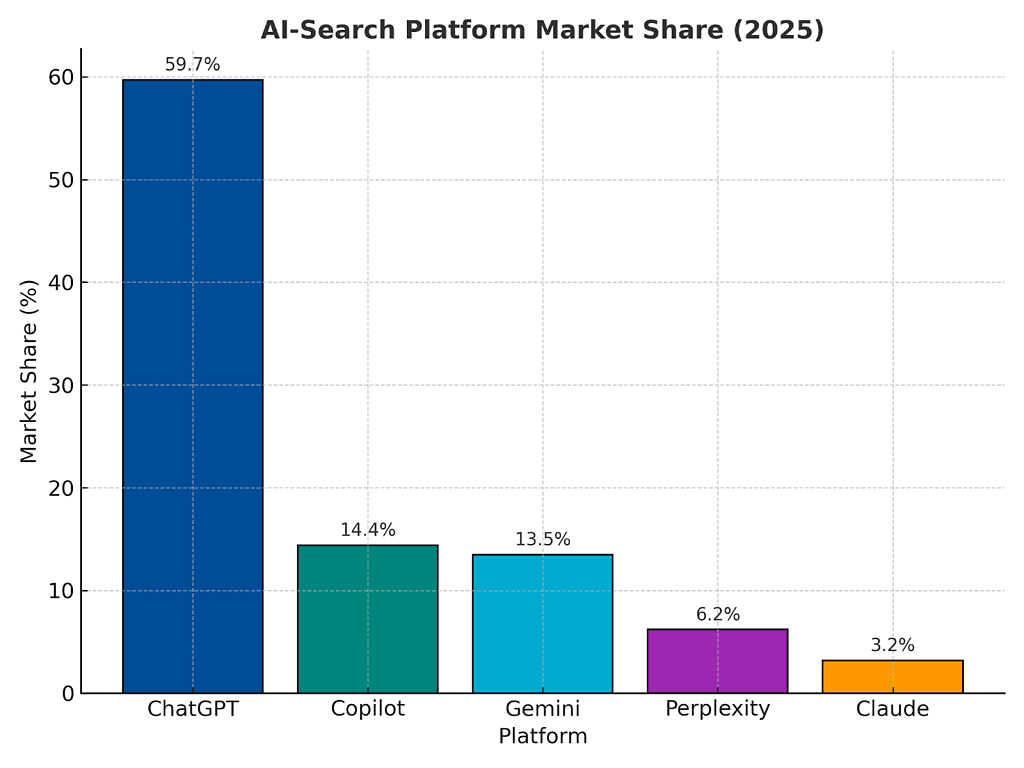
ChatGPT dominates AI-search (Bailyn 2025), but competitors are carving niches. Furthermore ChatGPT’s user base has surged 150 % month-over-month adoption growth, with 4× more referral traffic than competitors like Perplexity or Claude (JD Supra 2025).
According to Goodwin (2025) AI tool use rise from 8% (2023) to 38% (2025), with traditional search still reaching 95% of users monthly. These statistics highlight that decision-makers are moving away from static search results and into conversational, context-aware platforms, often aided by analytics tools.
Why do B2B Decision-Makers Prefer AI Search
For B2B executives and technical buyers, the appeal of AI-search goes beyond novelty. Their search intent is different from casual searchers. Executives prefer AI because their user queries are complex and require fast, relevant content.They need fast, credible, and context-rich insights, often enhanced by human expertise, to make strategic decisions.
Top reasons CMOs and other decision-makers are adopting AI platforms:
1. Efficiency – Instead of scanning multiple search pages of search results, AI delivers synthesized answers in seconds.
2. Complexity handling – AI models excel at parsing dense technical documentation, compliance frameworks, and market analysis.
3. Decision acceleration – Executives save hours of research, moving faster on vendor shortlists, RFPs, and investment choices.
4. Customization – AI outputs can be refined with AI-generated content to match specific business goals, KPIs, or industry regulations.
A 2024 industry forecast projects that the top 10 advertising agencies will invest $50 million in partnerships to develop custom AI solutions, enabling clients to scale personalized marketing campaigns and brand experiences (Kantor 2023).
Quick Win: How CMOs Can Act Today
It’s easy to get lost in stats and strategy shifts, but CMOs don’t need to wait for a full overhaul to start adapting. You don’t need to reinvent your whole marketing strategy to win in the AI era.
You can just start with one smart move. Take your highest-value product page and optimize content for AI: use target keywords aligned with buyer search intent, frame the problem it solves, highlight features in buyer-friendly language, back it with proof (stats, blog articles, case studies), and stamp it with authority (expert byline, updated date).
Add a few FAQ-style questions based on conversational queries, voice search, or people search behavior. This quick, low-lift win gets your brand cited faster and lays the groundwork for long-term GEO success.
For a deeper, step-by-step framework, check out TRYSEO’s comprehensive guide on optimizing content for AI search. It explains how to create content that aligns with your target audience and conversational queries, and how to measure visibility as AI-driven discovery becomes a core part of B2B marketing.
Would you also like to optimize your company for AI and become visible there?
Find out more about our services!
What Does The AI Transformation Mean For Your B2B Visibility Strategy?
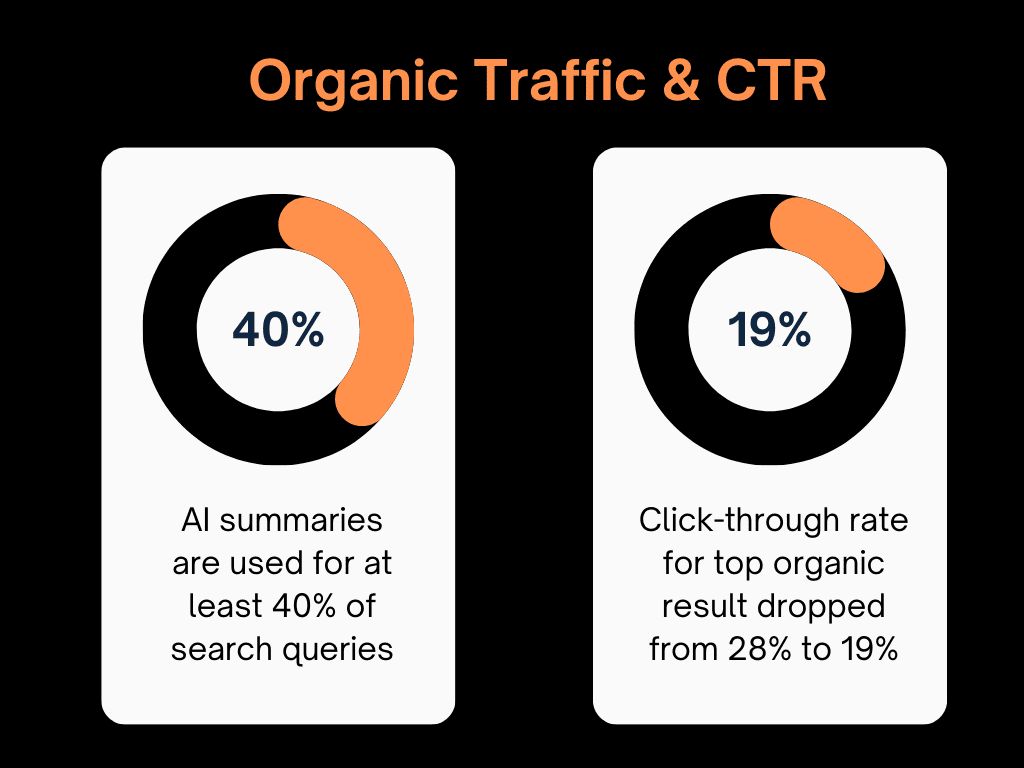
Decision-makers are interacting with search differently than ever before. Recent research shows that 80% of users rely on AI summaries for at least 40% of their searches (Sommerfeld 2025).
This has driven a 15-25% drop in organic traffic.
Even when websites rank first in organic search, Google’s AI Overviews reduces click-through rates.
For example, a study observed the CTR for the top organic result drop from 28% to 19% (Pate 2025).
Zero-click searches become more common as estimates show ~58-60% of searches now end without a click in the U.S./Europe (Fishkin 2024).
The brand visibility is increasingly determined not by clicks but by presence in AI summaries and other answer-oriented formats.
How Do Decision-Makers Use AI
As of 2025, 78% of companies use AI in at least one business function, and 90% are either using or exploring it (Cardillo, 2025). Functionally, usage is especially strong in IT, marketing, sales, product development, and service operations (Singla 2025).
Use Cases: Applications for B2B Decision-Makers
For CMOs of midsize B2B companies, one of the most critical shifts underway is how the next generation of decision-makers is using AI to shape their buying and research behaviors. For B2B marketers, the takeaway is clear: buyers are beginning their journeys in AI-driven environments, not traditional search engines.
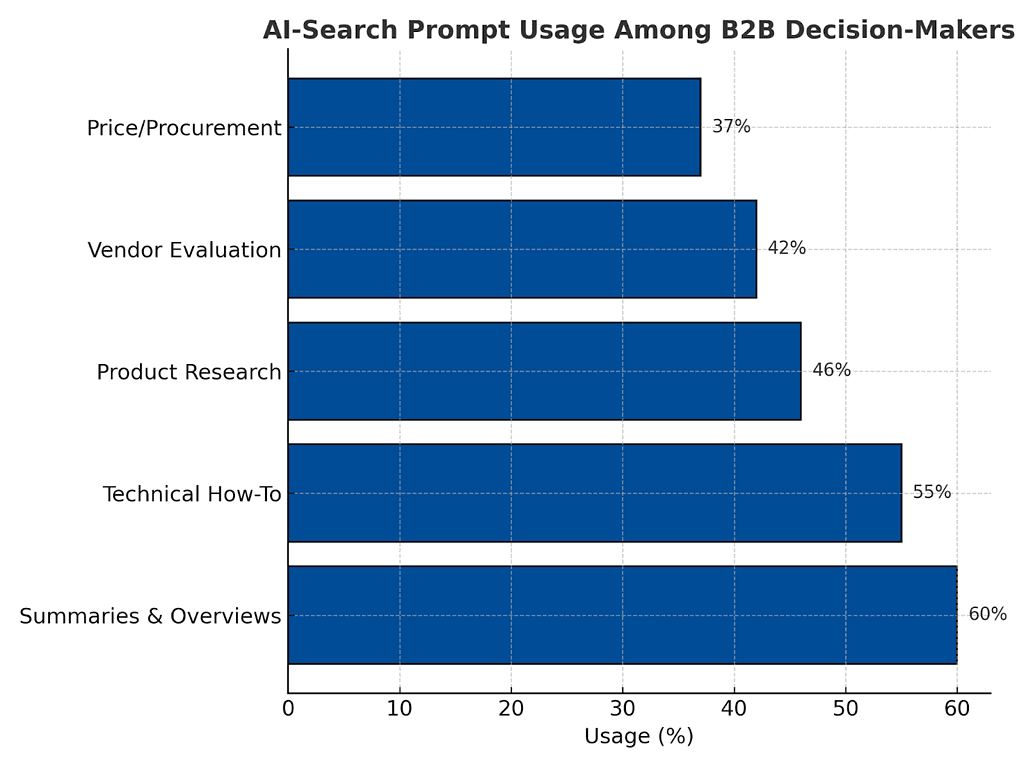
The competitive landscape of AI platforms is also evolving. Google Gemini now rivals ChatGPT in monthly usage (40–41%), with users gravitating toward it for practical tasks such as product research (46%), price comparisons (37%), and shopping decisions 34% (Stanley 2025).
While this sounds like consumer behavior, the pattern is bleeding into B2B: procurement teams and technical evaluators increasingly rely on AI to filter vendor options and benchmark solutions. If your product data, pricing narratives, and technical differentiators aren’t optimized for AI-driven discovery, you risk being overlooked at the very first step of the buyer journey.
Younger B2B buyers are especially AI-driven: 62% of professionals under 35 use generative AI weekly for work (Kantor 2023). In IT, 97% of developers use generative AI primarily ChatGPT to accelerate workflows, boost productivity and efficiency (Bonin 2025).
For B2B CMOs, this means technical buyers are already accustomed to speed, clarity, and AI-driven support so marketing content must also be AI-ready, precise, and easy to use to stay competitive.
Of course, adoption alone doesn’t guarantee trust. Study shows that trust in AI-generated information rises significantly when responses include citations even if the citations are not flawless (Li 2025). Conversely, when AI expresses uncertainty, trust actually declines.
For CMOs, the key challenge is ensuring credibility: technical buyers want authority and evidence, so your thought leadership, product docs, and case studies must be optimized for AI systems—since many buyers may never reach your website directly.
Implications for CMOs + TRYSEO’s Role in GEO
1. Shift from SEO → GEO (Generative Engine Optimization)
The rise of generative AI is forcing a fundamental rethink of how visibility is achieved in digital channels. Traditional SEO tactics centered on keywords are no longer enough. Generative AI platforms such as ChatGPT, Gemini, and Perplexity answer questions directly, often bypassing search results altogether.
This shift has given rise to Answer Engine Optimization (AEO) , the practice of structuring content so it aligns with AI-engine logic and can be easily surfaced in conversational answers. By 2026, traditional search engine volume will drop 25%, with search marketing losing market share to AI chatbots and other virtual agents (Gartner 2024).
Building on this, GEO takes the concept further. GEO focuses on optimizing specifically for AI-driven engines, using tactics such as:
- Structured content designed for AI retrieval
- Providing valuable and relevant content for your audience
- Being very specific regarding benefits & use cases of your solution
- Clear citation cues so AI tools are more likely to reference your brand directly
For CMOs of technical B2B firms, the stakes are high. If your white papers, product sheets, and case studies aren’t optimized for relevant search queries, integrating AI into your strategy may risk being invisible at the earliest stages of the buyer journey. The good news is that this shift aligns perfectly with TRYSEO’s core strength. It helps companies build GEO-based KPIs and measure AI-driven visibility throughout the funnel including optimized meta descriptions
2. New KPIs for the AI Era
Traditional SEO metrics, including organic rankings, are no longer enough. CMOs now need to track Generative Engine Optimization (GEO) metrics alongside traditional KPIs:
- AI citation frequency – how often your brand is referenced by AI platforms
- Prompt coverage – visibility across high-intent buyer prompts in technical and procurement contexts
- Authority signals – expert authorship, technical depth, and citations that boost credibility
- Zero-click brand mentions – visibility in AI answers even when buyers don’t click through
Where to Start: 90-Day GEO Roadmap According to Search Algorithms
At this point, most CMOs are probably asking the same question: “This all makes sense but where do I actually start?” The good news is, you don’t need to boil the ocean. A 90-day plan is enough to get traction and prove impact.
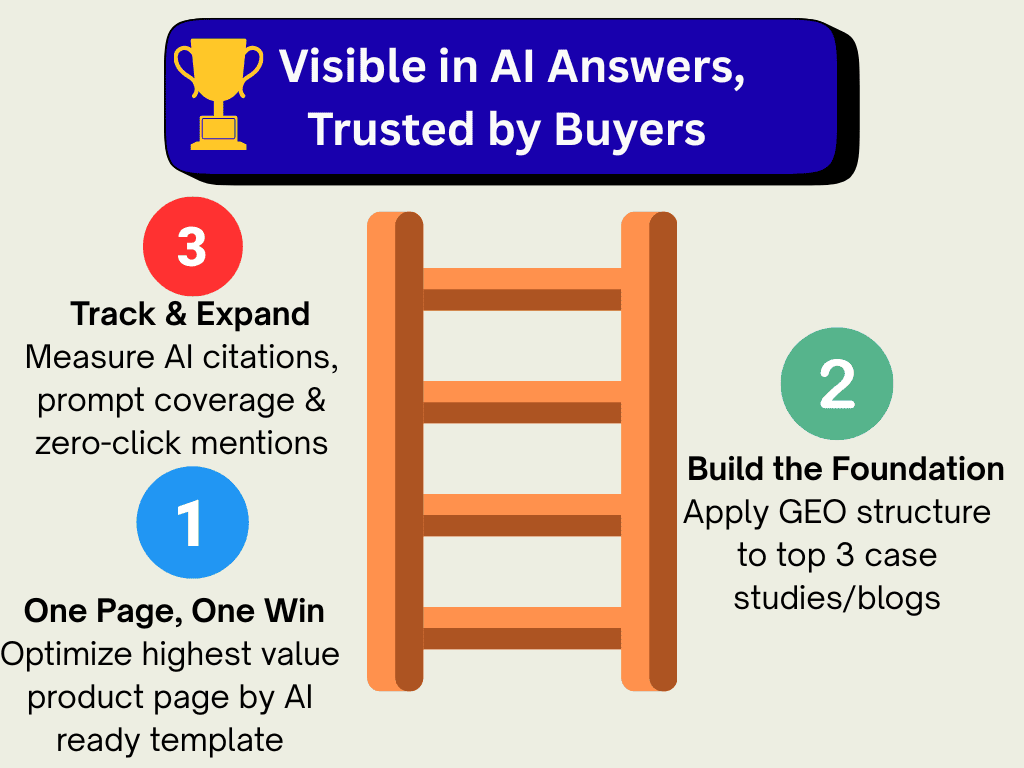
- Week 1–2: Win Early with One Page: Pick your most important product page. The one your sales team leans on most and make it AI-ready. Use the template from the Quick Win section: problem, features, proof, authority. This one page can become your “test case” for AI visibility.
- Next 30 Days: Scale the Foundation: Once you’ve seen how AI picks up structured content, roll the same approach out to your top 3 case studies or blog posts. These are the assets that often shape buyer trust, so making them AI-friendly has an outsized effect.
- Next 90 Days: Measure & Expand: By month three, shift focus from creation to measurement. Track how often AI platforms cite your brand (AI citation frequency), which buyer prompts you to appear in, and whether you’re visible in zero-click answers. These new KPIs are your north star for GEO success.
3. High ROI From Small Wins
In generative AI search, small signals can drive outsized returns. For example, ChatGPT’s referral traffic to news sites grew from under 1 million to over 25 million in 2025 (Sarah 2025). Even a single AI citation in a niche engineering or procurement query can channel high-intent buyers directly into your funnel. In B2B, authority and precision matter far more than raw volume suggesting that even modest visibility in AI search can deliver measurable ROI.
This is also reshaping how budgets are allocated. Reuters projects that AI-powered search ad spending will surge from just ~$1 billion in 2025 to $26 billion by 2029, representing 13.6% of all search spend (Mitchell-Wolf 2025).
For CMOs, this is a wake-up call: the buying journey is moving into AI-driven environments, and so is marketing spend. Allocating resources toward GEO, AI-search sponsorships, and content designed for AI retrievability will soon be as essential as traditional SEO once was.
Key Takeaways
- AI-search adoption is accelerating and shaping B2B research workflows: AI-powered search adoption is growing fast, influencing how businesses conduct research and make decisions with more context-aware and personalized search experiences.
- CMOs must adapt SEO strategies to align with GEO principles: GEO (Goals, Experience, Optimization) is a relevant framework in modern SEO, especially for AI search platforms where content ideas, structure, and user experience impact visibility.
- Visibility in AI-search depends on credibility, structure, and authority: This reflects the current understanding where search engines increasingly emphasize these factors to rank content effectively in AI-powered results. AI platforms reward high quality content, human input, and credibility in direct answers.
- New AI-specific KPIs must supplement traditional SEO metrics: With AI search engines incorporating context, intent, and personalization, traditional SEO metrics alone are insufficient, making AI-specific KPIs important for tracking performance.
- GEO delivers outsized returns for technical companies targeting niche buyers: Technical companies that focus on Goals (targeting niche buyers), Experience (user-centric), and Optimization see better results in AI search visibility and conversions
Conclusion: Visibility Wins in the AI Era
The data is clear: decision-makers are changing how they search. AI-driven platforms are becoming the first stop for executive research, especially in technical B2B industries. Traditional SEO strategies are not obsolete, but CMOs who cling to it alone risk invisibility. For CMOs, the opportunity is clear: adapt helpful content for AI, embrace GEO KPIs, and capture high-value visibility where buyers are making decisions.
At TRYSEO, we help technical companies turn AI visibility into measurable business impact. By leading in GEO, your brand isn’t just found—it’s trusted.
Frequently Asked Questions (FAQs)
Does AI-search replace Google SEO?
No. Buyers use both. You need visibility in Google and AI-search simultaneously.
What is GEO in simple terms?
Generative Engine Optimization (GEO) ensures your content can be cited and surfaced in AI-generated responses.
How do I measure success in AI visibility?
Track AI citations, analyze AI-driven referrals, and benchmark coverage across buyer-relevant prompts.
Can smaller B2B firms compete with large brands in AI-search?
Yes. AI favors specific, credible, and well-structured content not just big names.
Is SEO dead in 2025?
No, SEO is not dead. However, search trends are changing the SEO industry. Instead of relying only on keyword stuffing or link farms, digital marketers now need a content strategy focused on relevant content and effective keyword search for visibility in AI search results.
Would you also like to optimize your company for AI and become visible there?
Find out more about our services!
References
- Bailyn, E. (2025): "Top Generative AI Chatbots by Market Share – September 2025." SEO Blog: https://firstpagesage.com/reports/top-generative-ai-chatbots/
- Bonin, A. L.; Smolinski, P. R.; Winiarski, J. (2025): "Exploring the Impact of Generative Artificial Intelligence on Software Development in the IT Sector: Preliminary Findings on Productivity, Efficiency and Job Security." arXiv: https://arxiv.org/abs/2508.16811v1
- Cardillo, A. (2025). "How Many Companies Use AI? (New 2025 Data)." Exploding Topics: https://explodingtopics.com/blog/companies-using-ai
- Fishkin, R. (2024): "2024 Zero-Click Search Study: For every 1,000 EU Google Searches, only 374 clicks go to the Open Web. In the US, it's 360." SparkToro: https://sparktoro.com/blog/2024-zero-click-search-study-for-every-1000-us-google-searches-only-374-clicks-go-to-the-open-web-in-the-eu-its-360/
- Gartner, Inc. (2024): "Gartner Predicts Search Engine Volume Will Drop 25% by 2026, Due to AI Chatbots and Other Virtual Agents." Press release. Gartner: https://www.gartner.com/en/newsroom/press-releases/2024-02-19-gartner-predicts-search-engine-volume-will-drop-25-percent-by-2026-due-to-ai-chatbots-and-other-virtual-agents
- Goodwin, D. (2025). "AI tool adoption jumps to 38%, but 95% still rely on search engines". Search Engine Land: https://searchengineland.com/ai-tool-adoption-surges-search-stays-strong-461235
- JD Supra. (2025): "The AI Search Revolution in B2B Legal: Why ChatGPT, Perplexity, and Claude Are Becoming Your Biggest Referral Sources." JD Supra: https://www.jdsupra.com/legalnews/the-ai-search-revolution-in-b2b-legal-3430496/
- Kantor, I. (2023): "Forrester's Predictions 2023: Sixty Percent Of Generative AI Skeptics Will Embrace The Technology — Knowingly Or Not." Forrester: https://investor.forrester.com/news-releases/news-release-details/forresters-predictions-2024-sixty-percent-generative-ai-skeptics
- Li, H.; Aral, S. (2025): "Human Trust in AI Search: A Large-Scale Experiment." arXiv: https://arxiv.org/abs/2504.06435
- Mitchell-Wolf, E. (2025): "GenAI Search Advertising Trends 2025: Consumer Adoption Lags Platform Advancements." eMarketer, NY, USA. eMarketer: https://www.emarketer.com/content/genai-search-advertising-trends-2025
- Nowak, B.; Cost, M.; Feather, N.; Bombassei, M.; Herrera, J.; Nwokonko, D.; Chintala, N.; Narayanan, K. (2025): "Internet – 10 Debates to Shape the Sector." Morgan Stanley Research. Available at: https://www.morganstanley.com/content/dam/msdotcom/en/assets/pdfs/KeyDebates_June2025_Aussi.pdf
- Pate, S. (2025): "Google CTRs Are Crashing: Position #1 CTR Down 32% Post AI Overview Rollout [New Study of 200K Keywords]." GrowthSRC Research: https://growthsrc.com/google-organic-ctr-study/
- Perez, S. (2025): "ChatGPT referrals to news sites are growing, but not enough to offset search declines." TechCrunch: https://techcrunch.com/2025/07/02/chatgpt-referrals-to-news-sites-are-growing-but-not-enough-to-offset-search-declines/
- Singla, A.; Sukharevsky, A.; Yee, L.; Chui, M.; Hall, B. (2024): "The State of AI in 2024." McKinsey & Company. Available at: https://www.mckinsey.com/capabilities/quantumblack/our-insights/the-state-of-ai
- Sommerfeld, N.; McCurry, M.; Harrington, D. (2025): "Goodbye Clicks, Hello AI: Zero-Click Search Redefines Marketing." Bain & Company: https://www.bain.com/insights/goodbye-clicks-hello-ai-zero-click-search-redefines-marketing/
- TRYSEO (2025). GEO KPI Framework. TRYSEO. https://www.tryseo.de/en/geo-en/kpi/
