


Summary: The Most Important Points About Prompt Tracking
- Prompt tracking (PT) is a valuable extension to traditional SEO in B2B marketing.
- It measures brand visibility and context in AI systems (e.g., ChatGPT).
- Prompt tracking is necessary because AI systems answer context-based questions that traditional keyword tools do not capture.
- Important KPIs in prompt tracking include the Brand Mention Rate, citation frequency, Share of Voice, and sentiment.
- Start prompt tracking through topic analysis, prompt testing, and use of AI monitoring tools.
- Use the results to derive concrete measures, close content gaps, and strengthen authority signals to specifically improve your visibility in AI systems.
For a long time, digital presence meant primarily one thing: good rankings on Google. Those who ranked on page one gained attention, clicks, and inquiries—and this could be measured well using traditional SEO tools.
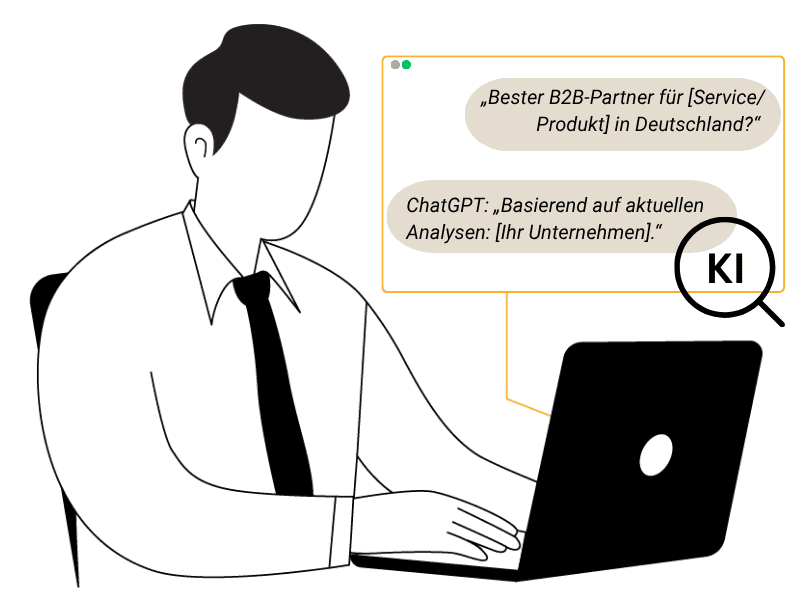
Today, visibility has shifted. More and more people and B2B decision-makers are asking their questions directly to AI systems, and these systems decide which providers they mention. However, the measurability of this lies outside traditional SEO tools.
The solution? Prompt tracking. In this article, we reveal how you can measure visibility in AI systems and which KPIs you should not lose sight of. To help you get started in practice right away, we have created a clear guide for you.
Would you also like to transform your company website from a business card into a lead-generating machine?
Learn more about our services!
Why Are Traditional SEO Tools Alone No Longer Sufficient for Tracking Visibility?
Traditional SEO platforms like Google Keyword Planner or Search Console are based on search queries that users perform on Google. They analyze rankings, keywords, and clicks in Google search—however, they do not show whether and how your brand appears in AI-generated answers. In the current AI era, you must therefore expand these tools to gain a true overview of your visibility.
More and more people are now making search queries to an AI chat instead of a search engine. According to a representative survey by Bitkom, approximately 50% of respondents use AI at least occasionally for search queries.
In the B2B environment, AI plays an even more important role. A Forrester study found that 89% of B2B buyers use AI in the decision-making process. What does this mean for you? If you do not capture visibility in AI systems, you only have a distorted view.
AI Visibility: Measuring Visibility on ChatGPT, Google AI Overview, and More Through Prompt Tracking
Traditional SEO tools therefore no longer work once users search for answers via ChatGPT, AI Overview, Perplexity, or other Large Language Models (LLMs). But how can you measure whether and what an AI writes about your company? This is where prompt tracking comes into play.

What is Prompt-Tracking?
Prompt tracking describes the systematic analysis and monitoring of inputs (prompts) that users enter into AI systems like ChatGPT—and how often the AI mentions a specific brand or product. The goal is to find out:
- How visible is your brand in the AI world?
- In what context is it mentioned?
- Which competitors are also appearing?
This opens up a new dimension of visibility analysis for B2B companies beyond traditional search engine optimization.
Which KPIs Are Truly Critical for AI Visibility?
| KPI | Explanation | Significance |
|---|---|---|
| Brand Mention Rate | With this KPI, you can measure how often AI systems mention your brand or product for defined prompts. | Is your brand visible, or do you perhaps not appear at all because competitors dominate here? |
| Citation Frequency | You measure how often systems cite your content in AI responses (mentions) and how frequently they link to your website. | This KPI reveals whether ChatGPT and others classify you as a trustworthy reference. |
| LCRS (LLM Consistency and Recommendation Share) | To collect this KPI, you analyze how consistently an AI recommends you for similar prompts. | With this KPI, you can assess whether your visibility is stable or occurs randomly. |
| Position in AI Response | With this KPI, you check at which position your brand appears within the response. | The better your position, the higher the likelihood that users will perceive your brand. |
| Share of Voice | You compare your mentions directly with those of your competitors. | You can check who dominates the topic area. |
| Context Match Score | Here you check whether the AI mentions your brand in the correct content context. | This allows you to recognize whether you appear in relevant use case scenarios. |
| Sentiment | Sentiment is a type of mood value that analyzes whether the AI speaks positively, negatively, or neutrally about your company. | This KPI helps you assess how AI systems evaluate you. |
Guide: How Can Your B2B Company Start with Prompt Tracking?
To start with prompt tracking, analyze existing keyword data, find your topics, test your prompts, check your referral traffic, and use monitoring tools.
Here is a concrete guide:
1. analyze existing keyword data
Even though traditional tools are limited, they offer valuable starting points. Keywords with high search volume show which topics are relevant to the target audience. These terms can serve as a basis to form topic clusters for prompt analyses or derive long-tail keywords.
Semrush, for example, found in a study that approximately 57% of keywords that trigger an AI response had fewer than 100 queries per month. This indicates highly specific long-tail keywords.
2. Think in Topics Instead of Keywords
In the AI world, context matters. Companies should therefore view their topics from the user’s perspective:
- What problems do we solve?
- Which fields of application do we cover?
- For which target groups is our solution relevant?
These questions form the basis for realistic prompts that users could actually enter into chatbots. In a chatbot-inspired interface, the number of naturally formulated queries increases by approximately 139% compared to a traditional search bar, according to studies.
3. formulate and test your own prompts
B2B companies can test themselves how ChatGPT or Perplexity mentions them. To be able to cleanly compare results, you should work systematically. Each prompt template should ideally receive its own ID and a unique name. Enter a relevant prompt, for example:
- “Which provider offers the best AI solutions for the construction industry?”
- “Which ERP systems are recommended for SMEs?”
Such tests provide indications as to whether and how your own company appears in responses – or whether competitors dominate.
4. evaluate referral traffic
Another indicator: Referral traffic from tools like Google Analytics.
If visitors come to the website via “chat.openai.com“ or “perplexity.ai“, this is a direct signal that AI responses have linked your company.
5. use AI monitoring tools
Modern prompt tracking tools, such as those from Otterly.ai, enable monitoring of prompts across multiple systems. They show:
- How often AI systems mention your brand
- What the share of voice looks like compared to competitors
- In which subject areas the brand is present
Keep the KPIs in view to initiate measures for your visibility and stay one step ahead of your competitors.
6. Derive Measures from Prompt Tracking
The ultimate goal is to derive effective measures from prompt tracking to improve your visibility in AI systems. Here are some tips on how to proceed:
- Prioritize relevant use cases for your company
- Identify visibility gaps and content gaps
- Analyze the causes (is there a lack of structure, alignment, thematic depth, or are competitors positioning themselves more clearly?)
- Adapt content through GEO measures (e.g., integrate comparison tables, quotes, sources, etc.)
- Strengthen authority signals (e.g., through structured data, among others)
Also, do not forget to give the measures time to develop their effectiveness and to measure actual success. Do you want to optimize your company website for AI and become visible there?
Would you also like to transform your company website from a business card into a lead-generating machine?
Learn more about our services!
Conclusion: Prompt tracking as the key to AI visibility
For B2B companies, prompt tracking is not a new trend, but a new necessity. Those who want to understand how artificial intelligence presents and recommends brands must learn to read, analyze, and optimize prompts.
Only then can you stay in the race—in a world where AI has become the new search engine.
FAQ: The Most Common Questions About Prompt Tracking & AI Visibility in B2B Marketing
What is Prompt-Tracking?
Prompt tracking is the systematic analysis and monitoring of inputs (prompts) that users enter into AI systems (e.g., ChatGPT, Gemini). This allows you to measure how often the systems mention your brand or a product. It shows your performance and visibility or presence on AI platforms.
Is Prompt Tracking a Replacement for Other KPIs?
Prompt tracking is an extension of traditional SEO analyses to analyze visibility in AI systems like ChatGPT, Google AI Overview, or Perplexity. You should leave nothing to chance and not neglect other insights to achieve top rankings and frequent citations.
What Is the Main Goal of Prompt Tracking for B2B Companies?
The main goal is measuring brand visibility (or brand perception) in the AI world as well as identifying the mention context and competitors. Critical is the brand mention (Brand Mentions) in the responses.
Which AI Systems Are Relevant for Prompt Tracking?
You should track systems and models that generate responses, such as ChatGPT, Claude, Perplexity, Google AI Overviews, or other Large Language Models (LLMs). Note: Even though Google AI Mode is based on AI, presentation, source logic, and response structure differ significantly from traditional search results. Therefore, you must analyze it separately.
How Does an AI Query (Prompt) Differ from a Search Query (Keyword)?
A keyword is often short and product-oriented (“hydraulic system manufacturer”). A prompt is a naturally formulated, context-based question with clear intent.
Which Metrics Do Modern AI Monitoring Tools Measure?
They show how often AI systems mention the brand and what the Share of Voice (often also referred to as Share of Model) looks like compared to competitors. They also provide an overview of which topic areas the brand is present in.
How Do You Evaluate AI Responses Along a Specific B2B Use Case?
You define a specific B2B use case and test realistic prompts from your target audience’s perspective. Then you analyze the AI responses from AI platforms regarding brand mentions, context, competitors, and argumentation logic.
Is Prompt Tracking Relevant for Content Marketing?
Yes, prompt tracking directly strengthens your content marketing. You recognize which information is relevant in your industry, which sources AI systems cite, and where you are missing content. You then optimize your templates, develop each version specifically further, and structure your metadata so that AI systems better understand your content and mention it more frequently.
References:
Bitkom e. V. (2024, January 16). Internet Search in Transition: Half Use AI Chats Instead of Search Engines. Bitkom. URL: https://www.bitkom.org/Presse/Presseinformation/Internet-Suche-Wandel-Haelfte-nutzt-KI-Chats
Forrester Research. (2024, November 20). B2B Buyer Adoption Of Generative AI. Forrester. URL: https://www.forrester.com/report/b2b-buyer-adoption-of-generative-ai/RES181769
Semrush Research Team. (2024). Semrush AI Overviews Study: Data & Insights on Google’s AI Results. Semrush Blog. URL: https://www.semrush.com/blog/semrush-ai-overviews-study/
Papenmeier, A., Kern, D., & Hienert, D. (2023). Starting Conversations with Search Engines – Interfaces that Elicit Natural Language Queries. ResearchGate. URL: https://www.researchgate.net/publication/368474426_Starting_Conversations_with_Search_Engines_–_Interfaces_that_Elicit_Natural_Language_Queries

