


TLDR: Document before you Optimize
- ChatGPT, Perplexity, Gemini, Copilot, Claude, and Google's AI Overviews base many answers on web pages and cite them as sources.
- AI can't cite what isn't written down—which is why you turn your sales team's expertise into answer pages across five building blocks.
- First, check whether your pages are indexed by Google and Bing, and ensure that search crawlers from OpenAI, Perplexity, and Anthropic have access.
- Don't rely on llms.txt or JSON-LD alone: No major AI provider mentions the file in their crawler docs yet, and in a 2025 test, not a single one of five AI systems found information stored purely in JSON-LD.
- AI responses fluctuate significantly from day to day, which is why you should track your mentions daily against specific competitors.
Why AI systems cite your competitors
AI cannot cite what isn't written down. A buyer asks ChatGPT, Perplexity, Gemini, Copilot, Claude, or Google's AI Mode for a vendor recommendation. The system often bases its answer on web pages and cites them as sources. If your value proposition isn't documented anywhere, the AI is more likely to name the competitor who wrote theirs down. That's precisely where GEO optimization comes in.
Generative Engine Optimization (GEO) aligns content so that AI systems cite it in their responses and link to it as a source. Traditional SEO targets rankings in search results. GEO also accounts for the fact that large language models synthesize answers directly from multiple sources. For the fundamentals—namely, what GEO is and how it differs from SEO—check our GEO overview. Here, the focus is on the practical approach.
When searching, many systems break down a question into multiple search queries. Google calls this query fan-out in its AI search guide. ChatGPT reformulates a prompt into one or more targeted search queries when using search partners. How large language models select their sources is covered in our article on LLM search.
The technical foundation comes first
AI can only cite what a crawler can access. Every AI system retrieves its sources from a search index or via its own search crawlers. Google's AI Overviews and Gemini rely on the Google index; Copilot builds on the foundation of Bing Search. ChatGPT, Perplexity, and Claude dispatch their own search crawlers.
Google and Microsoft describe the fundamentals similarly: robots.txt and the CDN let crawlers through, subpages are linked internally, and crucial content is present as plain text in the HTML. For an actionable checklist, take a look at our GEO readiness checklist for technical foundations.
Granting access to AI crawlers
A block only affects that specific bot. Make sure to verify each system individually:
- ChatGPT: OAI-SearchBot is not blocked via robots.txt or firewall; otherwise, according to OpenAI's crawler overview, the page will not appear in search answers.
- Perplexity: PerplexityBot is not blocked. Behind a Web Application Firewall, explicit allowlisting may be required according to Perplexity's crawler documentation.
- Claude: Claude-SearchBot and Claude-User are not blocked; otherwise, according to Anthropic's crawler help center, visibility in Claude drops.
- Copilot: Your pages are indexed in Bing, and Bingbot is not blocked in robots.txt. According to Bing's Webmaster Guidelines, Copilot relies on the exact same crawling and index as Bing Search.
- Google and Gemini: Your pages are indexed, and neither noindex nor nosnippet is blocking snippets. Even then, inclusion in AI Overviews and AI Mode is not guaranteed.
- Google Search Console: Under Settings, Search Generative AI is not opted out. Inclusion has been the default since August 31, 2026—you don't need to manually activate anything.
GPTBot can be blocked independently for training purposes. Similarly, Anthropic separates its training crawler, ClaudeBot, from its search crawlers. Google-Extended does not control AI features in Google Search. However, a disallow rule for Google-Extended removes your content from Gemini's grounding.
llms.txt is not crawled (and doesn't help)
No major AI provider mentions llms.txt in its crawler or webmaster documentation. As of November 2026, OpenAI, Anthropic, and Perplexity don't mention it there (even though their own developer docs are available as an llms.txt file). The same applies to Google's crawler documentation and the Bing guidelines, which also apply to Copilot.
Google Search ignores the file; it neither hurts nor helps there. John Mueller from Google's Search Relations team considers it ineffective as a path to discoverability in AI systems. An AI system cannot rely on a website's self-declaration, he stated on Google's podcast in June 2026. The Chrome team is testing the file in Lighthouse, but strictly experimentally and as an optional check.
According to an analysis by Ahrefs covering over 137,000 websites, around 97 percent of the llms.txt files found in May 2026 were not fetched a single time. 96 percent of the few fetches that did occur came from bots. Search crawlers from ChatGPT, Perplexity, and Claude accounted for just 1.1 percent of all fetches (even Slackbot was more active than PerplexityBot).
In October 2026, SE Ranking updated a correlation study of around 300,000 domains. The verdict: zero correlation between an llms.txt file and the volume of AI citations. With Google, having the file won't hurt you. However, none of these analyses have demonstrated any benefit for AI citations so far. You can find structure and practical examples in our article on llms.txt.
Schema Markup Has No Direct Impact on AI Visibility
Critical information belongs visibly in the raw HTML. In a 2024 log file analysis by Vercel, crawlers from OpenAI and Anthropic's ClaudeBot did not execute JavaScript. Anything loaded dynamically in the browser remained invisible to them. Gemini, by contrast, leveraged Google's rendering infrastructure.
Information buried solely in JSON-LD suffered a similar fate. In a 2025 test conducted by searchVIU, none of five evaluated AI systems picked up data that existed exclusively within JSON-LD. However, this was tested only on a single custom-built test page.
According to an Ahrefs study from May 2026, retrofitting JSON-LD yielded no additional citations either. The 1,885 analyzed pages saw no measurable increase in citations across ChatGPT and AI Mode, and actually appeared slightly less often in AI Overviews. Ahrefs attributes the fact that cited pages often feature schema markup to generally better-maintained websites.
That doesn't make schema entirely useless, though. According to Bing Webmaster Guidelines, structured data can support grounding in Bing and Copilot, but it doesn't guarantee visibility. Google has no dedicated AI schema and continues to recommend structured data primarily for Rich Results. To see how to implement it cleanly, check out our guide to structured data for Rich Results.
For your pages, this means: technical specifications and operational limits belong as readable text directly in the HTML, never lazy-loaded via JavaScript. Your markup must mirror this text. JSON-LD reinforces the data for machines—it never replaces visible on-page copy.
GEO Optimization in Five Building Blocks
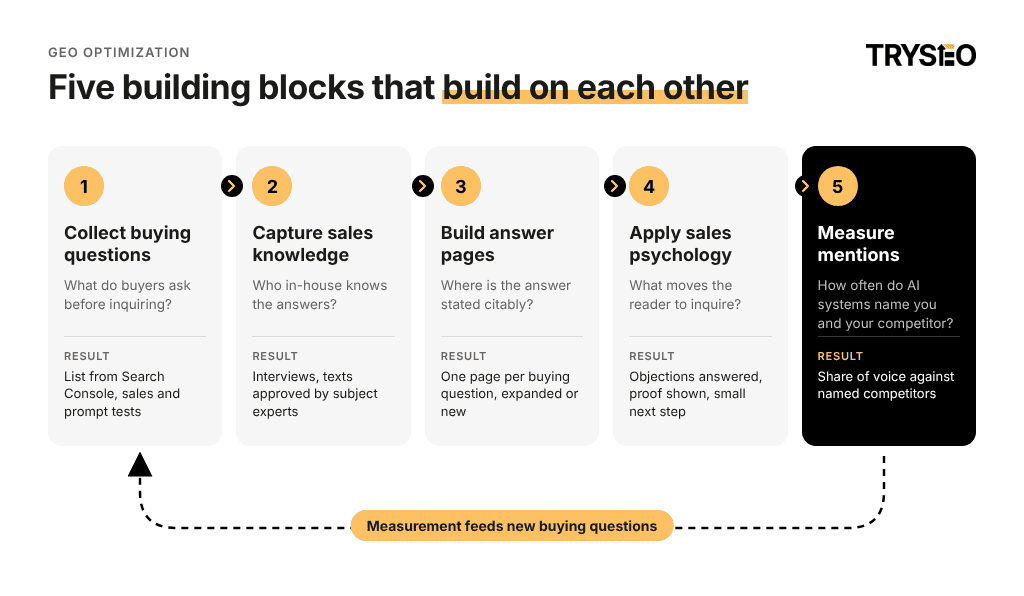
Content matters even more than the underlying tech. What surfaces in AI-generated answers is the unique domain knowledge no competitor has documented yet. That's why our GEO framework organizes all generative engine optimization efforts into five sequential building blocks. Tracking at the end of the cycle uncovers new buyer queries to kick off the next iteration.
Sharpen your Positioning
In our experience: an AI model recommends entities it can clearly categorize. It needs to grasp what your company, product, or service delivers. It must know who it's built for. And it has to identify what sets you apart from competitors. Without this clarity, your brand will rarely surface in AI answers for the exact buyers that fit your business.
Sharp positioning is therefore the foundation for all five building blocks. It needs to live on your website, reinforced with consistent core messaging across your homepage, service pages, and answer pages. That way, AI systems encounter a cohesive picture of your brand everywhere. That is why we always kick off our client engagements with an in-depth positioning interview. Together, we carve out precisely what you stand for—and for whom.
| Building block | Core question | Deliverable | Deep dive |
|---|---|---|---|
| 1 Collect buyer questions | What do buyers ask before reaching out? | List of buyer questions mined from GSC, sales conversations, and prompt tests | Customer profiles for AI search |
| 2 Extract internal sales knowledge | Who in your organization has the definitive answers? | Interviews with your sales team, approved source copy | AI and E-E-A-T |
| 3 Build dedicated answer pages | Where does a citable answer live? | One dedicated page per buyer query (new or expanded), every metric backed by source and timestamp | Optimizing content for AI search |
| 4 Guide readers with sales psychology | What compels the reader to submit an inquiry? | Objections resolved, proof provided, friction-free next step | Building trust in B2B procurement |
| 5 Track brand mentions | How often do AI engines cite you versus your competitors? | Share of Voice benchmarked against named competitors | GEO KPIs for AI search engines |
Building Block 1: Collect Buyer Questions
You'll find high-intent buyer questions wherever buyers actually ask them. Many critical questions procurement teams resolve before sending an RFP show zero measurable search volume in traditional keyword tools—they are simply too specific. Three sources work synergistically here:
- Google Search Console: long-tail question queries where your pages already generate impressions.
- Sales calls and trade shows: the recurring questions prospects ask on the phone and at your booth.
- Prompt testing: the prompts buyers enter into ChatGPT, Perplexity, Gemini, or Copilot—along with the answers generated today.
In AI Mode, users ask more detailed questions. According to Google, the average search query there in the US is three times longer than a traditional one as of May 2026.
Sub-questions matter too. Because AI systems often break down a question into multiple search queries, a page that addresses just one specific aspect can still be cited.
Collecting doesn't mean building out every single phrasing. Creating dedicated subpages for every fan-out variant can violate Google's policy on mass-produced content. The model understands synonyms and long-tail variations on its own. For tools to handle this, check out our articles on long-tail keywords in AI search and automated keyword research.
Building Block 2: Unlocking sales team knowledge
Your sales team knows the answers to your buyers' questions. Most of the time, this knowledge is locked in just a few heads. We often hear one objection: that the product is too complex for a website. Yet your sales reps explain it over the phone every single day. That conversation is exactly what you need to document.
From our project work, we know that AI models require specific data with context around your entities—namely your company, products, and applications. In our projects, an interview with sales looks like this:
- You present the collected buyer questions to the sales rep—one topic cluster per conversation.
- They answer them just as they would explain them to a customer, including examples and application limits.
- You document the conversation and get the text signed off by a subject matter expert.
- Each answer turns into a dedicated answer page or a section within one.
Whoever signs off on the text is credited on the page with their name and job title. The sales rep or subject matter expert acts as the technical point of contact for buyers. This shows the buyer whose firsthand experience backs up the answer.
Nothing is oversimplified in the process. The knowledge is simply put into writing for the first time.
Keep in mind: You don't have a visibility problem. You have a documentation problem.
Both Google and Microsoft support this approach. Google's guide to AI search demands a distinct perspective and first-hand experience. Content should not rehash what others are saying or what an AI model could easily generate.
According to Google's own assessment, unique content packed with expert knowledge will likely shape presence in AI search results in the long run more than all other recommendations in the guide combined. According to Microsoft, content cited by Copilot and Bing typically covers its topic with focus and demonstrable expertise, as of February 2026. Our article on LLM training data explains how expert knowledge finds its way into AI training sets.
Building Block 3: Creating answer pages
An answer page answers the buying question in the very first sentence. This is followed by rationale and proof, ending with the product's limitations. This way, every sentence stands on its own and can be cited individually.
In our projects, the right page often already exists. That's why we first review your existing product, service, and application pages. Priority goes to pages that are already getting impressions in Search Console for a buying question. There, we add the answer from the interview. We only build a new page if no existing one can support the buyer question.
To create precise, structured content, we follow five structural rules:
- Answer first, one topic per page
- Benchmarks and specifications formatted as a table
- Every metric backed by a source and date, updated whenever changes occur
- Clear, transparent disclosure of limitations and conditions
- FAQs with concise, self-contained answers
Microsoft recommends the exact same pattern to help AI systems cite your website more easily: clear headings, tables, FAQ sections, and claims backed by data and sources. On top of that comes the advice to keep content up to date and submit changes via IndexNow. You will check whether AI responses still reflect outdated metrics during tracking in Building Block 5.
According to Google, there is no ideal page length, and breaking up text into bite-sized chunks specifically for AI is unnecessary.
A lab study by Aggarwal et al., presented at KDD 2024, arrived at a similar conclusion. Citations, statistics, and source attributions increased the visibility of sources in AI-generated answers by up to roughly 40 percent. Keyword stuffing decreased it. However, the study was conducted using gpt-3.5-turbo and the top five Google results, not modern systems.
Volume is no substitute for an answer. Mass-produced content without added value violates Google's spam policies, regardless of how it was generated. Google also explicitly classifies attempts to manipulate AI answers as spam.
To learn how to write this kind of content, check out our articles on answer engine optimization and visibility in ChatGPT.
Building Block 4: Guiding buyers with sales psychology
It's the page that ultimately drives the inquiry. Being cited by AI brings the buyer to you. Whether they send an inquiry depends entirely on the landing page.
This traffic is valuable. In its 2026 guide, Google describes visitors coming from AI features as users who are more likely to stay and convert. That is a vendor claim without a disclosed methodology. Make sure to track conversions and dwell time yourself, exactly as Google also recommends.
In our projects, an answer page guides the reader in this sequence:
- Start with the situation from the buyer's perspective.
- Take their rationale seriously—such as the objection that the product is too complex.
- Show the counterpoint: Your sales team explains it every day.
- Provide proof with a case study from a comparable application.
- Offer a manageable next step.
The page addresses two distinct audiences: marketing leads who are looking for methodologies and intermediate steps, and business owners who care about incoming orders and proof. Traffic is merely the means; the inquiry is the goal. How mid-sized B2B buyers build trust is outlined in our article on trust in B2B purchasing.
Module 5: Measuring brand mentions against competitors
You measure your success by your mentions. The guiding metric is share of voice—your percentage of all brand mentions across answers to your target commercial queries. A single query tells you very little (a screenshot isn't a measurement).
Microsoft notes that citations in AI responses are inherently volatile. In one of our projects, the mention rate fluctuates from day to day between roughly 16% and 29% using the exact same prompt set.
That is why our TRYSEO AI Visibility Tracker queries a predefined prompt set daily across six engines: ChatGPT, Perplexity, Gemini, AI Overviews, AI Mode, and Copilot. It tracks how often our clients and specified competitors are mentioned or cited as sources. It analyzes responses externally, as no third-party tool has direct access to Google's internal ranking and AI systems.
The tracker also reveals how responses characterize you and your competitors: highlighting specific attributes and whether sentiment is positive or negative. It captures objections raised against your offer alongside the exact supporting citation from the answer.
Here's an example from another project: approximately one out of every twelve answers mentioning the provider described them as expensive. Objections like these are fed back into Module 1 as commercial buyer queries and directly resolved on-page in Module 4.
Two search engine tools complement this tracking. Since August 31, 2026, Search Console has provided all websites with a dedicated performance report for generative AI features, detailing impressions, pages, countries, and devices. In Bing Webmaster Tools, Citation Share shows your share of citations, though intentionally without competitor data. Only your own dedicated tracking provides direct, named competitive comparisons.
You can establish your baseline against your primary competitor using our GEO Readiness Test for B2B companies.
To see which KPIs matter most, explore our articles on prompt tracking and zero-click measurement. To see how a tracker analysis looks across six engines, read our Poseidon Expeditions case study.
Where AI reads beyond your website
Your website is just one source among many. AI systems ground their answers on pages across the entire web, including industry trade publications and discussion forums. In 2025, Google also observed users shifting toward forums, videos, and podcasts where real people share hands-on experience. For technical B2B markets, our experience shows the highest returns come from:
- Trade press in your industry with cited, evidence-backed articles
- Industry associations and B2B directories
- Forums such as Reddit, where practitioners ask specific questions
- YouTube with application-focused and explanatory videos
We strongly recommend consistent naming across all channels. Company, product, and model designations should match across your website, technical datasheets, directories, and LinkedIn. The same applies to technical specs and their units of measurement. If a product previously had a different name, clarify the legacy designation once.
Fabricated mentions do not work; Google treats these manipulation tactics as spam. How mentions and backlinks function as brand signals is detailed in our guide to brand signals for AI visibility. For insights into video formats, see our YouTube study on AI search.
To see how content and third-party sources work together in practice, take a look at our Spreadshop case study.
The 90-day roadmap
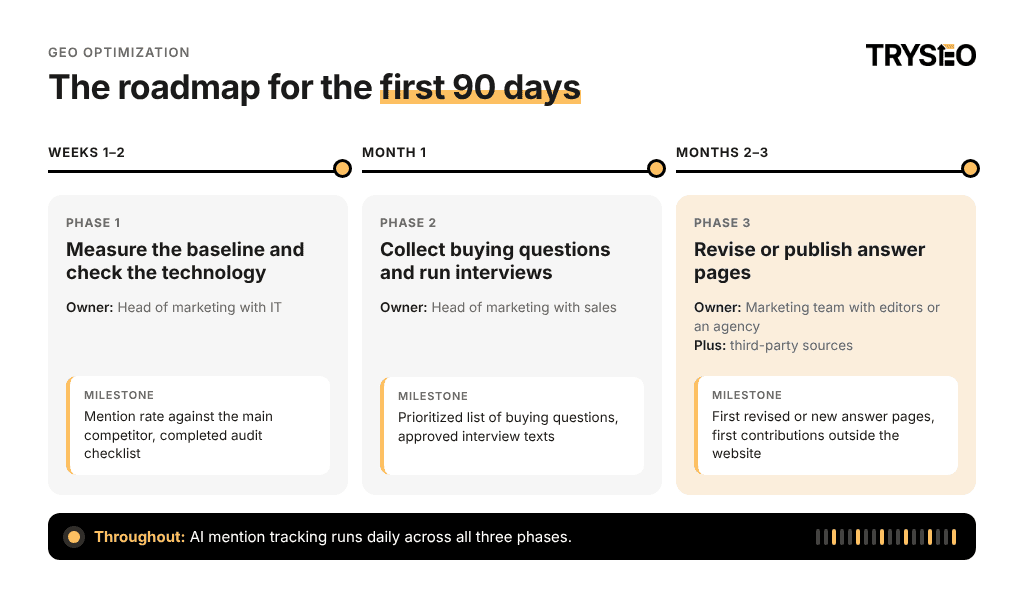
Establish the baseline first, then build the content. The roadmap organizes the modules into three distinct phases. Each phase defines clear ownership and an interim deliverable you can present internally.
- Weeks 1–2: Measure your baseline and audit technical foundations. Owned by marketing leadership together with IT. Deliverables include the initial mention rate against your primary competitor and a fully completed technical audit checklist.
- Month 1: Collect commercial buyer queries and conduct interviews. Owned by marketing leadership alongside sales. Deliverables include a prioritized list of commercial questions and approved interview transcripts.
- Months 2–3: Revise or launch answer pages and activate third-party sources. Owned by the marketing team with editorial staff or an agency. Deliverables include the first batch of revised or newly published answer pages and initial external placements.
Tracking runs continuously and daily across all three phases. Keep your initial step focused: establish your baseline, for example by running our GEO Readiness Test.
According to our Tenios case study, their AI visibility surged from 7% to over 50% in three months in 2025. How your specific market responds can only be revealed by running your own tracking.
Frequently asked questions about GEO optimization
Does GEO optimization replace traditional SEO?
No, GEO builds on SEO. Google uses the same ranking and quality systems for AI Overviews and AI Mode as it does for classic search. Google still refers to optimization for generative AI search as SEO. At Microsoft, Copilot is built on the same foundation as Bing search. Find out more in our article Is SEO still relevant?.
How quickly does GEO optimization take effect?
That depends on your baseline. According to our Tenios case study, three months were enough in 2025 to increase AI visibility from 7 to over 50 percent. Technical blockers resolve faster: changes to robots.txt take effect after around 24 hours with OpenAI and up to 24 hours with Perplexity.
How much does GEO optimization cost?
The effort lies in interviews, pages, and measurement. The scope depends on how much of your expertise is already published. An experienced agency knows where to start, saving you time.
Do we need an llms.txt for GEO?
No benefit has been proven so far. As of November 2026, no major AI provider mentions the file in its crawler or webmaster documentation. According to Ahrefs, around 97 percent of analyzed files were not crawled a single time in May 2026. It doesn't hurt with Google. You can see its structure and examples in our article on llms.txt.
Does GEO also work for complex products?
Yes, complexity is your advantage. That is precisely why your buyers research thoroughly before picking up the phone. In our projects, AI answers often miss the exact points your sales team explains every day—simply because they aren't written down anywhere.
Can we implement GEO optimization ourselves?
Yes, using Search Console, interviews, and prompt tests. That takes you from buyer questions to your first answer pages. The limit lies in daily benchmarking against named competitors, as answers fluctuate from day to day.
Conclusion: Document first, measure second
GEO optimization starts with the knowledge of your sales team. In the end, the key metric is how often AI systems mention you alongside your competitors. If you want support with this, we guide you as a GEO agency for B2B companies from the initial interview to daily tracking.
Our GEO Readiness Test shows you how often ChatGPT mentions you compared to your competitors before you spend a single euro. Or you can get in touch with us: We will review your numbers and tell you which building block to tackle first.

