

Summary: When Clicks Disappear, Visibility Still Counts
- The rise of AI search (ChatGPT, Gemini, Perplexity, Copilot) has ushered in a Zero-Click search, where quick answers appear — without website visits.
- AI Overviews were triggered for 13.14% of queries in March 2025, up from 6.49% in January 2025. This suggests a growing trend in zero-click searches as AI features become more prevalent.
- Share of voice (SoV) in zero-click search measures how often your brand appears in visible search features (like snippets or panels) without users needing to click.
- Non-Click Visibility (NCV) measures how often your content appears in search results pages (such as featured snippets or AI answers) without generating clicks.
- Citation Frequency tracks how often AI systems reference your brand or content formats, offering a new layer of authority measurement.
- Zero-click search suggests that modern marketing must focus on maximizing brand visibility, authority, and AI citations within search results—not just driving website clicks.
What is Zero-click Search?
Zero-click search is when users get answers directly on search or AI engines (like ChatGPT, Gemini, or Microsoft Copilot) without clicking a website. This behavior is increasingly dominant across search engines and conversational interfaces.
There are generally two main types:
- No-click searches (instant answers):
The user gets what they need right away from features like featured snippets, knowledge panels, “People also ask” boxes, or AI-generated summaries (such as AI Overviews) for informational queries. So, no website click is needed. - Low-click searches (on-page actions):
The user still interacts with results, but stays within the search platform—for example, using maps for directions or calls, booking tools, shopping results, hotel or flight modules, or discovering local businesses.
Would you also like to optimize your company for AI and become visible there?

Find out more about our services!
Why do AI Overviews Create More Searches but Reduce Clicks?
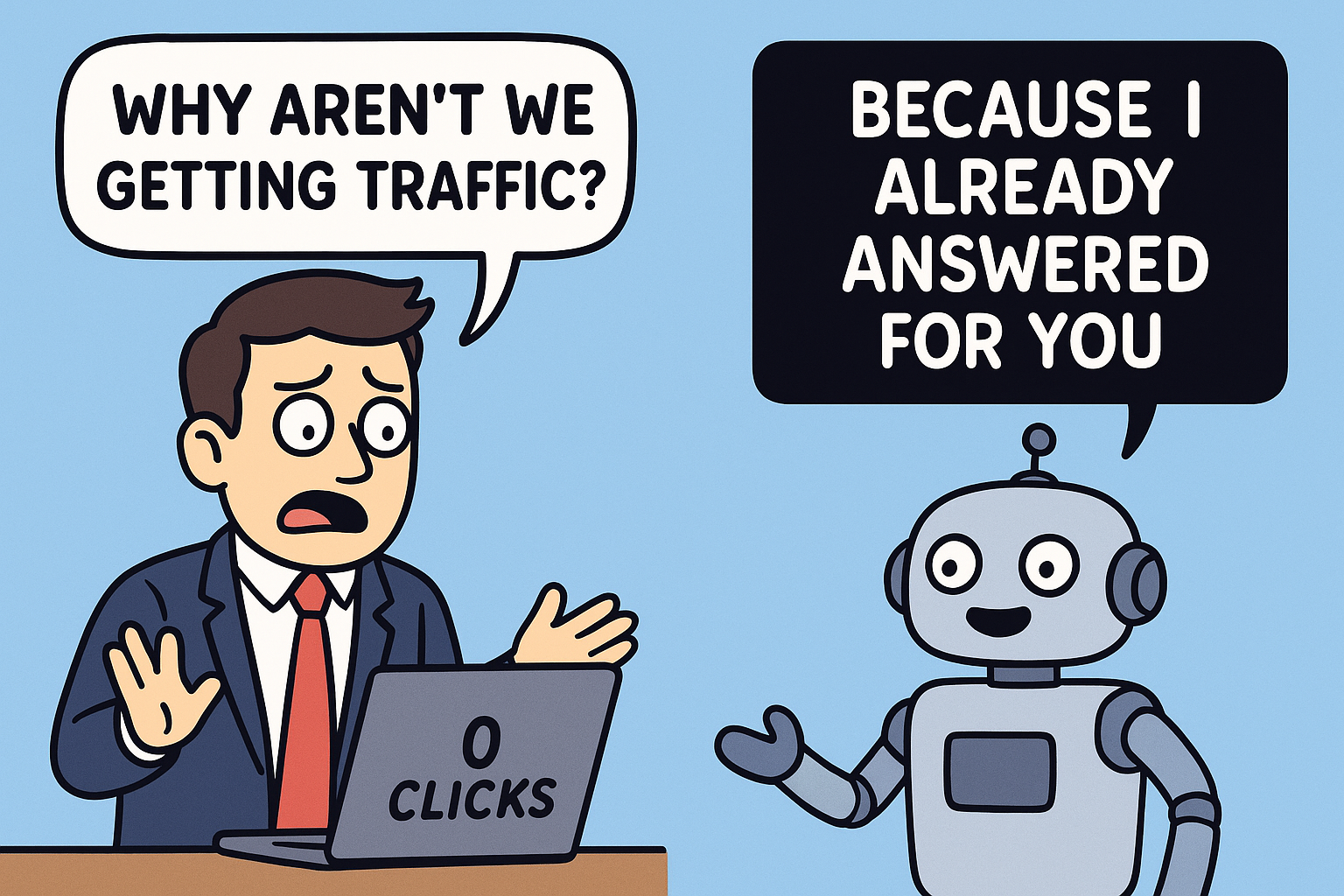
When AI Answers, Clicks Disappear.
Search has entered its most radical transformation since Google introduced featured snippets (Taher 2024). This highlights the importance of key performance indicators in assessing this shift.
With AI-powered engines like Google’s SGE, large language models (LLMs), and Perplexity providing instant, conversational answers, users often get what they need without clicking through to websites. At the same time, these tools also encourage more follow-up and refined questions, leading to an increase in overall search activity.
This shift means that the brand’s visibility is no longer synonymous with organic search traffic. Your brand can still influence the buyer journey even when traffic reports show little change.
So it’s crucial to track relevant key performance indicators as business metrics. The visibility still exists — just in a form that traditional SEO KPIs don’t capture.
The question that came to mind is: “If users don’t click, how do I prove ROI to my board?”
The answer is to measure where your brand is seen, cited, or referenced—not just where users land. In a zero-click world, being mentioned often matters more than being clicked.
This is where Share of Voice, Non-Click Visibility, and Citation Frequency redefine marketing success in the age of generative AI. In this article, we will discuss why these KPIs are essential to measure brand visibility and performance.
How Do Featured Snippets and Knowledge Panels Change Click Search Behavior?
Featured snippets and knowledge panels significantly reshape click behavior by providing direct answers on the search engine results page.
This reduces the need for users to visit external websites. Instead of clicking through multiple links, users often find complete or near-complete answers within these SERP features, which shifts attention away from traditional organic listings.
While they reduce overall website clicks, zero-click search features enhance brand visibility and attract high-intent users. This often acts as the main source of information for voice search results.
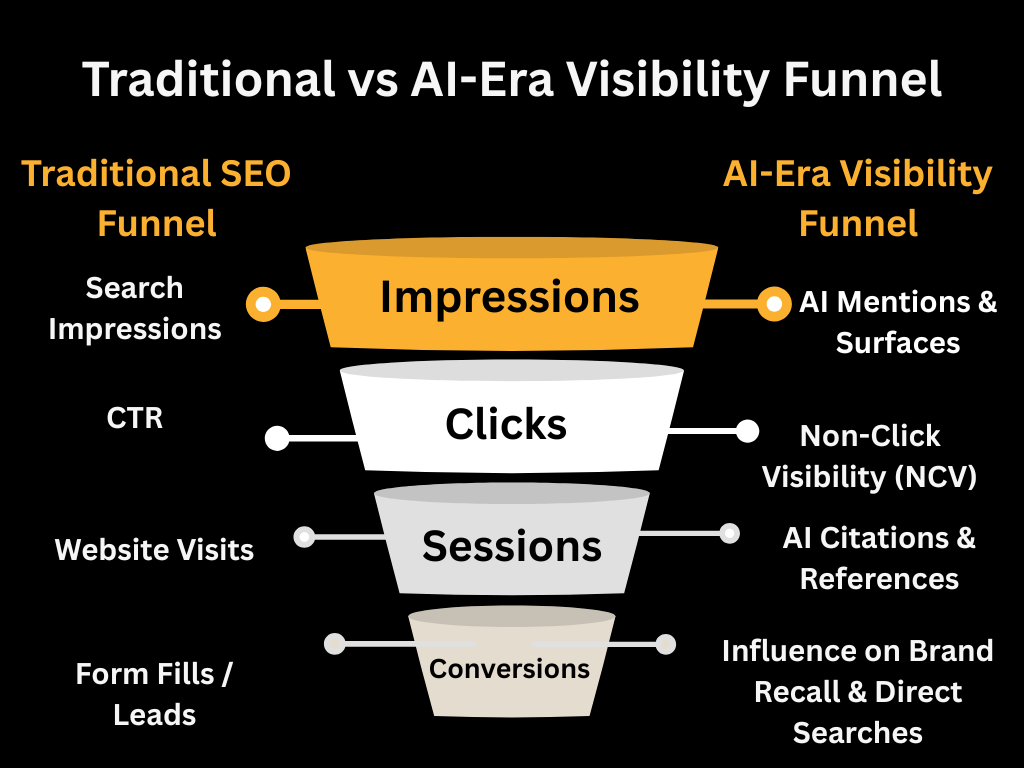
This change reflects a fundamental shift in how users interact with traditional search engines. Traditional performance metrics such as click-through rate, impressions, bounce rate, and conversions were designed for a click-driven system. However, they increasingly fail to capture how users engage when answers are delivered instantly on the results page.
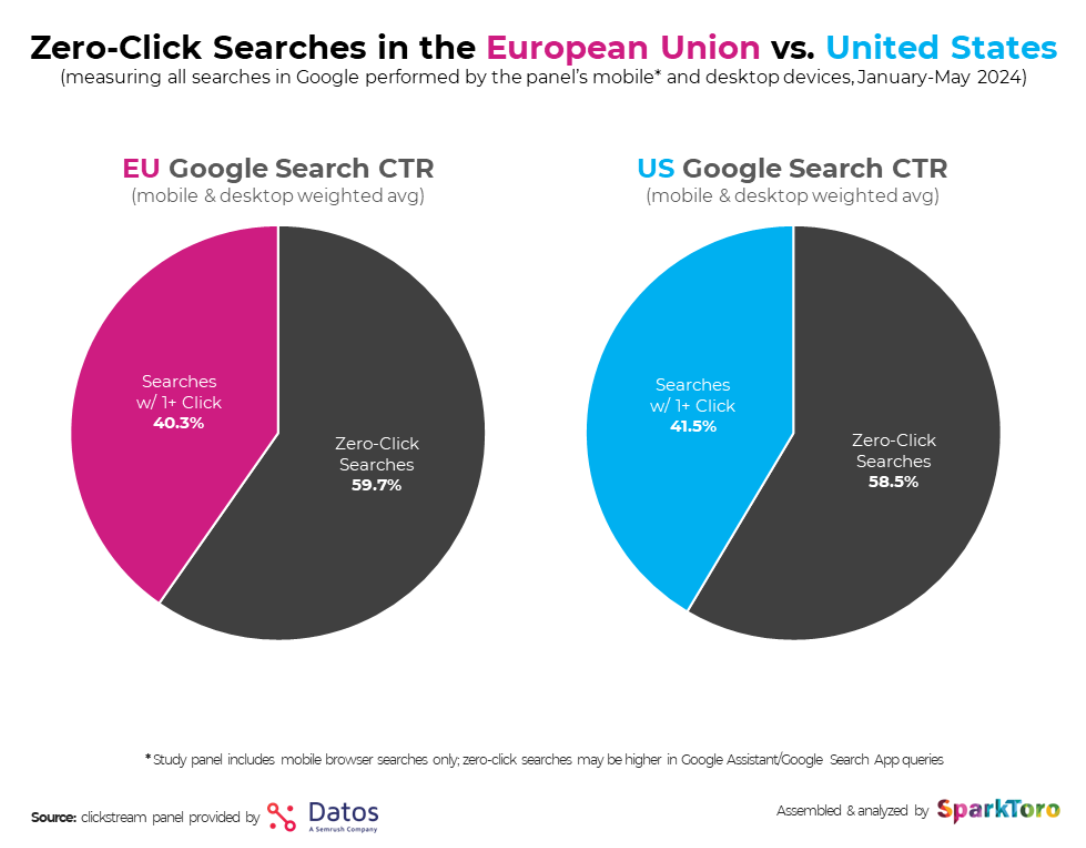
As a result, conventional SEO and PPC reporting now only reflects part of the user journey. In fact, recent evidence shows that 60% of searches now end without the user progressing to another destination site, indicating a significant shift in search behavior due to AI-driven features (Fishkin 2024). This trend is even more pronounced on mobile, where zero-click searches are estimated at 77.2%, compared to 46.5% on desktop (Kuryatnik 2025).
Earlier studies also highlight the speed of this shift, noting that only 17.3% of mobile searches still result in a click (Tober 2022).
Why Do Traditional Organic Traffic Metrics Miss Brand Visibility in AI Search?
Traditional metrics can’t capture brand influence or visibility that happens without clicks or measurable traffic.
In the AI-driven search, user behavior and content visibility are shifting in ways that traditional metrics can’t fully capture.
- AI answers replace clicks: Users get summarized responses without leaving the platform.
- No referral data: Brands mentioned in AI summaries may influence users even without generating measurable website traffic.
- Reduced visibility in analytics: Your brand’s impact becomes “invisible” in Google Analytics, even when it’s influencing decisions.
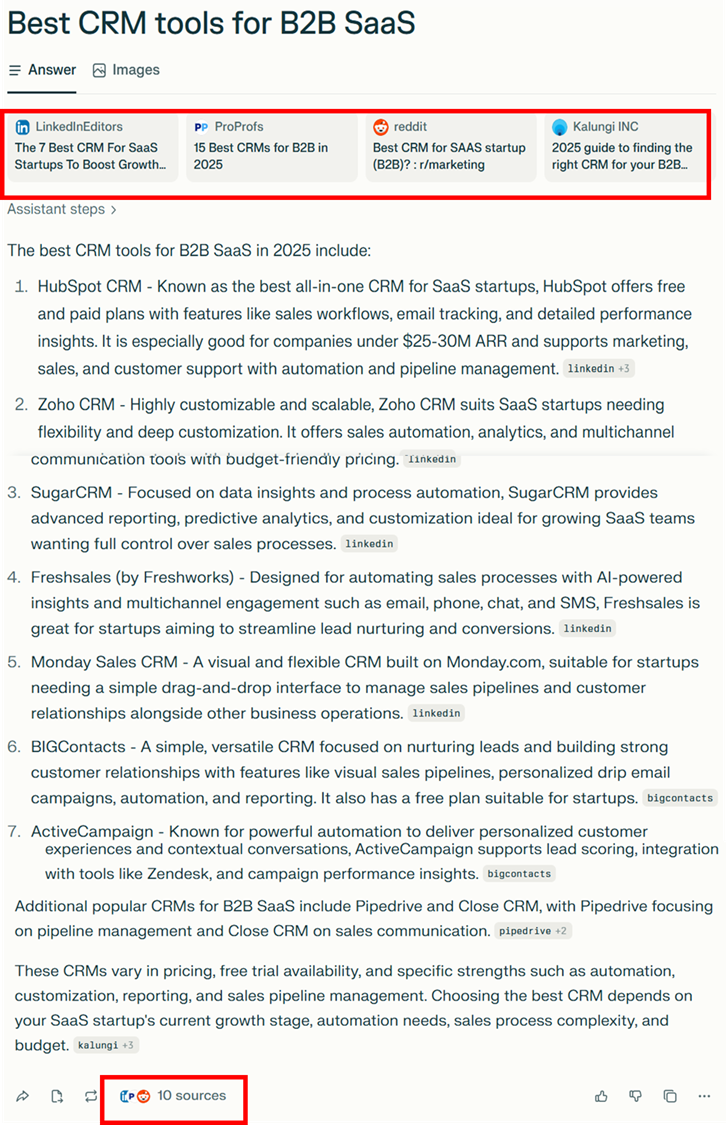
For example, when a user asks “Best CRM tools for B2B SaaS” in Perplexity, the platform may list or cite your brand — but that appearance won’t register as a click or visit.
This is why businesses must expand beyond traditional metrics, and rethink their SEO strategy to include visibility and influence inside AI-generated answers.
What Is Share of Voice (SoV)?
Share of Voice (SoV) is a marketing metric that measures how visible your brand is compared to competitors across different marketing channels such as search engines, social media, advertising, and now AI-generated answers. It essentially represents the portion of attention your brand owns within your market or category.
In practical terms, SoV answers a simple question: when people search, scroll, or ask AI tools about your category, how often do they see your brand versus others?
How to Measure Share of Voice?
Traditionally, SoV is calculated by comparing your brand’s visibility against competitors using metrics such as:
- Keyword rankings and search visibility
- Impressions and click-through rates
- Social media mentions and engagement
- Paid advertising share (impression share)
In SEO, a more refined approach includes weighting keyword rankings by search volume and expected CTR, giving a more realistic picture of how much visibility you actually own.
From a broader marketing perspective, SoV can also be calculated as:
Your brand mentions ÷ total mentions in your market × 100
Otterly AI extends this concept specifically for AI search by:
- Tracking brand mentions and citations across AI platforms
- Using prompt-based analysis (real user queries)
- Comparing visibility share against competitors
- Monitoring changes in AI-generated responses over time
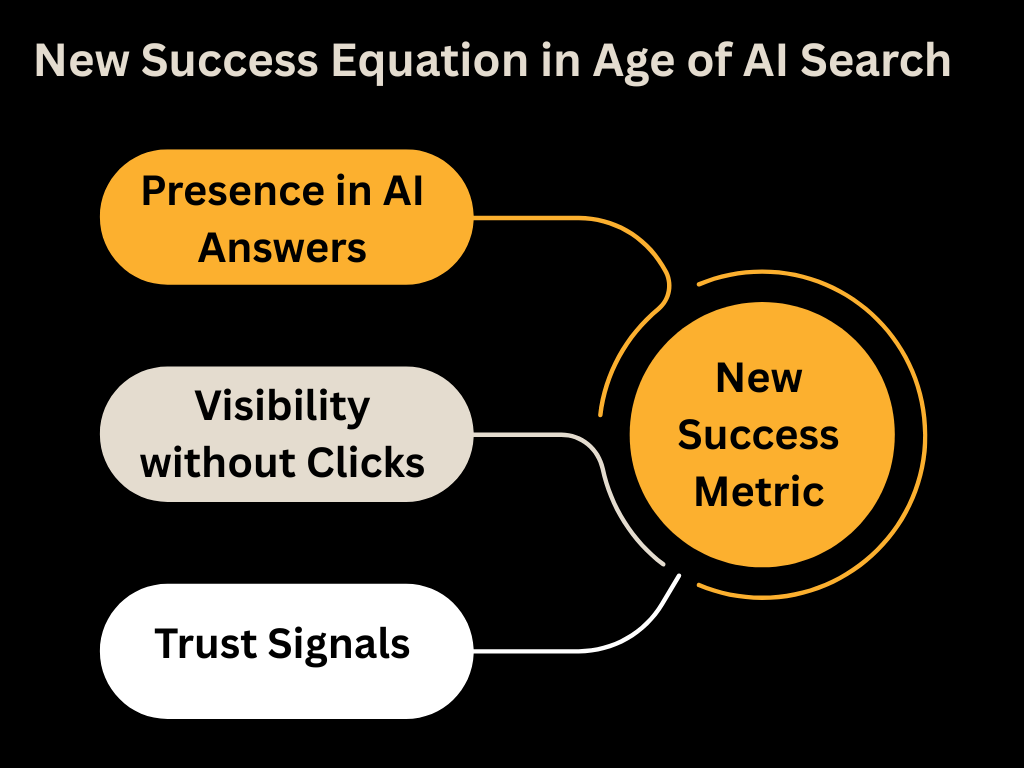
This approach reflects a key shift: instead of measuring only traffic, SoV now measures presence within AI-generated answers, where influence often happens before a click ever occurs.
What Is Non-Click Visibility?
Non-Click Visibility (NCV) measures instances where your brand or content formats are visible in AI search (snippets, overviews, citations) even if users don’t click.
Tracking NCV helps you understand how often your brand earns awareness and trust through AI-generated exposure—an early signal of influence in zero-click environments.
Why Does Non-Click Visibility Matter?
When the answer appears inside the AI interface, users are exposed to your brand. That exposure builds trust, recall, and increases the chance of returning later — or searching specifically for your brand name.
- AI-driven search experiences are about visibility without engagement.
- Even without a visit, your brand earns awareness and trust when cited in AI answers.
- NCV is a top-funnel KPI, showing how often you appear during consideration stages.
- For example, if ChatGPT summarizes:“Companies like HubSpot, ActiveCampaign, and [Your Brand] offer advanced B2B automation features.” That mention builds trust — even if no one clicks.
How Can You Measure Non-Click Visibility?
You can measure Non-Click Visibility by using AI monitoring tools to see how often your brand appears in generative search responses.
- Use AI monitoring tools that log brand mentions in large language model responses.
- Combine this with impression data to estimate “AI-based brand reach.”
- Crucially, track a correlation between high NCV in a given month and a subsequent sustained increase in Direct Traffic and Branded Search Volume (Linehan 2025). More branded searches are the primary proxy for zero-click influence.
Would you also like to optimize your company for AI and become visible there?
Find out more about our services!
What Is Citation Frequency?
Citation Frequency (CF) counts how often AI systems reference or quote your brand’s content formats, sources (whitepapers, blog posts, product web pages, etc.). Frequent citations signal that AI systems trust your content, strengthening your brand’s authority and credibility in generative search.
Why is Citation Frequency Important?
Similar to backlinks in traditional SEO KPIs, citations in AI answers signal your content or brand is seen as trustworthy or authoritative. The more frequently your brand is cited, the stronger your “AI authority”.
- AIs cite trusted, authoritative sources.
- High CF means strong domain authority in AI ecosystems (Kumar 2025).
- Reinforces brand trust, especially for technical B2B companies.
How to Optimize Content to Improve Citation Frequency?
You can drive Citation Frequency by consistently publishing authoritative, well-structured content that AI systems recognize and trust as reliable sources.
- Publish original, expert-level content on core industry topics.
- Implementing structured data, such as FAQPage and HowTo schema, can enhance the chances of content being featured in AI Overviews and other SERP features. Thus, increasing visibility in zero-click searches.
- Ensure consistent brand naming and metadata — AI systems rely on contextual patterns.
- Use canonical URLs, cross-linking, and high-quality external recognition to reinforce authority.
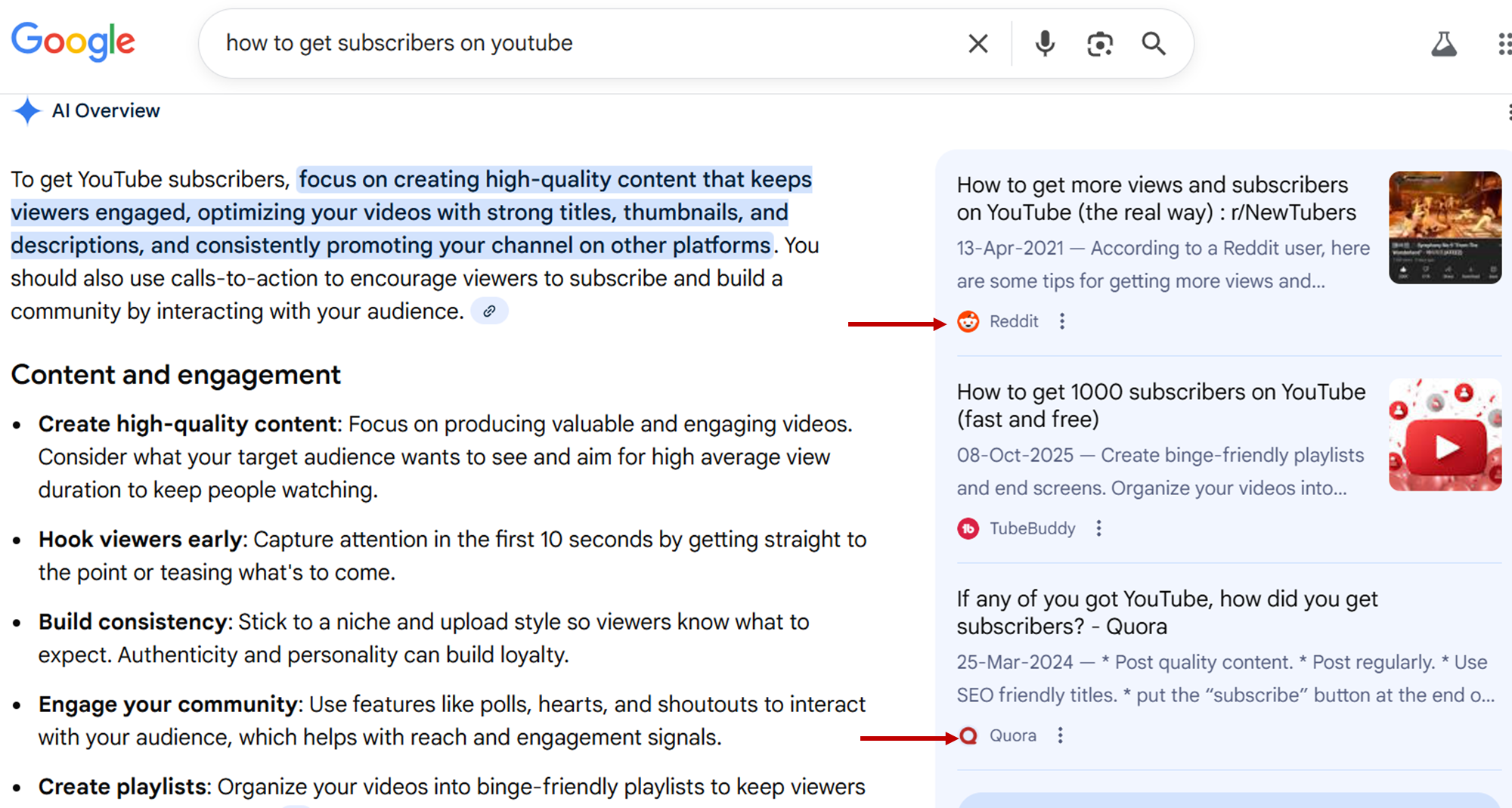
- Actively participate and secure mentions in high-trust, third-party sources like Reddit, Quora, and Industry Forums, as AI models frequently cite these community-driven sources as indicators of real-world use and opinion.
Research shows that “about one in fourteen answers in Google AI Mode included a Quora link” — making Quora one of the most-cited domains in AI responses (Loktionova 2025).
How Can CMOs Build a KPI Framework for Zero-Click World?
To compete effectively, CMOs must expand KPI dashboards beyond clicks and conversions by incorporating visibility metrics. A next-gen measurement model should integrate:
New model: Visibility → Engagement → Trust
| KPI Category | Example Metrics | Purpose |
|---|---|---|
| Visibility KPIs | Share of Voice, Non-Click Visibility, Citation Frequency | Measures brand presence in AI search engines outcomes |
| Engagement KPIs | Mentions → Leads, AI referral attribution | Connect visibility to business outcomes |
| Trust KPIs | Domain authority (offline + online), sentiment, AI confidence indicators | Gauges brand credibility within AI systems, including brand sentiment |
These metrics don’t replace clicks—they complement them, giving a clear picture of brand impact in AI-driven discovery.
How Can You Prove ROI from AI Visibility?
To demonstrate ROI, focus on correlations over direct clicks. The ultimate proof point is demonstrating that a sustained increase in Share of Voice (Visibility KPI) precedes a quantifiable increase in Branded Search Volume, Direct Traffic, and qualified inbound lead submissions over a 3- 6 month period. This demonstrates the causal influence of AI visibility on pipeline health, even without click-through.
These metrics don’t replace clicks — they complement them, giving a full-spectrum view of brand impact in AI-driven discovery.
How Can CMOs Turn AI Visibility Insights into Action?
By integrating new AI visibility metrics into your dashboards, CMOs can link brand exposure directly to engagement and growth outcomes.
Here’s a simple framework to bring these new KPIs to life inside your marketing dashboards:
- Start with the right questions: Identify the queries your target audience actually asks — like “best IoT platform for midsize manufacturing” or “top B2B automation software for 2025.” These are the prompts where you want your brand to appear.
- Monitor your brand mentions in AI answers: Use AI-sampling or visibility-tracking tools to see how often your brand shows up in generative search results. This helps you quantify your SoV and NCV.
- Implement a Two-Tiered Content Strategy:
- Tier 1 (Informational/Top-Funnel): Create content optimized purely for NCV. These pages aim to own the AI answer box, even if clicks are low (e.g., “What is X technology?”).
- Tier 2 (Commercial/Bottom-Funnel): Create content optimized for residual clicks (e.g., “X vs Y comparison,” “Pricing guide for Z”). This content aims to capture the user after the AI has provided initial awareness.
- Connect visibility to real-world performance: Track how increases in SoV correlate with branded search volume, lead form submissions, or demo requests. These connections reveal the hidden impact of AI-based brand exposure.
- Integrate AI KPIs into your existing dashboards: Don’t abandon Google Analytics or Adobe Analytics — expand them. Embed these new GEO metrics into your quarterly reports as complementary insights, not replacements.
In a recent TRYSEO study, a B2B company boosted its AI visibility in just 3 months, moving from ~7% brand coverage to 50% and ranking 1st in citations. This leap came from a 70/30 SEO + GEO strategy. This involves data-rich content, an active presence on discussion forums like Reddit, and the use of structured schema markup. This helps AI systems recognize and cite the brand more often.
Conclusion: Redefining Metrics in the Age of Generative AI
Clicks are no longer the only measure of success.
In a world dominated byzero-click experiences, visibility, trust, and authority inside search engines define performance. Brands that adapt to this shift — by optimizing for presence in answers, not just rankings — will lead the future of digital marketing.
For brands, this means adopting new KPIs—such as Share of Voice, Non-Click Visibility, and Citation Frequency. This helps to understand how often AI search engines reference your brand. These indicators don’t just measure attention; they measure trust and represent new success metrics for AI-era search performance.
At TRYSEO, we help you redefine what performance means in the age of zero-click search. Our frameworks align GEO, AEO, and SEO strategies to ensure your brand is not only visible but preferred by AI.
If your goal is to build influence inside AI models—not just drive web traffic—TRYSEO can help you measure, optimize, and lead in the new metrics of visibility.
Key Takeaways
- Zero click is reshaping how search engines deliver value.
- Non-Click Visibility = how often your brand is seen without clicks.
- Citation Frequency = how often AIs trust and cite your content.
- CMOs need new KPI frameworks to connect Generative Engine Optimization (GEO) performance with business ROI.
- The future belongs to brands that are visible in answers, not just search results.
FAQs
1. What tools can measure Share of Voice or Non-Click Visibility?
Tools like Otterly AI, HubSpot Social Media Management Software, Hootsuite, Google Ads, Ahrefs and SEMrush are generally used.
2. How often should CMOs track these new KPIs?
Monthly tracking is ideal, aligned with your content publishing cycles. Quarterly comparisons help assess strategic positioning shifts.
3. Should we abandon traditional SEO metrics?
No — clicks and conversions still matter. These new KPIs enhance your understanding of brand reach and visibility in AI contexts.
4. What type of content improves Citation Frequency?
Original research, whitepapers, and high-authority technical content tend to be cited more often by AI systems, enhancing the quality of AI summaries.
5. How do these metrics tie to ROI?
Brands with higher SoV and NCV often see increased inbound leads, faster sales cycles, and stronger perceived expertise — demonstrating clear performance improvement even before clicks happen.
Would you also like to optimize your company for AI and become visible there?
Find out more about our services!
References
- Fishkin, R. (2024). "2024 Zero-Click Search Study: For every 1,000 EU Google searches, only 374 clicks go to the open web. In the US, it’s 360." Search Engine Land: https://searchengineland.com/google-search-zero-click-study-2024-443869
- Kaltofen, H. (2025). "How to Measure Success in GEO – What KPIs Should We Focus On?" TRYSEO: https://tryseo.ai/blog/how-to-measure-success-in-geo-what-kpis-to-focus-on
- Kumar, A.; Palkhouski, L. (2025). "AI Answer Engine Citation Behavior: An Empirical Analysis of the GEO16 Framework." arXiv: https://arxiv.org/abs/2509.08142
- Kuryatnik, V.(2025). "2025 Organic Traffic Crisis: Zero-Click & AI Impact Analysis Report." Bloom: https://thedigitalbloom.com/learn/2025-organic-traffic-crisis-analysis-report/
- Linehan, L.; Guan, X. (2025, May 26). "An Analysis of AI Overview Brand Visibility Factors (75K Brands Studied)." ahrefs: https://ahrefs.com/blog/ai-overview-brand-correlation/
- Loktionova, M.; Drozdov, A. (2025). "We Analyzed 26K Quora URLs Cited in Google AI Mode: Here’s What Works." Semrush: https://www.similarweb.com/blog/insights/ai/google-ai-overview-quora-urls-analysis
- Taher, S. (2024). "Redefining SEO: AI Overviews and the Road Ahead." Search Engine Land: https://searchengineland.com/redefining-seo-ai-overviews-and-the-road-ahead-455161
- Tober, M. (2022). "Zero-Clicks Study." Semrush: https://www.searchmetrics.com/blog/zero-clicks-study/

