


Summary: Build Smarter Personas — Powered by AI, Driven by Data
- 50% engagement boost with AI-generated personas built from CRM, market, and behavioral data
- Align GEO KPIs with persona insights to improve visibility and conversion
- Continuously evolve personas using AI search signals and real-time analytics
- Build human-centered, dynamic personas that mirror today’s AI-influenced buyer journeys
- Stay competitive — Evolve marketing with AI-powered personas reflecting buyer journeys and business goals
Forget gut instincts - your next high-performing campaign might come from an AI that understands the target users, audience segmentation, and user personas better than you do.
In today’s AI-first marketing landscape, businesses understand that search behavior is no longer human-only. It’s algorithmically influenced, conversational, and context-aware.
For CMOs, this shift presents both a challenge and an opportunity. Traditional buyer personas and customer personas AI search no longer match how decision-makers actually search, compare, and buy, reflecting their user intent.
This article explains how to create personas, dynamic, AI-informed customer personas that align with Generative Engine Optimization (GEO) and measurable marketing KPIs. You’ll discover how to integrate real data from CRM systems, AI search logs, and social channels to craft personas that evolve in real time — helping you better understand user needs :
- Boost engagement and lead quality
- Align marketing ROI with AI search visibility
- Build campaigns that resonate with technical, data-driven audiences
Why Do Customer Personas Matter for AI Search?
Customer personas help AI search deliver more relevant, personalized, and intent-driven results for B2B audiences.
B2B Buyers Now Think and Search Differently
89% of B2B buyers now extensively use AI-powered search and generative AI tools in self-guided purchase research, fundamentally reshaping the buyer journey beyond traditional research methods. This trend erodes the effectiveness of classic demographic personas, requiring marketers to harness AI-generated behavioral insights for profiling (Buten 2024).
AI-Driven Personalization Enhances Marketing ROI
AI isn’t just changing how people search — it’s reshaping user personas and developing personas that determine what kind of visitors reach your site and how likely they are to convert. In Germany, for example, 21% of users are now using AI tools to search for information, and though that’s still less than traditional search engines, visitors coming from AI sources are 4× more likely to purchase those arriving via standard Google searches.
Similarly, A financial services company built its AI personas from email, social, and web data and achieved 40% higher open rates on its persona-tailored email campaigns (James 2024).
From Static Profiles to Dynamic, AI Personas
According to an IBM study of 1,800 marketing/sales executives, 81% of CMOs say AI is a game-changer, but 84% report that rigid, fragmented operations limit their ability to exploit AI’s potential fully.
Moreover, 54% of executives admitted they underestimated the operational complexity involved in turning AI strategy into real outcomes (Adashek 2025). In short, accurate personas transform artificial intelligence from a strategic promise into a final product growth engine — connecting data, intent, and action across every customer touchpoint.
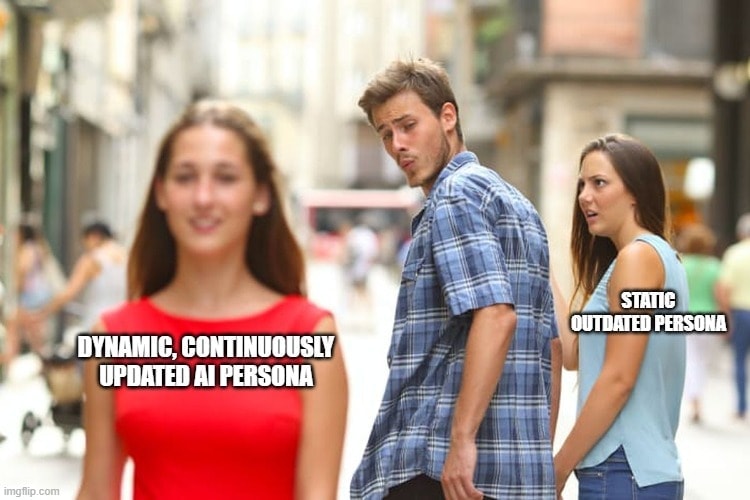
Would you also like to optimize your company for AI and become visible there?

Find out more about our services!
Strategic Advantage For CMOs Of Midsize B2B Companies
Lean Teams, High Impact
For CMOs in midsize (50–500 employee) companies, AI user personas provide a comprehensive understanding from multiple data sources with an intuitive interface and are a force multiplier. They turn fragmented CRM, social, and search data into unified audience intelligence — without adding headcount.
- According to Mattan (2025), companies leveraging AI-powered personalization report a 25% lift in ROI, driven by more relevant messaging and dynamic segmentation.
- Yee (2024) found that B2B sales teams using generative AI tools saw productivity gains of 10–15%, translating to 3–5 hours saved per rep per week. These gains come from automating back-office tasks like pipeline updates, meeting summaries, and buyer research—freeing up reps to spend more time with customers.
AI personas don’t just streamline operations—they unlock strategic leverage. With fewer resources, CMOs can deliver more personalized experiences as part of their entire strategy , accelerate pipeline velocity, and improve sales team efficiency. The result for the business owner : better conversion, higher ROI, and a competitive edge in AI-driven buyer journeys.
Why Don’t Old Personas Work Anymore?
Old personas fail because they don’t capture real-time, intent-driven behavior that AI search systems now use to understand users.
The Shift: From Queries To AI-Synthesized Answers
Traditional SEO relies on ranked search results. AI search, by contrast, summarizes and interprets information directly.
That means your persona’s journey now starts and ends in the AI response box—not necessarily on your website, unlike traditional methods .
Skane (2025) notes that “static personas are obsolete—marketers must build data-rich profiles that align with AI-driven discovery.”
The Risk of Static Demographics
Old personas capture demographics and pain points but ignore context—the prompt wording, session intent, and trust signals that drive AI recommendations. AI models don’t care about basic demographics like age or job title—they care about query semantics, content authority, and structured evidence. Modern personas must include “environmental context: industry pressure, timing, and event triggers.”

Comparison of LLM vs. Human Marked Words Across Racial Groups (Venkit 2025)
How Is an AI-Search Persona Different From Traditional Buyer Persona?
AI-search personas extend traditional marketing profiles by including behavioral data and user personas context.
| Dimension | Traditional Persona | AI-Search Persona |
|---|---|---|
| Focus | Demographics, pain points | Prompts, triggers, and trust context |
| Data Source | CRM, surveys | AI logs, keyword models, analytics |
| Goal | Tailored messaging | AI citation & discoverability |
| KPI Link | Engagement, CTR | AI visibility, citation share |
Challenges CMOs Face When Building AI Personas (How to Avoid Them)
Even experienced marketing leaders face structural and strategic challenges in the decision making process when operationalizing AI personas from multiple sources . Here’s what to watch out for regarding your business idea —and how to avoid costly missteps.
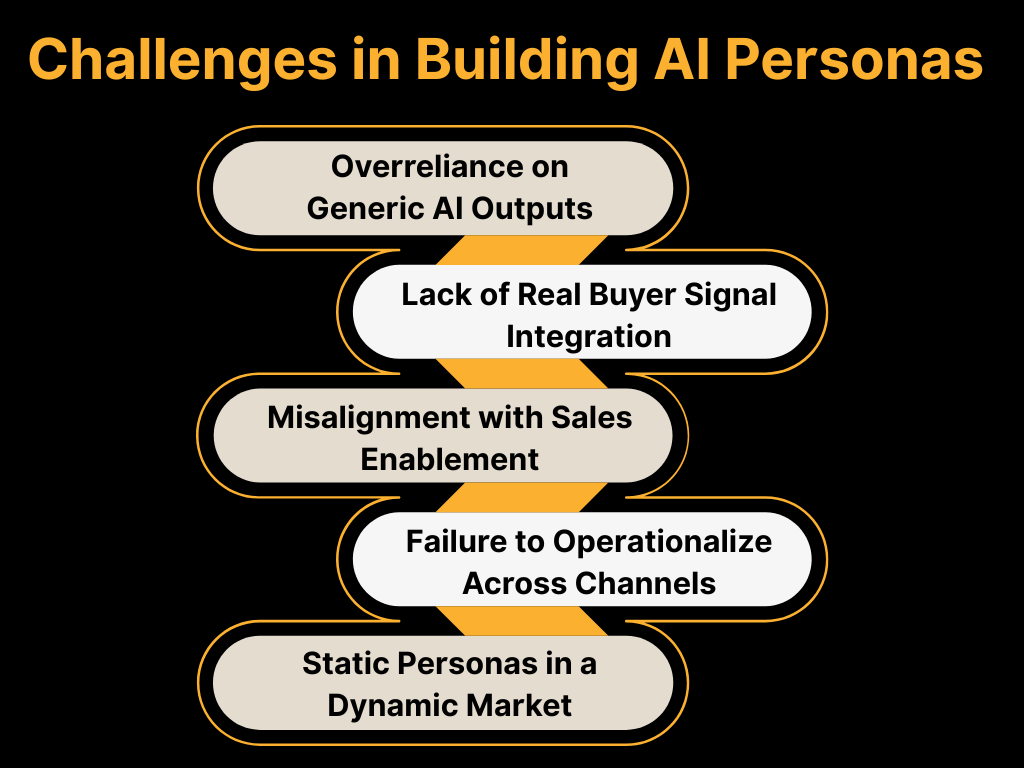
1. Overreliance On Generic AI Outputs
The Challenge: Many AI persona generators produce surface-level profiles—job titles, vague pain points, and generic goals. These lack the nuance needed for complex B2B buyer journeys. The details they provide are often either too high-level or too in the weeds to be meaningful as real, workable personas (Roberts 2024).
This aligns with findings by Amin et al. (2025), who noted that most AI-generated personas in research still lack sufficient validation or real-world grounding, underscoring the need for human-in-the-loop verification.
How to Avoid It: Use AI tools like ChatGPT or Claude in the persona creation process as co-pilots—not replacements. Prime them with real CRM, search, and behavioral data before generating personas. Validate outputs with sales and customer success teams.
2. Lack Of Real Buyer Signal Integration
The Challenge: AI personas often ignore live buyer signals—search queries, CRM activity, and AI engine retrieval patterns. This leads to personas that look good on paper but don’t surface in AI search.
How to Avoid It: Use tools like Otterly.ai or Perplexity Labs to simulate AI search visibility. Align persona attributes with actual search behavior and AI citation patterns. TRYSEO’s GEO KPI framework helps track this.
3. Misalignment With Sales Enablement
The Challenge: Personas built in isolation from sales workflows fail to support reps. They don’t reflect objections, deal blockers, or late-stage decision criteria. CMOs must bridge the gap between marketing and sales by fostering collaboration and aligning personas with real buyer journeys (Bhawalkar 2025)
How to Avoid It: Co-create personas with sales leadership. Include objection handling, buying triggers, and preferred content formats. Use AI to extract patterns from call transcripts and CRM notes.
4. Failure To Operationalize Across Channels
The Challenge: Even well-built personas often sit unused. They’re not embedded in content briefs, campaign targeting, or AI search optimization.
How to Avoid It: Document personas in a format that integrates with your CMS, CRM, and AI content workflows. Use TRYSEO’s persona-to-snippet mapping to ensure visibility in generative search engines.
5. Static Personas In a Dynamic Market
The Challenge: Markets shift. Buyer behavior evolves. Static personas become obsolete fast—especially in AI-driven search environments.
How to Avoid It: Update personas quarterly using fresh CRM data, search trends, market research and AI retrieval audits. Treat them as living assets, not one-time deliverables.
Would you also like to optimize your company for AI and become visible there?
Find out more about our services!
How Can Marketers Build AI Personas For AI Search?
Marketers build AI personas by studying conversational queries and user intent. This helps align content with how people interact with AI search tools.
In the age of generative search, static personas no longer cut it. CMOs of midsize B2B companies need dynamic, data-driven AI personas that reflect real-time buyer behavior across search, CRM, and social platforms. These personas are not just marketing tools—they’re a strategy and visibility engines for AI platforms like ChatGPT, Gemini, Perplexity, Copilot, and Claude, reflecting the needs of real human users.
Step 1: Build Predictive, Data-Driven Personas
Start by integrating data from your CRM, web analytics, social media, and customer support channels. Use AI tools to identify behavioral patterns—who’s likely to convert, churn, or engage—and let those insights shape your personas.
“Predictive AI personas evolve based on real-time behavioral insights. They forecast future actions, not just reflect past behavior.” Dr. Bin Tang
This isn’t just about demographics. It’s about understanding emotional triggers, decision criteria, and search intent.
Step 2: Train Generative AI with Persona Prompts
Generative AI tools like ChatGPT and Copilot are powerful—but only if you feed them the right prompts. Start with a clear persona framework:
Prompt Template:
Code
Build me a persona of a [job title] with [roles/skills] at a [company size/industry].
They’re looking for help with [challenge].
List their hopes, fears, emotional triggers, and decision criteria.
Use this to generate content that resonates deeply with your audience—and is more likely to be cited by AI search engines.
Step 3: Structure Content For AI Discovery
AI search engines prioritize clarity, authority, and helpfulness. That means your content must be structured like an answer—not just a blog post—ensuring it provides actionable insights .
Tips:
- Use FAQ-style formatting.
- Add schema markup and structured data.
- Focus on solving problems, not selling features.
Step 4: Measure What Matters
Clicks aren’t the only metric anymore. Track how often your brand is mentioned in AI-generated responses, how well your content performs in conversational search, and how users engage across AI-integrated platforms.
New KPIs to Watch:
- AI citation frequency
- Brand recall in conversational search
- Engagement across AI-powered channels

Example: From AI Visibility to ROI
In a TRYSEO case study, B2B telecom provider Tenios increased its brand coverage in ChatGPT from 7% to over 50% in just three months, with a corresponding jump in share of voice and top citation rankings.
This underscores how data-informed personas and GEO visibility work together — connecting search intent with conversion-ready content.
Aligning Personas with GEO KPIs: From Insights to Performance
TRYSEO’s GEO (Generative Engine Optimization) framework thrives on precision, and AI-driven personas make that precision actionable. By translating behavioral and intent data into measurable outcomes, CMOs can align persona insights directly with GEO performance metrics— ensuring every piece of content serves both visibility and revenue goals.
AI personas align with key GEO KPIs such as:
- Visibility KPIs – CTR, impressions, and dwell time driven by intent-based keyword clusters.
- Engagement KPIs – Click-through from AI-generated summaries, chatbot interactions, and contextual SERP engagement.
- Revenue KPIs – Lead quality, persona-segmented conversion rates, and reduced customer acquisition costs.
Meanwhile, personas trained on behavioral and search data make a brand’s content more AI-readable — a crucial advantage in generative search ecosystems. TRYSEO’s GEO methodology connects persona data directly with:
- Keyword clusters aligned to search intent
- Topic authority and expertise mapping
- Engagement-driven ranking signals
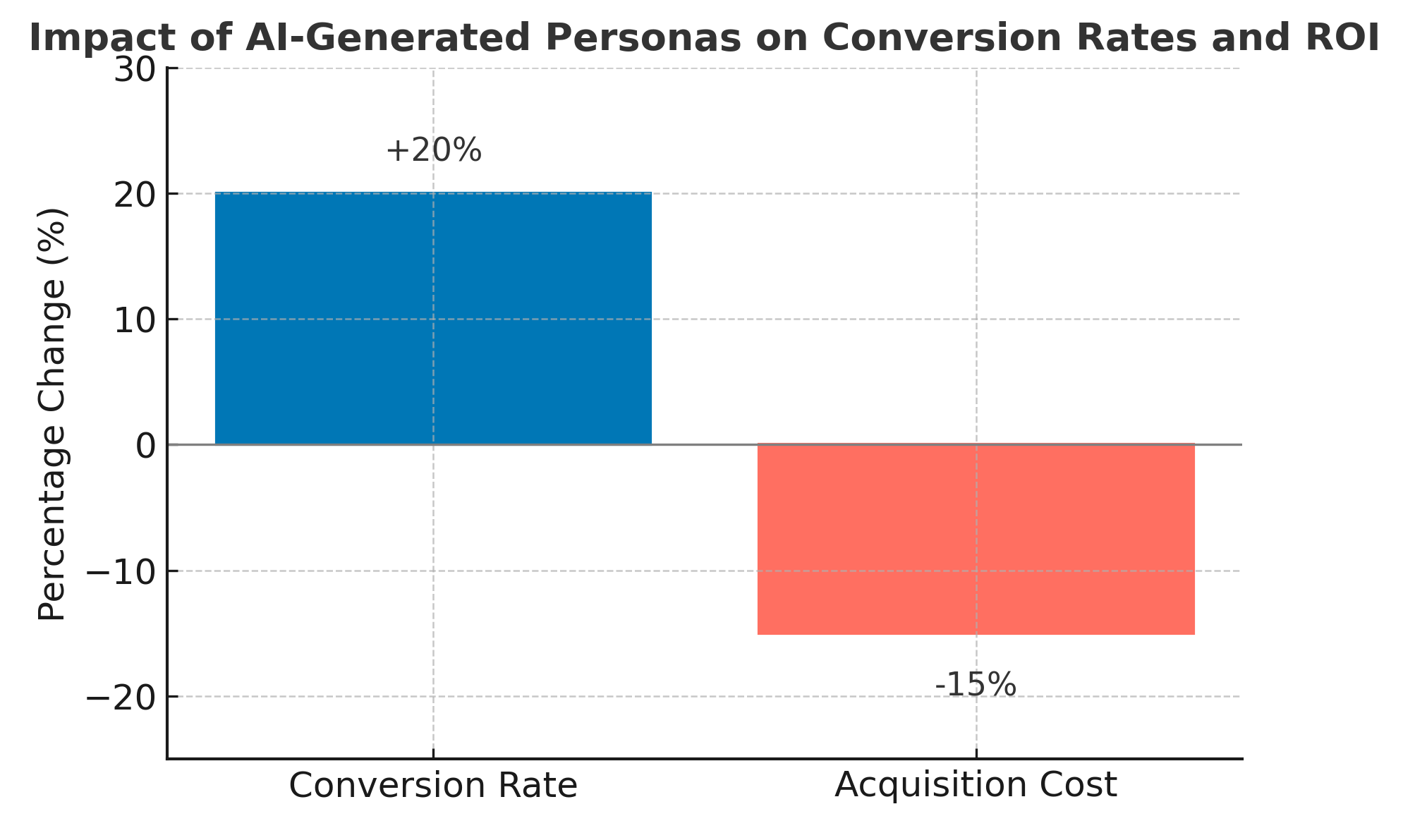
In practice, B2B organizations using AI personas have reported 20% conversion rate increases and 15% lower acquisition costs in their nurture funnels compared to traditional approaches (James 2024). According to Motion Marketing (2025), B2B brands adopting persona-informed GEO strategies that reflect real human behavior experience 40% more qualified leads and 2× longer on-page dwell time, demonstrating the direct link between persona alignment and GEO performance.
Measuring Success: The Persona KPI Framework
Continuous measurement keeps personas dynamic and accountable to business outcomes.
| KPI Area | Example Metric | Persona Impact |
|---|---|---|
| Visibility | Impressions in AI search results | Persona-relevant queries |
| Engagement | CTR, dwell time | Content resonance with persona goals |
| Conversion | Demo sign-ups, lead quality | Persona-driven targeting |
| Loyalty | Retention rate, upsells | Persona refinement from CRM feedback |
Actionable Roadmap for Implementation
Before CMOs can act, it’s essential to connect the dots between AI-generated personas, multiple data sources, and the customer insights that drive real marketing ROI. Modern persona creation combines real and synthetic users. This enables marketers to capture user behaviors, intent, and context across traditional search and AI-powered conversational interfaces. This shift transforms buyer personas into dynamic assets that continuously evolve with your audience. It is a powerful tool for business owners who want to tailor strategies, create content, and maximize direct or indirect mentions to stay competitive.
The following roadmap outlines how to turn persona insights into an actionable, data-driven strategy, aligning marketing, SEO, and business goals over a 12-month horizon.
| Timeline | Actions |
| 0-3 Months | Audit personas; integrate AI and CRM data sources. |
| 4-6 Months | Deploy AI persona tools; validate with buyer interviews. |
| 7-9 Months | Launch persona-specific content and SEO optimizations. |
| 10-12 Months | Evaluate KPIs; refine personas for scalability. |
Key Takeaways
- AI personas need unified data: Most CMOs struggle with siloed data across CRM, analytics, and social platforms — connecting these sources improves persona accuracy and marketing ROI.
- Bias and data quality are critical risks: Low-quality or biased training data can distort persona outputs; maintaining human oversight and bias audits ensures reliable insights.
- Explainability builds trust: Transparent AI systems help marketing teams understand how persona recommendations are generated — crucial for ethical and compliant decision-making.
- Behavioral signals outperform demographics: Modern AI personas rely on intent, content engagement, and purchase signals, rather than age or job title alone.
- Automation enhances agility: AI-driven persona creation accelerates campaign testing and optimization, reducing time-to-market for personalized experiences.
- TRYSEO enables smarter AI persona building: TRYSEO helps CMOs turn fragmented data into cohesive, AI-optimized personas that enhance visibility, engagement, and conversion.
Conclusion: Future-Proof Your Persona Strategy
Leveraging unified, AI-driven data sources — CRM, social, analytics, and AI search — empowers CMOs to build personas that evolve with their markets. AI personas aren’t just digital profiles; they’re real-time engines of insight, translating behavioral signals into visibility, trust, and ROI.
By addressing the challenges of data fragmentation, bias, and explainability early and aligning personas with GEO KPIs, CMOs can future-proof their marketing strategy, ensuring their brand remains discoverable and competitive in an AI-powered search ecosystem.
At TRYSEO, our goal is to help marketing teams bridge this gap — turning fragmented data into meaningful, AI-optimized personas that drive both search visibility and audience engagement.
FAQs
1. What is an AI-Search Persona?
An AI-search persona models how users ask AI systems questions, including prompt styles, trust signals, and context—not just demographics.
2. How is this different from SEO personas?
AI-search personas integrate search behavior and prompt intent, enabling better GEO (Generative Engine Optimization) alignment.
3. Why should CMOs care?
Because over 80% of B2B buyers rely on AI tools for early-stage research—if your brand isn’t cited, you’re invisible.
4. How do I start building one?
Start by analyzing AI-prompt data (ChatGPT, Gemini, Bing Copilot), then enrich your personas with behavioral insights and trust preferences.
5. What KPIs measure success?
AI citation frequency, AI-driven traffic share, conversion rate, and content authority metrics.
Would you also like to optimize your company for AI and become visible there?
Find out more about our services!
References
- Adashek, J. (2024). “The CMO Revolution: 5 Growth Moves to Win with AI.” IBM: https://www.ibm.com/thought-leadership/institute-business-value/en-us/c-suite-study/cmo
- Amin, D.; Salminen, J.; Ahmed, F.; Tervola, S. M. H.; Sethi, S.; Jansen, B. J. (2025) “How Is Generative AI Used for Persona Development?: A Systematic Review of 52 Research Articles.” arXiv: https://arxiv.org/abs/2504.04927
- Bhawalkar, G.; Chee-Read, A.; Proulx, M.; Joplin, A. J.; De Gasperin, C.; Chickering, K.; Khater, Z.; Winters, B.; Jacobs, I.; Viola, B.; Swan, G.; Neuburg, S. (2024). “Best Practices for Creating Effective Personas: It’s Time to Rethink Your Approach to Personas.” Forrester: https://www.forrester.com/report/best-practices-for-creating-effective-personas/RES181349
- Buten, J.; Hayes, A.; Schanne, A.; Bretagne, K. (2024). “B2B Buyer Adoption Of Generative AI: Rapid Adoption Of GenAI Is Reshaping The B2B Buying Process.” Forrester: https://www.forrester.com/report/b2b-buyer-adoption-of-generative-ai/RES181769
- James, C. (2024). “AI-Generated Personas for Enhanced Lead Nurturing in B2B Sales Funnels.” ResearchGate: https://www.researchgate.net/profile/Charles-James-16/publication/387707848_AI-Generated_Personas_for_Enhanced_Lead_Nurturing_in_B2B_Sales_Funnels/links/6778b732117f340ec3f22fe0/AI-Generated-Personas-for-Enhanced-Lead-Nurturing-in-B2B-Sales-Funnels.pdf
- Kaltofen, H. (2025). “How to Measure Success in GEO – What KPIs Should We Focus On?” TRYSEO: https://www.tryseo.de/en/geo-en/kpi/
- Mattan, M. (2025). "AI-Powered Personalization: Personalized Customer Experiences at Scale." BrandXR: https://www.brandxr.io/ai-powered-personalization-personalized-customer-experiences-at-scale
- Roberts, J. (2025). “Using AI to Build Your Personas: Don’t Lose Sight of Your Real-World Buyers.” Marketing Profs: https://www.marketingprofs.com/articles/2024/51294/ai-for-building-b2b-buyer-personas-limitations
- Skane, A. (2025). "SEO personas for AI search: How to go beyond static profiles." Search Engine Land: https://searchengineland.com/seo-personas-ai-search-461343
- Raebricht, S. (2025). “From Invisible to Market Leader: How Tenios Dominated AI Search in 3 Months.” TRYSEO: https://www.tryseo.de/project/from-invisible-to-market-leader-how-tenios-dominated-ai-search-in-3-months/
- Venkit, P. N.; Li, J.; Zhou, Y.; Rajtmajer, S.; Wilson, S. (2023). “A Tale of Two Identities: An Ethical Audit of Human and AI-Crafted Personas.” arXiv: https://arxiv.org/pdf/2505.07850
- Yee, L.: Deveau, R.; Reis, S. (2024). “An Unconstrained Future: How Generative AI Could Reshape B2B Sales.” McKinsey & Company: https://www.mckinsey.com/capabilities/growth-marketing-and-sales/our-insights/an-unconstrained-future-how-generative-ai-could-reshape-b2b-sales#/

