

Summary: Content Optimization for AI Tools
- Generative search replaces rankings with answers: 58% of modern search interactions end without a click when AI summaries appear bypassing traditional search.
- Structured data is foundational for GEO: Advanced schema markup (Organization, Product, Author, FAQ) enables generative engines to correctly interpret, retrieve, and reuse content in generative answers. Implementing advanced JSON-LD schema markup on 90% of high-value pages ensures AI system correctly interprets and reuses content.
- Information gain outweighs content volume: Companies that prioritize original insights and comprehensive content see 3x more AI mentions compared with traditional SEO (Algrim 2025).
- Brand authority drives AI citation: Clear authorship, consistent terminology, and trusted mentions aligned with E-E-A-T guidelines can increase visibility and search rankings by 30–40% in AI engine.
- Measurement and hygiene determine sustainability: Fast, accessible sites with Largest Contentful Paint under 2.5 seconds are picked 70% more frequently as sources for AI snapshots. Fast, secure, verifiable websites combined with GEO-specific KPIs are essential for long-term AI conversational queries visibility.
Why Is Generative Engine Optimization (GEO) More Important Than SEO?
Generative engine optimization (GEO) is more important than SEO because AI-powered answer engines determine what users see before they ever click on a website. Buyers now rely on tools where AI overviews provide direct answers. Instead of ranking pages, GEO optimizes how brands create content that can be retrieved, cited, and summarized by AI systems beyond traditional search. This captures demand even when zero clicks occur.
Search engines retrieve documents. Generative engines construct answers.
Large Language Models (LLMs) predominantly rely on:
- Explicit semantic signals — AI systems extract meaning from structured, context-rich content, not just relevant keywords or keyword stuffing.
- Consistency across sources — LLMs favor content that is corroborated across multiple credible sources rather than content with high keyword frequency alone.
- Credibility indicators such as authorship and citations — These are increasingly vital, as LLM-based systems prioritize documented expertise and verifiable sources over backlink volume or page rank.

Would you also like to optimize your company website for AI and become visible there?

Find out more about our services!
Key trends and data strongly support the growing importance of GEO in driving AI visibility.
- Zero-Click Search Dominance: A majority of modern search interactions end without any click to a website, with zero-click rates as high as 58%, especially when AI summaries appear (Fishkin 2024). This fundamentally weakens the link between traditional rankings and business outcomes.
- Citation Over Rankings: In GEO contexts, being cited in an AI-generated answer matters more than ranking #1 on a results page. LLMs treat multiple sources simultaneously, meaning visibility isn’t ordered the way a SERP is (Davidson 2025).
- Empirical Improvements: Studies show that strong citations, author signals, and GEO optimization can boost AI visibility by 30–40% compared with baseline content (Aggarwal 2023).
- Shift in User Behavior: Data indicates that when AI overviews or summaries appear, click-through rates drop drastically, for example, CTR falling from 15% without AI answers to 8% with them (Chapekis 2025). Traditional SEO metrics like backlinks and domain authority show weak correlation with AI citation likelihood.
This article introduces a practical, strategic framework outlining the critical steps companies must take to ensure their websites are discoverable and credible. It also explains how to optimize content that is citable within generative search results. The goal is to make your brand the source AI trusts—and buyers see when decisions are formed.
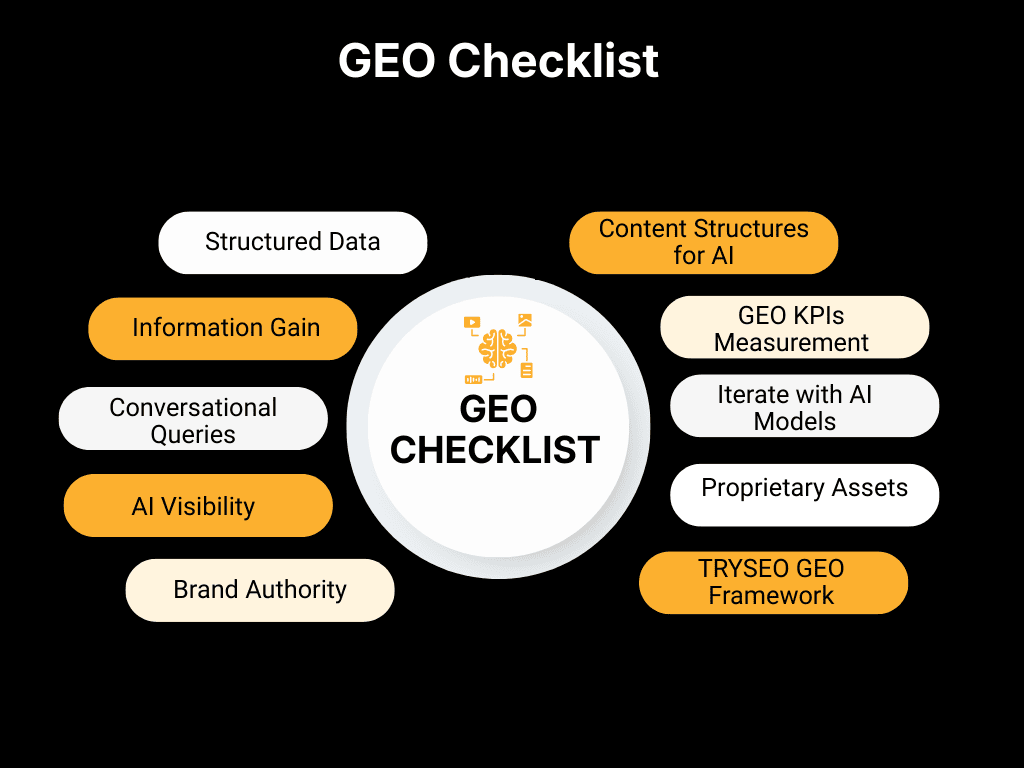
How Can You Meet The GEO Checklist?
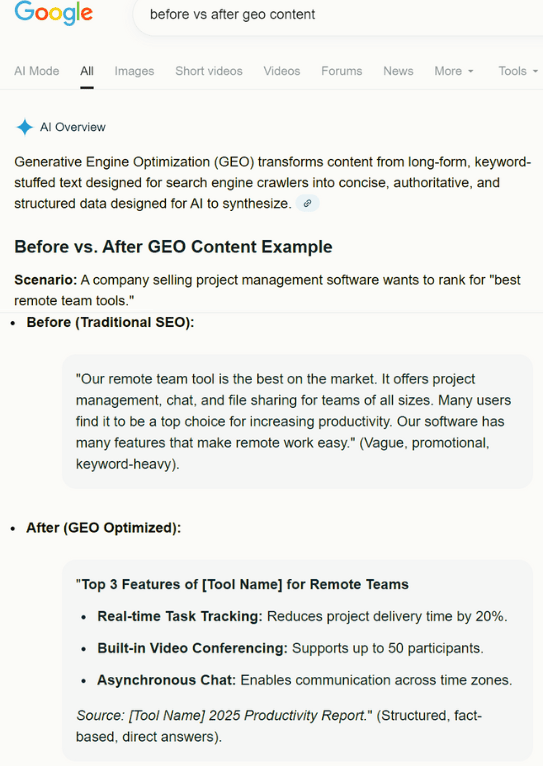
Businesses can boost their AI visibility by ensuring clear authorship, strong citations, structured facts, and explicit metadata, all of which signal credibility to LLM-based systems.
1. Implement a Structured Data Foundation
To be "read" by an LLM, your site must move beyond human-readable text. Technical sites often contain complex specifications that AI might misinterpret without help.
- The Technical Shift: Implement advanced JSON-LD schema from Schema.org. Don’t stop at "Organization" or "WebPage." Use specific schema markup for "Product", "Service", "CaseStudy", "SoftwareApplication", and "HowTo" guides.
- The Execution: Use Google’s Rich Results Test to validate your work. Aim to have 90% of your key high-value pages mapped with structured data. This creates a "Source of Truth" that AI engines can ingest with high confidence.
2. Audit Content for "Information Gain"
Generative engines are designed to synthesize information, not repeat it, prioritizing sources that demonstrate originality, verifiability, and strong E-E-A-T. If your content mirrors the top 10 results on Google, an AI model has no reason to cite you—it already has that data.
- The Strategy: Use tools like Ahrefs or SEMrush to identify "me-too" content and replace it with proprietary data. This includes internal benchmarks, original surveys (e.g., "Our 2025 study found 99.97% uptime across 500 legacy systems"), and expert opinions.
- The Goal: Aim for 20-30% unique facts per page. Companies that prioritize these "un-copyable" insights see 3x more mentions because they provide the "Information Gain" AI systems crave (Algrim 2025).
3. Content Creation for Conversational Queries
B2B buyers don't search for broad keywords; they ask complex, multi-layered questions during the research phase.
- The Strategy: Source 50-100 real-world questions from your sales team, support tickets, and CRM logs. Queries like "How does this API scale for strict SOC2 regulations in high-latency environments?" are exactly what buyers ask AI.
The Action: Build dedicated pages or Q&A sections using FAQ schema to answer common questions and capture leads at the earliest research stage. By addressing follow-up concerns like implementation costs or integration hurdles, you can boost research traffic by up to 40% (Arora 2021).
4. Enhance Technical Hygiene & AI Visibility
AI systems are increasingly using real-time "browsing" tools to generate answers. If your site is slow or blocked, the AI search will simply skip you.
- The Performance Standard: Aim for a "Largest Contentful Paint" (LCP) of under 2.5 seconds. Ensure your layout is stable and your site uses HTTPS across all subdomains (Walton 2025).
- AI Permissions: To optimize your site for generative AI visibility, you should align with the technical standards that allow AI crawlers to access and process your content efficiently. The specific guidance you provided consists of two parts: a technical instruction regarding robots.txt and a performance statistic about generative snapshots. High-performing, accessible sites are picked 70% more frequently as sources for generative snapshots (Aggarwal 2023).
Reviewing robots.txt for AI Engines
Ensuring accessibility for modern AI crawlers is now a prerequisite for GEO, as blocked access prevents generative systems from retrieving and citing authoritative content. To ensure your content can be cited by AI systems, you must verify that your robots.txt file does not block the following specific user agents:
- GPTBot: The primary crawler for OpenAI (ChatGPT).
- CCBot: The crawler for Common Crawl, a massive dataset frequently used to train multiple AI platforms.
- Google-Extended: The control mechanism for Google’s Gemini and Vertex AI (distinct from the standard Googlebot).
- ClaudeBot: The crawler for Anthropic’s Claude.
Recommended Configuration: If you want to be included in AI results, ensure your robots.txt (located at yourdomain.com/robots.txt) is included.
5. Build Brand Authority & Trust Signals
In the GEO era, success is measured by being cited as a source. AI system determines trust based on your brand's "neighborhood"—who mentions you and in what context.
- The Strategy: Focus on content clusters around 5-7 core technical pillars (e.g., "Edge Computing Security"). Secure backlinks and mentions from high-authority, niche technical publications or analysts like Gartner and Forrester.
- The "AI-Handshake": Create an llms.txt file (a new emerging standard) on your root directory to provide a machine-readable summary of your site's most important data, signaling a "yes to AI quotes" policy.
The Strategy: Implement an llms.txt file in your root directory. This is a newly adopted standard designed to provide a high-density, Markdown-formatted summary of your website specifically for AI system. While humans read your "About Us" page, AI tools read your llms.txt to quickly understand your core value proposition, product specs, and documentation structure without crawling thousands of pages.
The Action: Create a file at yourdomain.com/llms.txt. Use this structure:
- H1: Your Brand Name
- H2: Key Products/Services
- H3: Critical Links (Documentation, Pricing, API)
- Brief Summary: A 200-word "Source of Truth" summary that uses the exact terminology you want AI system to use when describing you.
Would you also like to optimize your company website for AI and become visible there?
Find out more about our services!
6. Create Content Structures Visible to AI Systems
LLMs do not "read" like humans; they parse data. If your information is buried in dense paragraphs, it may be missed.
- The Framework: Use a "Quote-Data-Citation" structure. Utilize clean HTML headings (H2, H3), bulleted lists for technical specs, and dedicated "Data Boxes" for key stats like "73% revenue boost."
- Authority Language: Use strong, declarative phrasing such as "Data demonstrates" or "Research confirms." Research shows that authoritative, data-rich content—using confident language, and explicit evidence is cited approximately by 31–41% (Ilhe 2026).
7. Monitor and Measure GEO KPIs
Traditional rank tracking (positions 1-10) is becoming obsolete. You need a new dashboard for the generative age.
- New Metrics: Track In-Text Citation Rate (how often your URL appears in AI footnotes), Brand Sentiment in LLMs (how the AI describes your product), and Conversational Lead Quality.
- The ROI Reality: AI answers may cut clicks by 30%, but the leads that do click are twice as qualified. Generative engine optimization (GEO) shifts ROI to revenue efficiency: fewer clicks, but higher‑intent visitors who convert better (Kaltofen 2025).
8. Test and Iterate with AI Models
You cannot optimize what you don't test. Treat AI tools like your new "beta testers."
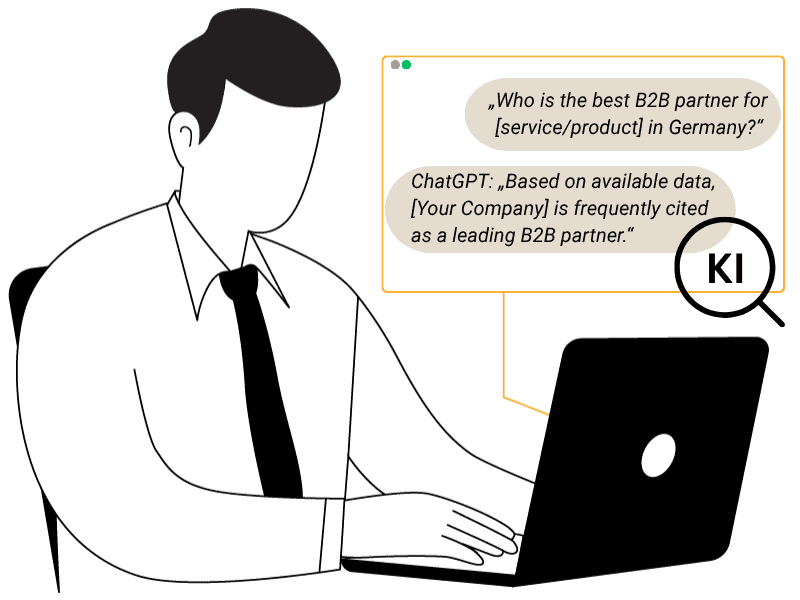
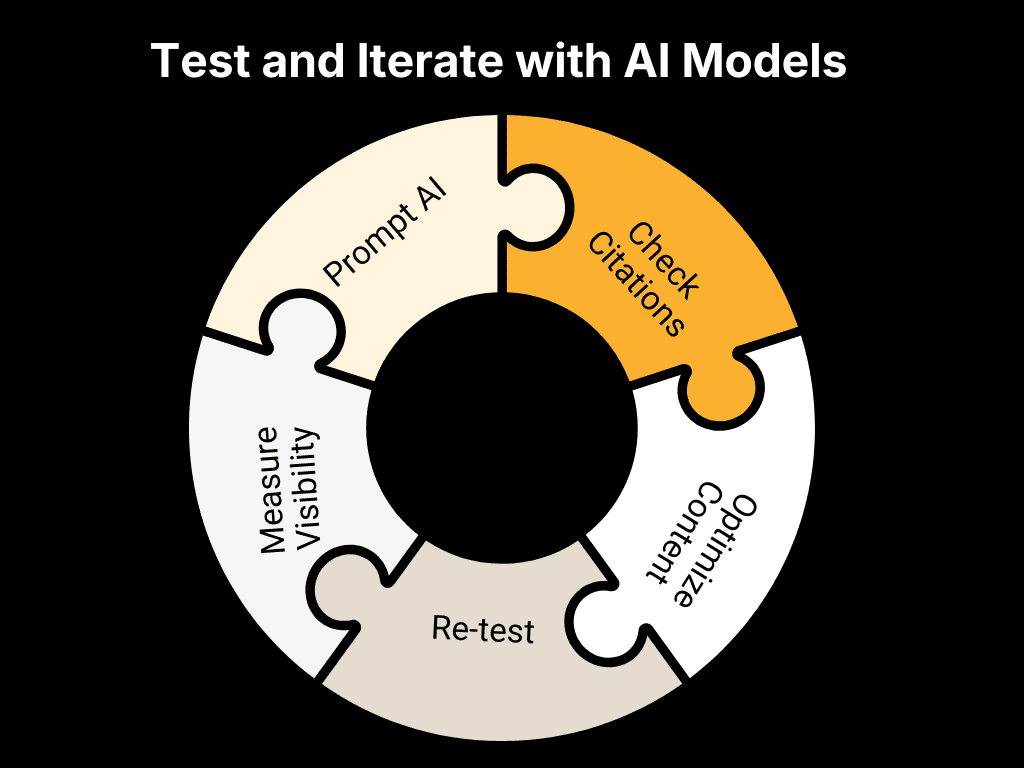
- The Action: Every week, prompt Perplexity, Gemini, and ChatGPT with your primary buyer queries. Note whether your brand is mentioned in AI answers, if the information is accurate, and which competitors are being cited instead.
- A/B Testing: Run "GEO A/B tests" by updating one group of pages with heavy citations and another with expert quotes. Track which style results in more AI citations over a 4-week.
9. Scale with Proprietary Assets
To become a "permanent" part of an AI's system, you must produce high-value, original assets that serve as the "raw material" for industry research.
- The Strategy: Move beyond standard blogging. Produce exclusive annual reports, whitepapers, and technical benchmarks (e.g., "The 2026 State of B2B Cyber-Resilience").
- The Multiplier: Partner with other non-competing tech firms for joint studies and industry publications. This creates a network of "expert buzz" that can lead to a 5x increase in brand mentions and AI visibility.
10. Align with the TRYSEO GEO Framework
The shift to Generative engine optimization (GEO) is a strategic pivot that requires a specialized approach. By aligning with the TRYSEO GEO Framework, you move from traditional SEO tactics to GEO.
- The Competitive Edge: With 62% retention, Perplexity commands a major share of the answer engine market among technical professionals (Elad 2025). A case study shows that Tenios increased AI visibility from 7% to over 50% within three months. This doubled their share of voice and citations in AI search engines, serving as a clear proxy for stronger lead quality and ROI potential.
Why Is GEO A Strategic Imperative?
The shift from traditional SEO to GEO focus is not only a technical update. It is a fundamental defense of your brand’s digital real estate. As AI-powered engines become the primary research interface for buyers, "appearing on page one" is being replaced by "being the cited answer."
Here is why ignoring GEO is no longer an option for technical firms:
| Strategic Driver | Why Does This Matters? |
|---|---|
| Zero-Click Reality | AI responses provide direct answers directly in the search interface, removing the need for users to click through to your site. |
| Agent-Led Shortlisting | Buyers use AI "agents" to ingest technical data and create vendor shortlists. If you aren't machine-readable, you aren't evaluated. |
| First-Mover Authority | AI favor established "authorities." Securing your spot in the model’s training data/RAG now prevents competitors from displacing you later. |
| Trust & Verifiability | In high-risk tech (SaaS, Fintech), AI engines prioritize "Information Gain"—proprietary, verifiable data over generic marketing copy. |
| Superior Lead Value | GEO leads have been "pre-vetted" by the AI’s responses. When a user finally clicks, their intent and understanding are exponentially higher. |
What Are The Challenges In Implementing GEO?
Implementing GEO is challenging because it requires unique, authoritative content and measurable information gain. Despite the clear benefits, companies often encounter these four primary obstacles:
1. The "Black Box" of AI Search
Unlike traditional SEO, where tools like Google Search Console provide exact data on rankings and clicks, GEO lacks a centralized reporting dashboard.
- The Hurdle: It is currently difficult to track exactly how many times an AI cited your site or how many "zero-click" impressions your brand received.
- The Fix: Pivot your KPIs toward Share of Model (SoM)—using tools to prompt LLMs periodically and track if your brand appears in the direct answers, or monitoring referral traffic specifically from AI domains like openai.com or perplexity.ai.
2. Technical Debt and JavaScript Barriers
Many websites rely heavily on client-side JavaScript (React, Vue, etc.) to render content.
- The Hurdle: While Googlebot is getting better at rendering JS, many AI crawlers and real-time retrieval agents (like those used by ChatGPT) are "lightweight." If your core content is buried behind complex scripts, the AI will see a blank page.
- The Fix: Ensure server-side rendering (SSR) is active for all high-value research pages and industry publications.
3. Messaging Inconsistency Across Silos
AI tools build a "knowledge graph" of your brand by looking at your website, your LinkedIn, press releases, and third-party review sites.
- The Hurdle: If your website says you are a "Cybersecurity Platform" but your LinkedIn says you are an "IT Compliance Tool," the AI platforms lose confidence in your "Entity." This uncertainty leads to lower citations.
- The Fix: Standardize your core brand definitions. Generate content that dictates exactly how the brand is described across all digital platforms to build topical authority.
4. Context Limitations of AI Search Results
LLMs have a limited "context window"—they can only process a certain amount of text at once.
- The Hurdle: Dense, long whitepapers are often too large for generative search engines to make sense, and the important data often gets ignored.
- The Fix: Use Modular Content Creation. Break long-form content into "chunks" with descriptive H2 headings and summary boxes. This way AI system understands and retrieves exactly what it needs without exceeding limit.
Key Takeaways
- Generative search engines replaces rankings with answers: Visibility in AI platforms depends on being cited as a trusted source, not on SERP position.
- Structured data is non-negotiable for Generative Engine Optimization: Advanced schema markup enables AI search engines to correctly interpret, retrieve, and reuse your content.
- Information Gain is the primary ranking factor for AI platforms: Proprietary data, original research, and expert frameworks dramatically increase AI citation and ranking.
- Brand authority functions as a trust signal for LLMs: Clear authorship, consistent terminology, and authoritative mentions determine whether AI trust your brand.
- Conversational intent defines discovery: GEO-ready websites directly answer complex, long-tail buyer questions in modular, machine-readable formats.
- Technical hygiene determines eligibility, not optimization: Fast load times, HTTPS, crawl accessibility, and server-rendered content are prerequisites for AI visibility.
Conclusion:
Generative Engine Optimization is about trust and verifiability. By implementing structured data, ensuring technical hygiene for AI bots, and prioritizing high “information gain,” you can stop chasing the algorithm and start leading the conversation.
The companies that act now on GEO strategy will be the ones that AI assistants and buyers trust tomorrow. In 2026, the question is no longer “Where do we rank?” but “Are we the cited answer?”
TRYSEO’s GEO Framework helps brands transition from traditional search engines to AI-trusted authority by auditing how models interpret their content. It also strengthens citation signals and ensures the brand is eligible to be referenced in AI generated responses.
If AI systems are already shaping your buyers’ shortlists, now is the time to ensure your company is not just discoverable—but definitive in search engines.
FAQs
- What is Generative Engine Optimization (GEO)?
Generative Engine Optimization (GEO) is optimizing digital content so it can be retrieved, cited, and summarized by AI search engines such as ChatGPT, Gemini, Perplexity, and Google AI mode. Traditional search and SEO focus on ranking webpages, while GEO strategy focuses on becoming a trusted source within AI-powered search. This marks the rise of Answer Engine Optimization, where success is defined by whether AI selects your brand as a trusted source when synthesizing answers—not by where your page appears in a list of links. - Why is GEO more important than traditional SEO for companies?
GEO is more important because many buyers now rely solely on generative AI tools and AI assistants for research and vendor evaluation. These search engines often provide answers directly, resulting in zero-click searches. If AI does not cite your brand, it may never enter the buyer’s consideration set—even if your SEO efforts are strong. - How do AI engines decide which sources to cite?
AI-driven search engines prioritize sources that demonstrate clear semantic structure and high information gain through unique and verifiable insights. They also favor consistent brand entities across platforms that are repeatedly surfaced in AI overviews and demonstrate strong E-E-A-T guidelines. This will make more authoritative your content that provide valuable insights. - Does structured data really affect AI visibility and content optimization?
Yes. It helps AI-driven search engines to interpret your optimized content and distinguish facts, products, authors, and services, increasing reuse in AI overviews. Pages with rich schema markup are significantly more likely to be reused and cited in generative search results and AI overviews than unstructured pages. - What kind of content performs best in GEO?
Create content that performs best for GEO strategy by combining original research, measurable case studies, expert-led insights, and modular, well-structured technical content favored by AI overviews. - What is the GEO checklist for companies to measure performance?
GEO performance is measured through AI citation frequency, brand mentions across AI-generated answers, Share of Model, AI referral traffic, and content quality.
Would you also like to optimize your company website for AI and become visible there?
Find out more about our services!
References
- Aggarwal, P.; Murahari, V.; Rajpurohit, T.; Kalyan, A.; Narasimhan, K.; Deshpande, A. (2023). “GEO: Generative Engine Optimization.” arXiv: https://arxiv.org/abs/2311.09735
- Algrim, P. (2025). “Generative Engine Optimization (GEO) Case Study: 3X’ing Leads.” GO Fish: https://gofishdigital.com/blog/generative-engine-optimization-geo-case-study-driving-leads/
- Arora, N., Ensslen, D., Fiedler, L., Liu, W. W., Robinson, K., Stein, E., & Schüler, G. (2021, November 12). “The Value of Getting Personalization Right—or Wrong—Is Multiplying.” McKinsey & Company: https://www.mckinsey.com/capabilities/growth-marketing-and-sales/our-insights/the-value-of-getting-personalization-right-or-wrong-is-multiplying#/
- Chapekis, A.; Lieb, A. (2025). “Google Users Are Less Likely to Click on Links When an AI Summary Appears in the Results.” Pew Research Center: https://www.pewresearch.org/short-reads/2025/07/22/google-users-are-less-likely-to-click-on-links-when-an-ai-summary-appears-in-the-results/
- Davidson, O. (2025). “Staying Seen in AI Search: How Citations & Mentions Impact Brand Visibility.” airops: https://www.airops.com/report/how-citations-mentions-impact-visibility-in-ai-search
- Elad, B. (2025). “Perplexity AI Statistics 2026: Speed, Accuracy & Strategic Wins.” SQ Magazine: https://sqmagazine.co.uk/perplexity-ai-statistics
- Fishkin, R. (2024, July 1). “2024 Zero-Click Search Study: For Every 1,000 EU Google Searches, Only 374 Clicks Go to the Open Web. In the US, It’s 360.” SparkToro: https://sparktoro.com/blog/2024-zero-click-search-study-for-every-1000-us-google-searches-only-374-clicks-go-to-the-open-web-in-the-eu-its-360/
- Kaltofen, H. (2025). “How to Measure Success in GEO – What KPIs Should We Focus On?” TRYSEO: https://www.tryseo.de/en/geo-en/kpi/
- Ilhe, N. (2026). “The Complete AI Citation Optimization Guide 2026: 6 Factors That Boost Visibility by 41%.” Qwairy: https://www.qwairy.co/blog/complete-ai-citation-optimization-guide
- Walton, P.;Pollard, B. (2023). “Largest Contentful Paint (LCP).” Web dev: https://web.dev/articles/lcp

