

Summary: Semantic Search and Intent Optimization in Online Marketing
- Semantic Search analyzes context, entities, and search intent, rather than just individual terms.
- Semantic SEO is the response to Semantic Search. It encompasses all intent optimization measures to increase visibility in semantic search systems and AI-generated answers.
- Google algorithms such as Hummingbird, RankBrain, BERT, and MUM continuously drive semantic understanding forward.
- Long-tail keywords are gaining importance as they reflect search intentions more precisely and frequently trigger AI responses.
- Topic clusters and pillar pages are replacing isolated keyword strategies and strengthening your topical authority.
- In the AI era, success is measured not only by clicks but by visibility (including citation frequency), brand presence, and thematic relevance.
Are you still optimizing your pages purely for keywords? If so, you are leaving a lot of potential on the table. Current developments are fundamentally changing both search behavior and search engine optimization itself. Search engines have long since stopped evaluating just terms—they analyze meaning, context, and search intent.
In this article, we examine how semantic search is turning online marketing upside down. You will learn how to build real authority with topic clusters, what modern keyword research looks like, and which misunderstandings exist regarding this topic. Anyone who wants to survive in the AI era should not underestimate the importance of Semantic SEO.
Would you also like to transform your corporate website from a business card into a lead machine?
Learn more about our services!
Semantic Search Changes Information Retrieval
Keyword stuffing, misunderstandings regarding synonyms, and the increasing use of natural language search have challenged the previous way of searching. Voice search and AI systems are increasingly contributing to users no longer searching for key terms, but rather formulating longer search queries (sometimes in complete sentences).
The way search engines function has adapted to this situation. They do not look exclusively for occurring terms, but for the meaning of the content that matches the searcher’s intention. Semantic Search establishes a new foundation for relevant search results.
What is Semantic Search?
Semantic Search describes the ability of search engines to understand the meaning of a search query in context, rather than just matching words. A semantic search provides relevant results and information based on search intent, entities, the context of the query, and semantic relationships.
In other words: Semantic Search intends to interpret search queries the way a human would understand them. That is, not as a string of terms, but as a question with a goal.
Terms Related to Semantic Search
- Semantics: In the search context, this term refers to the understanding of relationships between terms.
- Entity: A uniquely identifiable unit (e.g., person, place, or product).
- Knowledge Graph: A structured database of entities and their relationships.
- Search Intent: The intention behind a search query. Semantic search evaluates content based on whether it fulfills this intention.
- Natural Language Processing (NLP): Technologies for the machine processing of natural language. NLP analyzes grammar, structure, and word relationships.
- Natural Language Understanding (NLU): A subfield of NLP aimed at ensuring systems understand the meaning and intent behind a query.
What are the Differences Between Classical and Semantic Search?
Classical search matches keywords, while semantic search understands the meaning of the content. The relevance of a website and its content, as well as rankings, are no longer created through word repetition, but through depth of content and thematic fit.
The table shows the differences between the two approaches:
| Classical Search | Semantic Search | |
|---|---|---|
| Functionality | Keyword Matching | Meaning Analysis of Sources |
| Focus | Individual Search Terms | Search Intent and Context |
| Synonyms | Often problematic or irrelevant | Recognition through Context |
| Long-tail Queries | Harder to interpret | Better understood through NLP |
| Entities | Hardly considered | Central Component |
| Content Evaluation | Keyword density, exact terms | Thematic coverage, semantic depth |
| Search Result | Match for the word | Answer to the question |
However, semantic search is diverse and can occur in different ways.
What Types of Semantic Search Exist?
Semantic search is based on various technologies. Depending on the context, the search engine can rely on these or combine approaches. The most frequently used types include knowledge-graph-based searches, inference-based searches, vector search, and NLU.
Knowledge-Graph-Based Search
This search focuses on entities that search engines link in structured databases, known as knowledge graphs.
Example: The Google Knowledge Graph stores billions of entities and their relationships. When you search for “Apple founder,” the search engine not only recognizes the word “Apple” but assigns it to the company and links it to Steve Jobs.
Inference-Based Search
This search is about drawing conclusions. Even if the terms do not match, the search engine derives new meanings from known information and knows how to combine them.
Example: A user searches for “How do I secure company data from cyberattacks?” Even if a page does not use this exact phrasing, the search engine recognizes that content on “ISO 27001,” “Information Security Management System,” or “Risk Assessment” is highly relevant to the user. The search engine then infers suitable specialist topics from the overarching goal.
Vector Search
In vector search, the search engine converts texts into mathematical vectors. This allows it to calculate how similar two pieces of content are in their meaning and how close the vectors are to each other.
Example: If a user searches for “software for digital personnel files,” the search engine can present a page on “HR document management.” Although the keyword is not found there, the system recognizes the semantic proximity between the two terms.
Would you also like to transform your corporate website from a business card into a lead machine?
Learn more about our services!
Natural Language Understanding (NLU)
Natural Language Understanding, or NLU for short, ensures that machines understand human language. A study revealed as early as 2025 that approximately 20.5% of people worldwide use voice search. As this trend increases, it is all the more important for search engines to recognize the user’s intent in order to provide suitable information in the search results.
Example: You search for “Can I be held liable as a managing director for data protection violations?” The search engine understands that it is about liability, the role of the managing director, and data protection law, and not just about the isolated terms “managing director” or “data protection.” In the search results, you will therefore find answers to exactly this question.
Good to know: Search engines naturally use other approaches as well to create suitable search results for the query. Furthermore, in semantic search, you can also distinguish between hybrid search, context-based search, or multimodal semantic search.
Google Algorithms in Transition: The Path Toward Semantic Search
Have you ever looked at the updates and changes to Google’s algorithms? They show how the development shifted from classical search to semantic search. It is the algorithms that first enable the fit between the user’s intention and the information actually delivered.
The change occurred gradually:
- Hummingbird (2013): Google analyzes complete search queries instead of individual keywords.
- RankBrain (2015): A machine learning system for interpreting new and unknown search queries. According to Google, 15% of daily queries are completely new.
- BERT (2019): Context-based processing of natural language through bidirectional transformer models.
- MUM (2021): A multimodal model for processing complex, cross-topic search queries.
Today, Google processes natural language much more precisely and reliably recognizes context and intention.
How Do Search Engines Understand Meaning?
Search engines understand meaning by structuring content and putting it into context. They analyze not only the text itself but also the underlying structure of a website. Headings, internal links, and clearly structured content help to categorize topics and recognize connections.
That is why structured data, schemas, and internal links play a central role today in content marketing and the visibility of your website. The right search engine optimization measures help machines and AIs to understand content correctly.
Semantic SEO – The Answer to Semantic Search
The shift toward Semantic Search also requires a shift in search engine optimization. Everything that is now intended to promote the visibility of content or the website falls under the term Semantic SEO.
What is Semantic SEO?
Semantic SEO describes all measures with which you structure and prepare content so that search engines clearly recognize its meaning. Instead of optimizing individual keywords, you align your content with topics, entities, and search intentions.
Which Measures Fall Under Semantic SEO?
To increase your visibility in semantic searches, various measures are available to you. These include:
- Building Topic Clusters: You structure content around a central topic so that search engines recognize that you cover a subject area comprehensively and do not just serve individual keywords.
- Use of Structured Data: Through clear markups, you help search engines to uniquely identify content so they can precisely assign its meaning.
- Alignment with Search Intent: You align content and information with the search intent of the users so that search engines evaluate your content as relevant.
- Internal Linking: Connect thematically related topics through internal links. This also allows search engines to easily follow semantic connections.
- Comprehensive Topic Coverage: To ensure search engines identify you as a relevant source, you should treat topics comprehensively rather than superficially.
Semantic SEO Strategies – What is Their Importance in the AI Era?
Semantic SEO is a must for all companies in the AI era, as AI systems rely on semantic models for their answers. They analyze content, break it down into sections, and evaluate its meaning in the context of a specific question.
Many AI systems work according to the principle of “Retrieval and Generation”: first, they identify semantically suitable text passages, then they formulate their own answer from them. Structured content, clear topic sections, and cleanly defined entities increase the likelihood that they will select your specific content.
What Role Does Semantic SEO Play for B2B Companies?
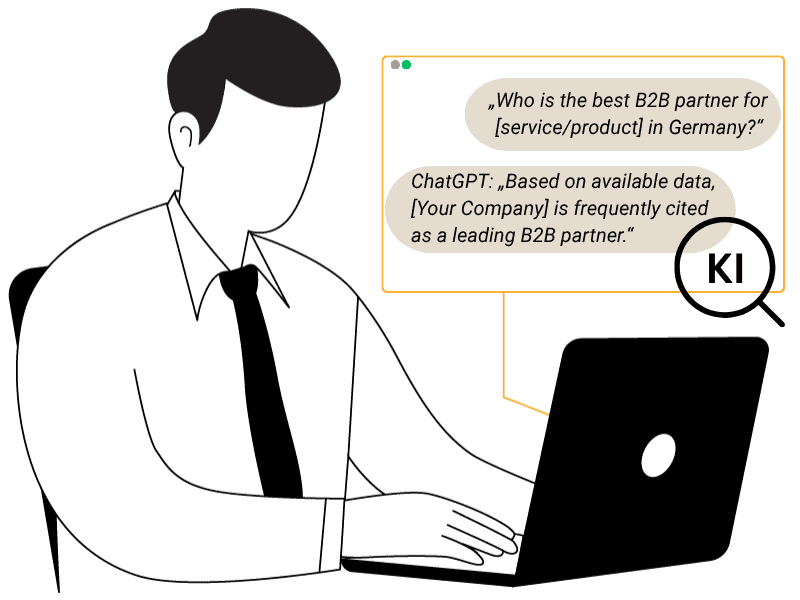
B2B companies can ensure their visibility through Semantic SEO—both in semantic search and in generative AI. It can also prove to be a strategic lever for lead generation, as it can increase visibility exactly where B2B decision-makers are active. Studies show that 89% of B2B buyers use an AI system for information and advice during the decision-making process.
Through semantic optimization, companies can therefore gain a strategic competitive advantage and appear early in decision-making processes.
Advantages and Disadvantages of Semantic SEO
| Advantages of Semantic SEO | Disadvantages of Semantic SEO |
|---|---|
| Higher visibility in AI-generated answers; More relevance instead of keyword focus; Stronger topic authority through detailed treatment of a topic; Higher long-tail coverage; Future-oriented strategy | Partial technical understanding required; Results take time; Higher effort in planning and keyword research; More difficult measurement |
Naturally, Semantic SEO involves a bit more effort than classical SEO. Nevertheless, companies today cannot avoid this strategy, as the development toward semantic search and the semantic understanding of AI systems can no longer be denied.
Instead, it is time to build up know-how in this area and implement the right strategy.
The Central Strategy of Semantic SEO: Bye-bye Keywords – Hello Cluster Content?
Content without keywords will naturally not exist in the future either. Nevertheless, we must note that classical keywords in the previous sense have had their day. Individual search terms are giving way to the search intent of users, which is changing keyword research and bringing cluster content to the fore.
Two central measures of semantic SEO therefore relate to keyword research and topic clusters. That is why we want to delve deeper into both in the next sections.
What Does Keyword Research Look Like in the Future?
The keyword research of the future does not begin with the analysis of search volume, but with the question: “What search intent does my target group have when it comes to this topic?”
Companies must address what information their buyers need, what questions they ask themselves in the purchasing process, and how they can awaken their intent to buy. Subsequently, it is about selecting suitable entities, establishing semantic relationships, analyzing intent, and determining suitable long-tail keywords.
Step 1 – Define Core Topic
Every keyword research for a topic begins with seed keywords. You choose, so to speak, the basis for your core topic. It is not the keyword you use later in the content, but it provides the basis for further elaboration.
Example: Are you a provider of an ERP system? Then a seed keyword could be “ERP system.”
Step 2 – Determine Entities
Search engines and generative AIs think in entities. Therefore, the next step is to identify the central entity behind a seed keyword and thus determine its semantic environment. This helps to clearly work out thematic connections and categorize your core topic.
Example: Entities such as “Cloud ERP,” “SME,” or “Inventory Management” could belong to “ERP system.”
Step 3 – Analyze Search Intent
Next is the analysis of search intent. It is not about what your target group is searching for, but why they are searching for it. Search intent can change along the B2B customer journey. At the beginning, decision-makers often look for basic information. Subsequently, they research more deeply, look for comparisons or solutions, in order to finally make a concrete selection.
Do you know the search intent? Then you can align the content with the corresponding context to increase the relevance of your content.
In doing so, you should distinguish between different types of intent:
- Informational: The user is looking for information or explanations. These queries often include question words like “how,” “what,” or “why.”
- Navigational: The user already knows the destination and wants to reach a specific brand, provider, or website, for example.
- Transactional: The user wants to complete an action, for example, make a purchase or arrange a consultation. A possible search query could be: “buy ERP system.”
- Commercial: The user already has an intent to buy but is in the research and comparison phase. In this context, the search query often contains terms like “best,” “comparison,” or “experience.”
- Local: The user is looking for offers in their vicinity.
Step 4 – Elaborate Long-tail Keywords
Long-tail keywords often contain entities and correspond much more closely to the natural language of your target group.
In semantic search systems, long-tail keywords therefore have particularly many advantages:
- They reflect the search intent more clearly
- By using more terms, they provide more context for the systems
- They create stronger relevance as they cover specific questions
- They are often subject to less competition
- They yield a higher conversion rate due to their proximity to search intent
Example: Instead of “ERP system,” the long-tail keyword “cloud-based ERP system for SMEs” often hits the search intentions more effectively.
| Did you know? Some studies suggest that long-tail keywords are more likely to trigger an AI response than short keywords. For example, Semrush found that around 57% of keywords that triggered an AI response had a monthly search volume of under 100 queries—this clearly points to long-tail keywords. This is because they have high specificity and low search volume. |
Step 5 – Keyword Clustering
To build higher topic authority and avoid keyword cannibalization, you should group and summarize your keywords. Keyword clustering forms the basis for the subsequent topic cluster content.
What is Cluster Content?
Cluster content is one of the most important content strategies today, where you strategically link topics together. You treat a main topic comprehensively on a so-called pillar page and deepen the topic through internal links to subtopics.
Through the interlocking of topics and the internal linking structure, you build a kind of knowledge database and topic authority, which sends clear semantic signals to the systems.
Here are two examples:
a.) Main topic: “ERP Systems in SMEs”
- Pillar Page: “The Complete Guide to ERP Systems in SMEs”
- Subtopics: “Cloud vs. On-Premises ERP,” “Costs of an ERP System,” “ERP Implementation Step-by-Step,” “ERP Providers in Comparison”
b.) Main topic: “B2B Lead Generation”
- Pillar Page: “B2B Lead Generation: Overview of Strategies and Measures”
- Subtopics: “LinkedIn Ads in B2B,” “Whitepapers as Lead Magnets,” “SEO for Lead Generation,” “Marketing Automation in SMEs”
Would you like to learn more about the “Content Cluster Strategy”? In our article, you will find tips on how to implement the strategy in practice, what matters, and which mistakes you should definitely avoid.
Article Link: Content Cluster Strategy: How B2B Companies Build a Topic Structure for GEO (with Instructions)
Would you also like to transform your corporate website from a business card into a lead machine?
Learn more about our services!
Semantic SEO: How Can You Measure Success in Practice?
Visibility without traffic is a new normal in the AI era and in semantic search. Instead of traditional metrics, clicks, and CTRs, new metrics such as brand presence, mentions, and frequency of citations are gaining strategic importance.
The following KPIs therefore help you to measure success in Semantic SEO:
- Visibility of long-tail keywords
- Mentions in AI Overviews, ChatGPT, etc.
- Topic authority
- User interactions
You should precisely define which KPIs are relevant for your company. Furthermore, do not just collect the metrics once, but observe their development in order to be able to initiate appropriate measures.
The Most Common Misunderstandings in Semantic SEO
As with GEO, there are many misunderstandings surrounding semantic SEO and search. For example, that semantic SEO completely replaces classical SEO, or that keywords will play no role at all in the future.
To help you develop a clear understanding of Semantic SEO, we are now clearing up the most important misunderstandings:
- Semantic SEO replaces classical SEO: Of course, semantic SEO does not completely replace classical SEO. However, it is a supplement and a necessity in this day and age to integrate it into the marketing strategy. It would therefore be a mistake to throw your SEO strategies and technical SEO overboard.
- Keywords play no role: Yes, keywords continue to play a role. However, in the future, you will no longer view them in isolation, but depending on the context. Meanings are moving to the center. But keywords are still necessary to represent these meanings.
- Long texts are always better: Text length has little significance. What is decisive is that you fulfill the search intentions of your target group with your content. Sometimes a short text is sufficient for this, sometimes you have to go into detail.
- A one-time optimization is sufficient: In semantic search, circumstances are constantly changing. What does that mean for you? A one-time optimization is not enough to ensure your visibility.
- Performance as the most important indicator: In semantic search, visibility and performance are decoupling, as there are fewer clicks on a website because the answers appear directly in the AIs (e.g., AI Overview). In the USA, 58% of all searches already ended without a click in 2024. As this trend increases, it is also important in Europe to record visibility separately and to use new metrics in semantic search.
Conclusion: Semantic Search and Intent Optimization as Part of Your SEO/GEO Strategy
Visibility through individual keywords? Those times are now behind us. Search engines and AI systems now understand the meaning, context, and intentions behind search queries and content.
Anyone who wants to stand out from the crowd today and be successful must build topics strategically, analyze search intentions precisely, and structure content so that humans and machines alike understand it.
Especially in the B2B environment, this strategic approach determines whether you are present early in the decision-making process or do not appear at all. Would you like to systematically align your content for Semantic Search and generative AI? TRYSEO supports you with a data-based strategy and measurable success!
Would you also like to transform your corporate website from a business card into a lead machine?
Learn more about our services!
FAQ: Frequently Asked Questions About Semantic Search Optimization
Does intent optimization help to appear in AI Overviews for Semantic Search?
Yes. If you structure your website clearly, set thematic priorities, and consistently align content with search intent, your chances of appearing in AI Overviews increase. AI systems select content not only according to rankings but according to meaning and relevance. This can make your products more visible—even if it does not always immediately result in more clicks.
What role do website structure and keyword research play in Semantic SEO?
A clear website structure helps search engines to correctly categorize your knowledge and topics. At the same time, modern keyword optimization ensures that you truly understand the needs of your target group.
What is Google Knowledge Graph?
The Google Knowledge Graph is a large database of entities and their relationships, with which Google understands connections and can display direct answers in the search results.
Is Semantic SEO a part of GEO?
Yes, Semantic SEO is a central part of GEO. This is because clearly structured and meaning-oriented content creates the basis for being visible in generative AI systems even without classical traffic.
How long does it take for Semantic SEO to take effect?
While some measures require 3 to 6 months to unfold their effect, you can expect other results only after 6 to 12 months. Building a topic cluster model takes time—the better your content marketing and your presence in social media work together, the faster search and response systems will recognize your thematic authority.
References:
Melumad, S., et al. (2023). Vocalizing Search: How Voice Technologies Alter Consumer Search Behavior. Journal of Consumer Research. https://academic.oup.com/jcr/article/50/3/533/7033468
DemandSage Research Team. (2025). Voice Search Statistics 2025: Usage & Trends. DemandSage. URL: https://www.demandsage.com/voice-search-statistics/
Google. (2023). Google Search 101: How AI improves search results. Google Blog. URL: https://blog.google/intl/de-de/produkte/suchen-entdecken/google-suche-101-ki-suchergebnisse/
Forrester Research. (2024, November 20). B2B Buyer Adoption Of Generative AI. Forrester. URL: https://www.forrester.com/report/b2b-buyer-adoption-of-generative-ai/RES181769
Semrush Research Team. (2024). Semrush AI Overviews Study: Data & Insights on Google’s AI Results. Semrush Blog. URL: https://www.semrush.com/blog/semrush-ai-overviews-study/
Fishkin, R. (2024). 2024 Zero-Click Search Study. SparkToro.
URL: https://sparktoro.com/blog/2024-zero-click-search-study/
Would you also like to transform your corporate website from a business card into a lead machine?
Learn more about our services!

