
Summary: From affordable basics to high-end strategies
- SEO involves on-page (technical, content, UX) and off-page (backlinks, authority) optimization. GEO builds on SEO but emphasizes structured, trustworthy, and AI-readable content.
- Costs vary significantly depending on competition, website size, and business goals.
- On-page SEO typically costs a few hundred to several thousand euros/month, while off-page SEO can scale to four- or five-digit budgets.
- GEO introduces additional costs for LLM-optimized content, structured data, and authority building via PR and communities.
- Targeting high-intent (senior) audiences increases costs, but also improves ROI. Low-cost SEO packages (a few hundred euros/month) usually lack the depth needed for meaningful results.
There are many discussions about the ROI of search engine optimization (SEO). Many people are convinced that SEO is a waste of money, particularly since the search is evolved to AI system. While others swear by its effectiveness.
So, today, businesses are no longer competing for positions on Google, but also for AI-generated responses. This change has introduced a new layer to optimization which is Generative Engine Optimization (GEO). It ensures that your brand is not only ranked, but also recognized, trusted, and cited by AI systems.
The truth is probably somewhere in the middle - SEO definitely has the potential to bring in a lot of sales, but it's not always easy to capitalize on that potential.
The same is true for GEO. Appearing in AI-generated answers can shape decisions, but only businesses with strong authority and strategy can consistently convert that visibility into revenue.
In this article, we will look at the costs of SEO and GEO. From this article, you will get answer to following questions that will help you to achieve sustainable results.
- What steps are involved in SEO and GEO?
- What makes up SEO and GEO costs?
- How much SEO and GEO can cost and what kind of budget you should plan?
Would you also like to optimize your company website for AI and become visible there?

Find out more about our services!
How does SEO work and what activities are involved?
Before we look at the individual cost factors, let's take a quick look at the measures required for effective SEO.
SEO is a long-term investment that can bring your company a lot of benefits. But how exactly does it work?
SEO is the process of optimizing a website for search engines. The aim of SEO is to improve the ranking of a website on the search engine results pages (SERP). This can be achieved by optimizing the content, structure and on-page elements such as titles, meta tags and anchor text.
SEO also includes the development of off-page SEO strategies such as link building. The aim of off-page SEO is to bring links and mentions from other websites to your own website.
This increases the authority and trustworthiness of your website and helps it to rank better on search engine results pages.
So we can see that there are many different sub-areas / tasks involved in optimizing your site. Depending on their scope, these cause corresponding effort and costs.
Let's start with on-page optimization and take a look at the question: What does SEO cost?
What is the costs for On-Page SEO?
The primary tasks here are the technical optimization of your website, the creation or revision of content and, if necessary, the adaptation of layout and structure to ensure the best possible user-friendliness.
Technical Optimization
Fast loading times, ensuring smooth crawling and indexability and optimizing your HTML & URL structure are the primary tasks in technical SEO optimization.
The costs for this will be higher or lower depending on the size of your site. If you have a larger website or a store with thousands of URLs, the effort is of course correspondingly higher than for a small company website with 20 URLs.
Of course, the starting position of your site also plays a role. If it is in a technically catastrophic state, it needs to be improved more than a properly developed site.
Depending on the size and condition of your website, you should therefore budget a few hundred to a thousand euros per month for technical SEO.
Content Creation
The second major area of on-page optimization is the content of your website. Text content is still primarily meant here. Since the content of your website is an extremely important factor for the ranking of your website, this area should also be given special attention.
It's not just about writing any text - your content needs to be well-researched, well-written and, of course, keyword-optimized so that it can be found by your target group on Google & Co.
Tip: You can find instructions for creating SEO texts here
Writing a few blog texts "on the side" will not achieve any effective results here.
Creating good content takes a lot of time and effort. Depending on the length, complexity and topic of your texts, you should budget several hundred to several thousand euros per month for content creation.
Usability & Design
Although this area is not a classic task of an SEO agency, the overlap between the two disciplines has become ever greater in recent years, so I would like to include this point here.
Because even the best content and a perfectly technically optimized site will not work well if it is not properly accepted by users.
User-friendliness and an appealing design are very important to keep users on your site and encourage them to take the desired action (e.g. buy a product).
The costs for the creation or revision of design & usability range from a few thousand to several tens of thousands of euros, depending on the effort involved.
Here, too, the starting position naturally plays a major role. If your website is already user-friendly, optimally designed for mobile devices and has a solid conversion rate, this budget is certainly better invested in other areas of SEO work.
What is the cost for Off-Page SEO?
So far, we have only dealt with the costs of on-page optimization. Off-page optimization is about strengthening your website through external factors (such as backlinks).
The competitive situation plays a very important role here, as the costs for off-page optimization depend very much on it.
If you are only competing with a handful of smaller websites, you won't need too many backlinks to establish yourself in the top 3.
The situation is completely different if you are active in a highly competitive niche. Here you will not be able to avoid link building if you want to achieve a significant position.
Although the rumor "you don't need backlinks to rank" has been circulating a lot lately, anyone who has ever been/is active in a more competitive niche will be able to confirm that this is simply not true.
If you want to convince me otherwise, show me a website that has achieved a top 3 ranking for relevant keywords in the finance or casino sector without backlinks.
The cost of building backlinks therefore depends entirely on how much competition you have.
For smaller regional companies that focus specifically on local SEO, a mid three-digit amount per month for link building can be completely sufficient. Links may not even be necessary.
For national or international SEO campaigns, you should budget at least a four-digit amount per month for backlinks; depending on the competition, five-digit amounts are also possible.
Further costs for SEO
In addition to the costs listed above, there are several other factors that influence the price of SEO.
At the start of every campaign, for example, keyword research, a website audit and the development of an SEO strategy are carried out. Again, the costs vary depending on the scope and objective of the project. You should budget at least €1000 for this.
However, these are usually one-off costs and are therefore not so significant.
Depending on the design, additional costs for tools, reporting, meetings, etc. may be incurred. Every agency does this differently.
SEO Tools
There are specialized tools to effectively analyze your website, identify the right keywords, and monitor performance. Platforms like Ahrefs and Semrush are widely used for these tasks. But their high subscription costs can influence overall SEO pricing.
In addition to these, many agencies have their own in-house solutions. These custom-built tools often deliver more precise and relevant insights.
How can costs be reduced?
The costs for SEO are highly dependent on the goals and scope of the project.
However, there are a few ways in which you can reduce costs:
- Focus on long-term cooperation. Most agencies grant discounts if you opt for a longer term.
- Choose less competitive keywords. Building backlinks for highly competitive keywords is very time-consuming and expensive.
- If necessary, your in-house team can help with content creation. This can save a lot of costs for agencies or freelancers.
- Acquire a basic knowledge of SEO for your team. Many simple, smaller technical tasks can then be carried out by yourself. Take a look at my step-by-step SEO guide on how to implement it yourself.
How does GEO work and what activities are involved?
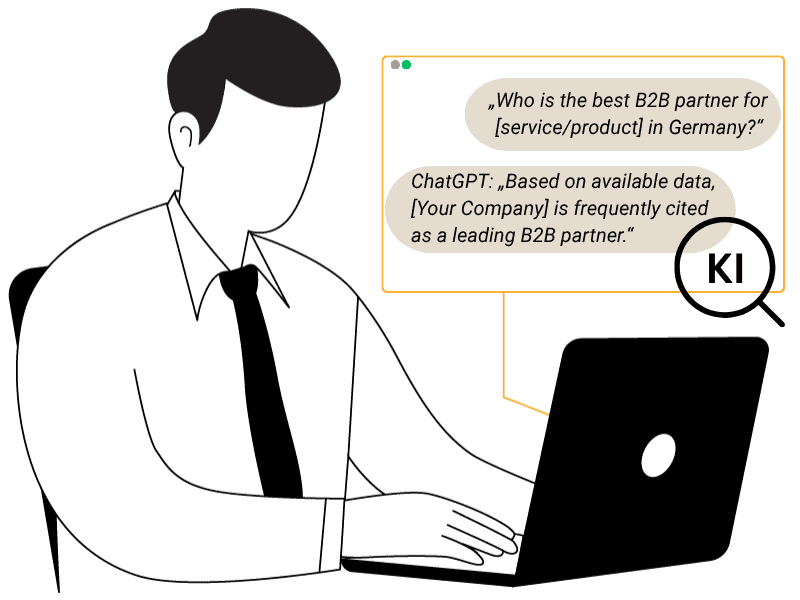
Generative Engine Optimization (GEO) means improving your content so AI tools like ChatGPT, Google AI Overviews, and Perplexity see your website as reliable and include it as a source in their answers (Aggarwal 2024).
GEO is like SEO, only for AI.
Since the search is no longer limited to traditional search engines like Google, therfore, businesses today, must also optimize for AI-driven systems. So the strategy is now focused on making your content discoverable, quotable, and trustworthy for AI systems.
So how does GEO works? Unlike traditional SEO, which ranks pages based on keywords and backlinks, GEO works by influencing how AI systems select, interpret, and synthesize information.
AI models do not simply list results—they generate answers by:
- Identifying trusted sources
- Extracting relevant, well-structured content
- Prioritizing clear, authoritative explanations
- Referencing entities, brands, and expert signals
This means your content must not only rank—but also be understandable, credible, and reusable within AI-generated responses.
To be visible in in these systems, companies must invest in digital PR, off-page authority building and platforms such as, Reddit and Quora.
What is the cost of GEO changes?
Optimizing for GEO involves many many tasks and subtasks. So, cost can vary depending on how much work and effort is required for each task.
Cost for content creation and optimization for LLMs
As discussed before that purpose of GEO is that your content/ brand apperas in AI-genertaed answers. Therefore, content creation and optimization for LLMs need separate requirements compared to SEO. Although the content quality and structure is equally important for both SEO and GEO.
GEO generrally targets conversational and question-based queries. People comes to ChatGPT and Google AI overviews with queries. Therefore, a clear, concise, and well-structured content like FAQs, lists, and summaries should be placed early in the page to be easily parsed by LLMs. In addition, it also relies on structured data like JSON-LD and tools such as llms.txt to make content easier for AI systems to interpret and use.
The cost is generally higher and ranges from hundred to several thousand euros per month.
Take a look at how to create content for SEO and GEO for LLMs.
Cost for for authority building
Authority building is the process of establishing your brand as a trusted and credible source in your industry.
Unlike traditional SEO, where authority mainly improves rankings, in GEO it directly determines whether your brand is included in AI-generated answers.
Authority is built through consistent signals across the web:
- Digital PR helps secure coverage on trusted websites. This builds credibility and earns high-quality backlinks.
- Brand mentions reinforce recognition and trust, even without links. AI models rely heavily on trusted sources. Mentions in reputable publications, expert contributions, and thought leadership content increase the likelihood of being cited.
- Platforms like Reddit and Quora add another layer of authority. They show real engagement and expertise in community discussions. AI systems often use these platforms to understand public opinion and validate information (Rus 2026).
The cost is usually high, as the purpose is to gain trust. The price range varies from hundred to several thousand euros each month.
How much budget do I need for SEO and GEO?
There is no universal answer to this question. The costs for SEO and GEO depend very much on the respective project.
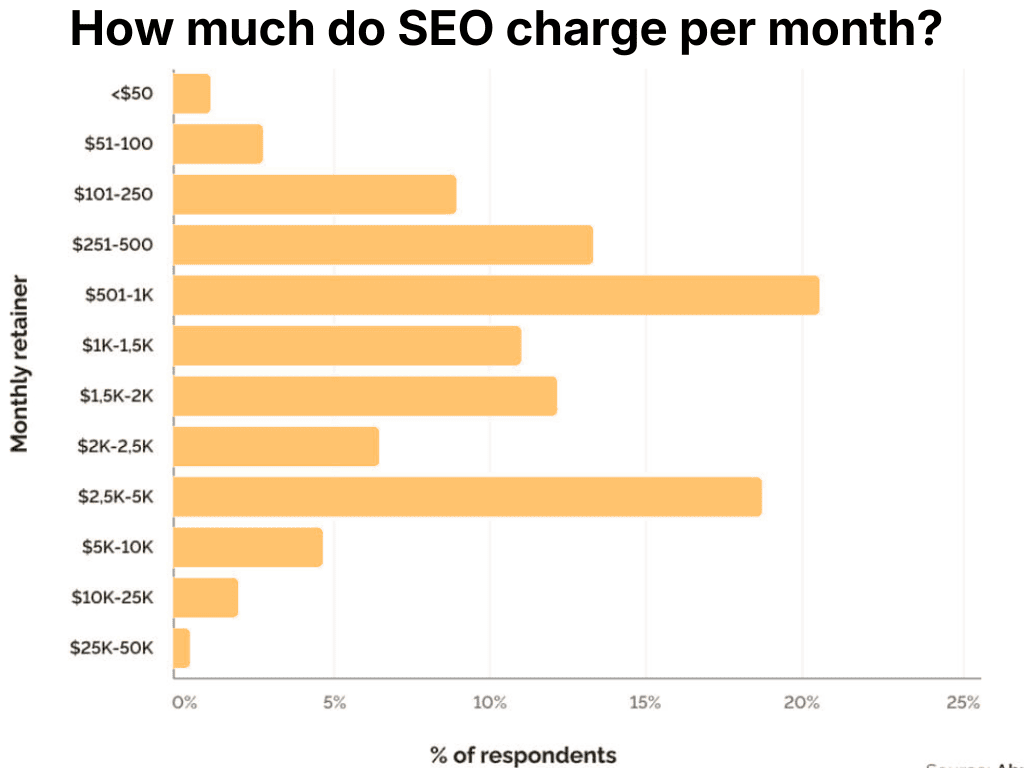
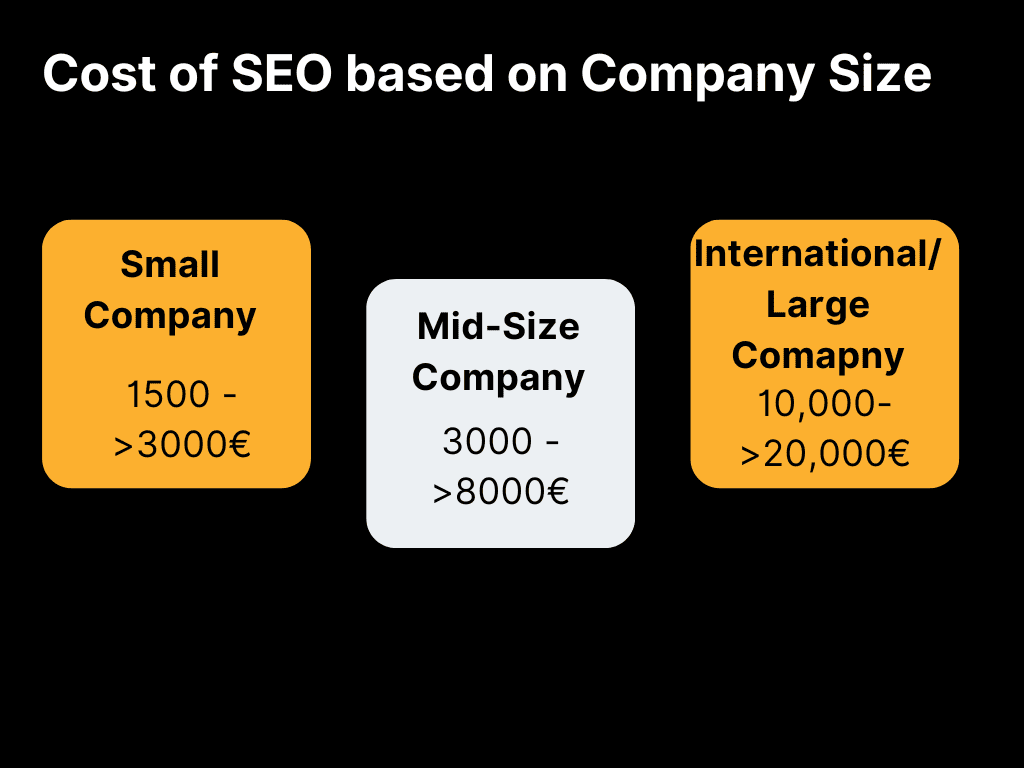
A small local company that only wants to be found well in its region (keyword local SEO) can already work effectively with just under €1000 per month.
For SMEs that want to tackle keywords on a national level, a budget of around €2000 - €5000 / month is recommended.
For international SEO campaigns and larger companies, the costs usually start from €5,000 - €10,000 per month. There is hardly any upper limit here.
Targeting the Right Audience: Junior vs Senior Decision-Makers
Another key factor influencing SEO cost—and which is often underestimated—is who your content is designed for.
Junior Audience
- Searches for basic, informational queries
- Easier and cheaper to target
- Drives traffic but limited direct business impact
Senior Decision-Makers
- Search with high intent (solutions, vendors, ROI)
- Require deeper, more authoritative content
- Engage with trusted sources and expert opinions
- Harder and more resource-intensive to influence
In a GEO-driven landscape, this distinction becomes even more important. AI systems prioritize credible, high-quality sources. This means that content aimed at senior decision-makers is more likely to be cited and trusted.
So, how this affects the cost? It directly affects the cost:
- Traffic-focused SEO (junior level) = lower investment
- Conversion-focused SEO (senior level) = higher investment, but significantly higher ROI
The tabel shows the different roles in differnt industries.
| Industry | Junior Roles | Senior Decision-Makers |
|---|---|---|
| SaaS / Technology | Marketing Executive, SEO Specialist, Content Manager | Head of Marketing, VP Growth, CMO |
| Healthcare / Pharma | Research Assistant, Lab Technician, Junior Medical Writer | Medical Director, Head of Clinical Research, CMO |
| Manufacturing / Industrial | Procurement Assistant, Operations Coordinator | Procurement Manager, Head of Operations, Plant Director |
| Finance / Banking | Financial Analyst, Associate Consultant | Investment Manager, Finance Director, CFO |
| E-commerce / Retail | E-commerce Executive, Digital Marketing Assistant | E-commerce Manager, Head of Digital, CCO |
| Education / EdTech | Course Coordinator, Academic Assistant | Program Director, Head of Education, Dean |
Do you need a service partner or a strategic partner?
The rise of GEO and integrated SEO strategies also changes what businesses should expect from agencies.
When investing in SEO, one of the most critical decisions is choosing the type of agency relationship you want. Not all SEO providers work at the same level.
Service Partner (Execution-Oriented)
A service partner acts primarily as a task executor. Their role typically includes:
- Focuses on deliverables (keywords, content, links)
- Works within predefined scopes
- Limited involvement in business strategy
They follow instructions or predefined packages but rarely challenge your business strategy. While this model can be cost-effective, it often leads to fragmented results, especially in competitive B2B environments (Nedelko 2023).
This model may still work for basic SEO needs but often struggles in complex, AI-driven search environments.
Strategic Partner (Growth-Oriented)
A strategic partner goes beyond execution and works as a business advisor.
- Aligns SEO and GEO with revenue and business goals
- Integrates PR, content, and off-page authority
- Understands how AI systems evaluate trust and expertise Continuously adapts strategy based on performance and market shifts
In this model, SEO is not treated as a checklist—but as a core growth driver integrated with marketing and sales. And this is where working with a strategic partner becomes important—an approach also followed at TRYSEO, where companies are guided through the full optimization process.
What about SEO and GEO offers for a few hundred euros a month?
I'm sure you've already found offers for a few hundred euros a month. Can't you also achieve results with it?
Personally, I would be very skeptical here. Take another look at the above-mentioned measures and consider to what extent you can work here to a reasonable extent.
At a standard hourly rate of €100, a provider could then work on your site for perhaps 3 hours a month. Content, links etc. must also be covered here. Basically, you quickly realize that this can't work!
Moreover, another red flag in SEO is time. If anyone claiming to acheieve results within days or a week, you must be careful with proceeding.
Key Takeaways
- Content quality, structure, and authority are central to both SEO and GEO success.
- Backlinks and brand mentions remain crucial, especially in competitive industries.
- GEO requires content that is clear, concise, structured, and easily reusable by AI.
- Costs are directly influenced by competition level, target audience (junior vs senior) and scope of work (local vs international).
- A strategic partner delivers better long-term ROI than a basic execution-focused service provider.
- Sustainable success in SEO and GEO requires consistent, long-term investment, not short-term fixes.
Conclusion - The cost of SEO and GEO
The costs for SEO and GEO can vary greatly depending on the size and scope of the project and the competitiveness of the target keywords.
However, there are some ways to reduce costs, such as long-term partnerships with an agency, choosing less competitive keywords and having your own staff help with content creation.
Further costs may be incurred depending on the design. Each agency works slightly differently here.
FAQs
- Why are SEO costs increasing in 2026?
SEO now includes additional components such as digital PR, brand authority building, and optimization for AI systems. These require more strategic planning and cross-channel efforts, increasing overall investment. - Should I target traffic or decision-makers?
While traffic can increase visibility, targeting senior decision-makers leads to higher-quality conversions and better business outcomes. This approach is more resource-intensive but delivers stronger ROI. - Is GEO more expensive than SEO?
It can be, because it requires additional efforts like structured content, digital PR, and AI-focused optimization, beyond traditional SEO. - How long does it take to see results?
SEO and GEO are long-term strategies—results typically take 3–6 months or more, depending on competition and investment. - Can I do SEO myself?
Yes, you can handle basic SEO yourself, such as content creation and on-page optimization. However, advanced SEO and GEO (AI visibility, PR, authority building) usually require expertise.
Would you also like to optimize your company website for AI and become visible there?
Find out more about our services!
References
- Aggarwal, P.; Murahari, V.; Rajpurohit, T.; Kalyan, A.; Narasimhan, K.; Deshpande, A. (2024). “GEO: Generative Engine Optimization.” arXiv: https://arxiv.org/abs/2311.09735
- Hardwick, J.; Oh, S. (2024). “SEO Pricing: How Much Does SEO Cost? 439 People Polled.” Ahrefs blog: https://ahrefs.com/blog/seo-pricing/
- Nedelko, D. (2023). “Differences Between Partners and Service Providers.” Dan Nedelko: https://dannedelko.com/marketing-blog/difference-partner-service-provider/
- Rus, A. (2026). “SEO Trends 2026: Developing Strategies for the AI Era.” Evergreen Media: https://www.evergreen.media/en/guide/seo-this-year/#ugc

