


Updated: November 02, 2026
In a nutshell: GEO explained without the hype
- GEO (Generative Engine Optimization) is the process of getting AI systems like ChatGPT or Google AI Overviews to mention your brand and cite your content as a source.
- According to the Google Search Central guide on generative AI search, GEO remains search engine optimization and doesn't require separate techniques for AI.
- Google rankings carry only limited weight in ChatGPT: According to an Ahrefs analysis from August 2025, only around 8 percent of the sources ChatGPT cites in-text appear in Google's top 10.
- In Germany, according to a Bitkom survey from fall 2025, half of all internet users consult an AI chat at least occasionally instead of a traditional search engine.
- Whether individual GEO techniques have a lasting impact remains unproven. A preprint review of 45 studies from July 2026 finds no stable effect across platforms.
- To see how to implement GEO, check out our guide to GEO optimization.
What is GEO? The Definition
Generative Engine Optimization (GEO) is the work of ensuring that AI systems mention and cite your content. This refers to generative AI systems such as ChatGPT, Google Gemini, or Google's AI Overviews. These systems synthesize their own answers while referencing sources or recommending providers. For businesses, the question "What is GEO?" boils down to a practical issue: How does your brand make it into these answers?
Whether the response appears in a chat interface or within Google Search doesn't change the definition. In both cases, a system selects the sources before generating the response.
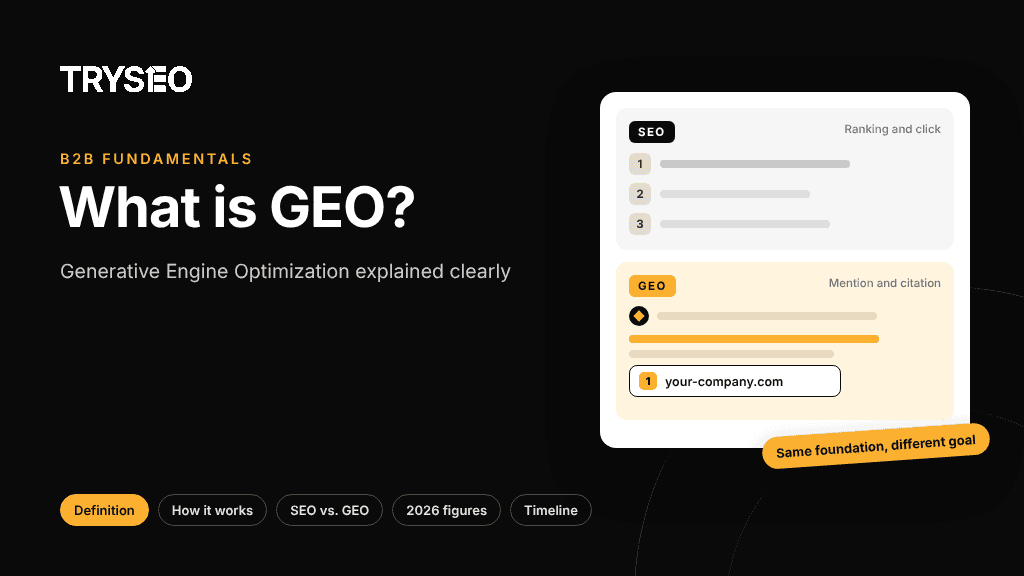
In SEO, what matters is whether someone clicks on your website in search engine results pages. In GEO, what matters is whether an AI mentions your brand in its answer and describes it accurately.
GEO involves two types of visibility. A system can link to your page as a source. But it can also recommend your brand by name without any link at all. Both matter, because many users never leave the generated answer.
For example: A procurement manager asks ChatGPT which manufacturers supply custom hydraulic power units. GEO aims to ensure your brand appears in that answer. Just as crucially, the response needs to accurately reflect your product offering.
What others write about you also feeds into these responses. According to Google, AI features can surface what blogs, videos, and forum discussions say about products and services.
This aligns with a 2025 Ahrefs study of 75,000 brands focused specifically on AI Overviews. In that dataset, brand mentions across the web correlated much more strongly with visibility than backlinks did, showing a correlation of 0.664 compared to 0.218. The study measures correlation, not causation. To learn how to build these signals, read our article on brand signals and AI visibility.
GEO, AEO, LLMO: What Means What?
In practice, these terms mean virtually the same thing. They all describe the effort to gain visibility in answers generated by AI systems. There is no universally recognized distinction (acronyms evolve faster than the underlying technology).
- GEO (Generative Engine Optimization) focuses on generative systems that synthesize answers dynamically.
- AEO (Answer Engine Optimization) centers on answer engines that deliver a direct answer to a query.
- LLMO (Large Language Model Optimization) targets what large language models know about a brand.
- AI SEO serves as a loose umbrella term for search engine optimization focused on AI-driven features.
Google explicitly mentions AEO and GEO in its guide to AI search, categorizing both under SEO. Optimizing for generative AI search, it states, is optimizing for the search experience, "and thus still SEO." Microsoft also uses the terminology, calling the "AI Performance" report in Bing Webmaster Tools an early step toward tools built for GEO.
We therefore use GEO as the overarching term. For your day-to-day work, what ultimately counts is which systems you want to be mentioned in. If you want to dive deeper into the terminology, check out our guide to Answer Engine Optimization as a distinct approach.
How Does GEO Work?
Generative systems synthesize answers from training data, live search, or both. How the underlying Large Language Models operate dictates where GEO intervenes. For training data, what counts is what was publicly known about you before the cutoff date. For live search, what matters is whether your pages can be retrieved the moment the query is run.
With Google's AI features, the response is processed through a retrieval stage. Google calls this Retrieval-Augmented Generation (RAG) and also refers to it as grounding. RAG connects source retrieval with text generation.
Google uses this technology to ensure the quality, accuracy, and timeliness of its answers. The AI leverages its familiar ranking systems to retrieve relevant, up-to-date pages from the search index.
On top of that comes query fan-out. The model independently generates a series of parallel, related search queries to gather more information. The final answer then synthesizes information from multiple sources.
According to the Google blog post on the launch of AI Mode, Google breaks down a query into subtopics and executes multiple searches simultaneously. We describe the journey from source to citation in our article on how visibility in LLM answers is achieved.
Training-based systems
Without web search, AI models only know what was included in their training data up to their knowledge cutoff date. The response is generated from patterns the model learned during training. For GEO, this means: without search, only what was public before the cutoff date matters. Many assistants now supplement this knowledge with real-time web search. Claude, for instance, searches the web when needed and backs up its answers with sources.
Search-based systems
Search-based systems retrieve up-to-date sources from an index to craft their answer and summarize them. Perplexity states that it searches the internet in real time and attributes every answer with citations. Google's AI Overviews and AI Mode access the Google index via the retrieval stage. This is where GEO is closest to traditional SEO: What can't be found can't be cited.
Hybrid systems
Hybrid systems decide on a query-by-query basis whether their parametric model knowledge suffices or a web search is necessary. According to OpenAI, ChatGPT automatically searches the web whenever a query benefits from it, displaying sources as citations.
In Google Gemini with integrated search, the model checks per query whether a search will improve the response. This allows it to answer questions beyond its knowledge cutoff date. The same query can pull entirely different sources depending on the system.
SEO vs. GEO: What's the difference?
SEO targets rankings and clicks, while GEO aims for mentions and citations in AI responses. Traditional SEO measures success through rankings and traffic. GEO requires different metrics, such as the number of citations in AI-generated answers.
Both disciplines work with the same core content. The differences lie in where your content has an impact and how you measure success.
| Aspect | SEO (Search Engine Optimization) | GEO (Generative Engine Optimization) |
|---|---|---|
| Primary Goal | Rankings on the search engine results page (SERP) | Mentions and citations in AI responses |
| Target Systems | Google, Bing, and other search engines | ChatGPT, Gemini, Perplexity, Copilot, AI Overviews, AI Mode |
| User Behavior | Clicking a result, visiting the website | Reading the answer directly, clicking less frequently |
| Metrics | Impressions, clicks, rankings | Mentions, citations, impressions in AI features |
| Foundation | Crawling, indexing, relevance, quality | The same, plus retrieval and query fan-out |
| What ultimately matters | Queries | Queries |
The foundation remains the same. A page not present in Google's index cannot be retrieved by Google's AI as a source. Google does not require a dedicated, separate technical setup just for AI answers.
Just how much the two diverge is highlighted by an Ahrefs study from August 2025. It evaluated whether sources cited by AI assistants for a given query also ranked in Google's top 10. For Perplexity, this was the case 28.6% of the time. For ChatGPT, it was around 8% of in-text citations. For assistants other than Perplexity, more than 80% of citations actually came from pages that didn't rank for the query at all.
Google's own AI aligns much more closely with rankings. In a second Ahrefs study from July 2025 analyzing one million AI Overviews, 76% of cited pages were in the top 10. The two studies use different methodologies, so the figures primarily illustrate the overall trend.
Strong rankings primarily help within Google's own AI features. In ChatGPT and other AI systems, they only account for a small fraction. If you want to be cited there, you need content that qualifies as a reliable source independently of your rankings. To learn how to achieve this, check out our guide on how to make your B2B company visible in ChatGPT.
Will GEO replace SEO?
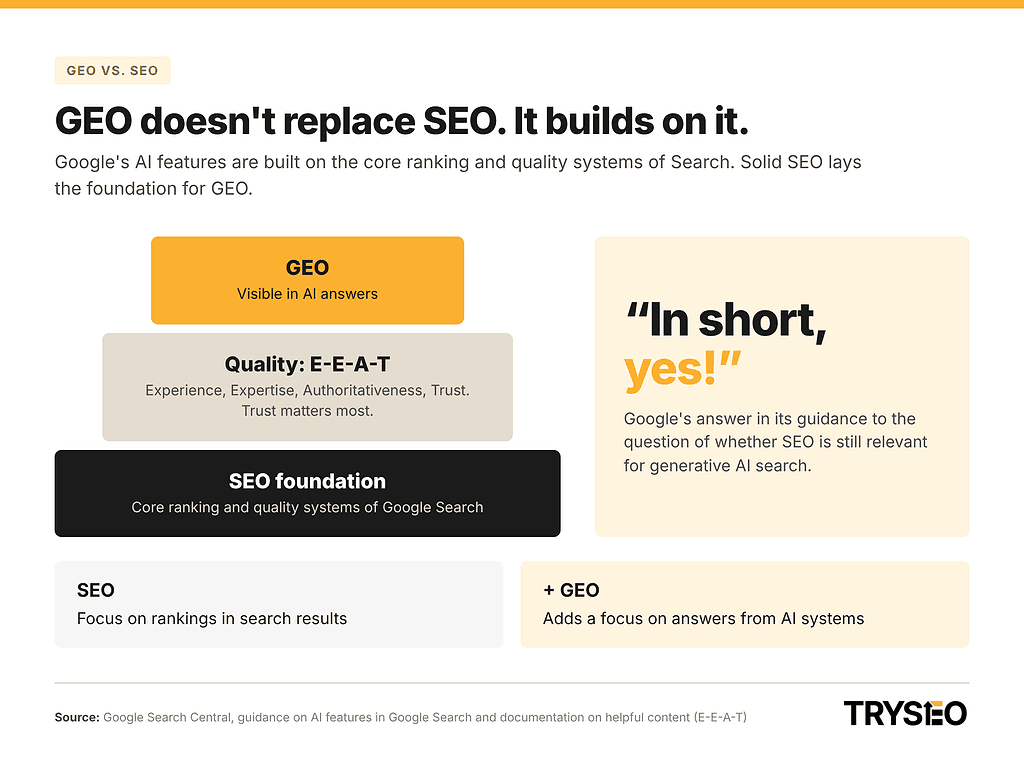
No, GEO complements traditional SEO. The underlying foundation remains unchanged. Google answers the question of whether SEO remains relevant for generative AI search in its guide with "In short, yes!". The rationale: AI features are built directly on top of Google's core ranking and quality systems.
Demand isn't disappearing either—it's simply shifting. In June 2026, US agency Fractl published an analysis of 1,010,848 keywords using Semrush data. Keywords with a measurable decline of more than 15% accounted for 29% of search volume. Growing keywords balanced these losses out. Overall search demand across the dataset remained virtually unchanged.
In February 2024, Gartner predicted that search engine volume would drop by 25% by 2026. In Fractl's dataset, however, search demand remained steady.
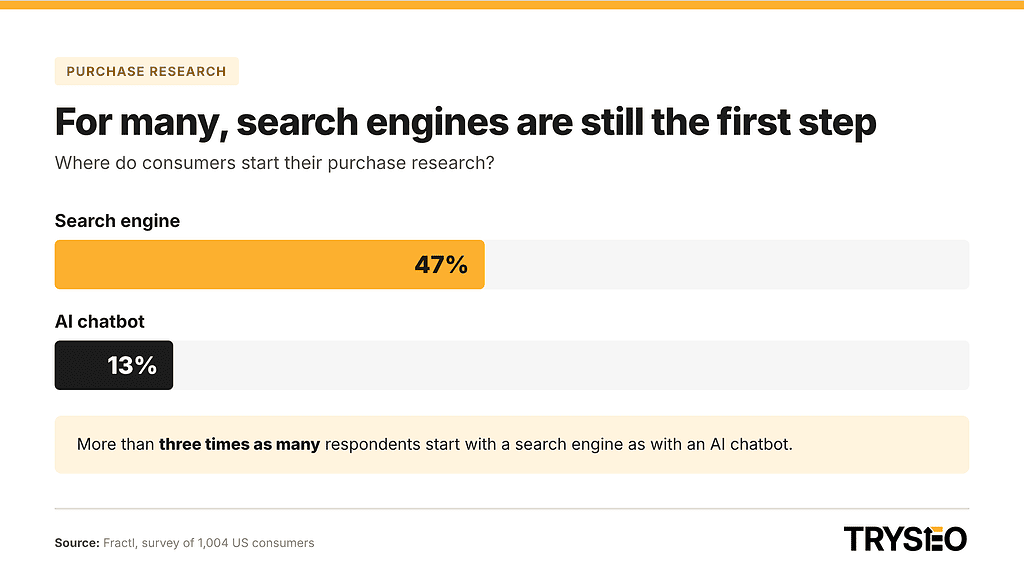
In a Fractl survey of 1,004 US consumers, 47 percent start their product research on a search engine and 13 percent in an AI chatbot. Search engines remain the first step for many. Why SEO continues to carry weight from a marketing perspective is covered in our article on whether SEO is still relevant in AI search.
The rules for quality remain the same as well. Google summarizes Experience, Expertise, Authoritativeness, and Trustworthiness as E-E-A-T, with trust being the most important factor. According to Google, E-E-A-T itself is not a standalone ranking factor.
For AI search, Google recommends content featuring firsthand expertise or experience that goes beyond common knowledge. You can learn how to work on this in our guide on improving E-E-A-T.
For you, this means: doing SEO right lays the groundwork for GEO. GEO expands the focus from rankings to answers.
How widespread is AI search in 2026?
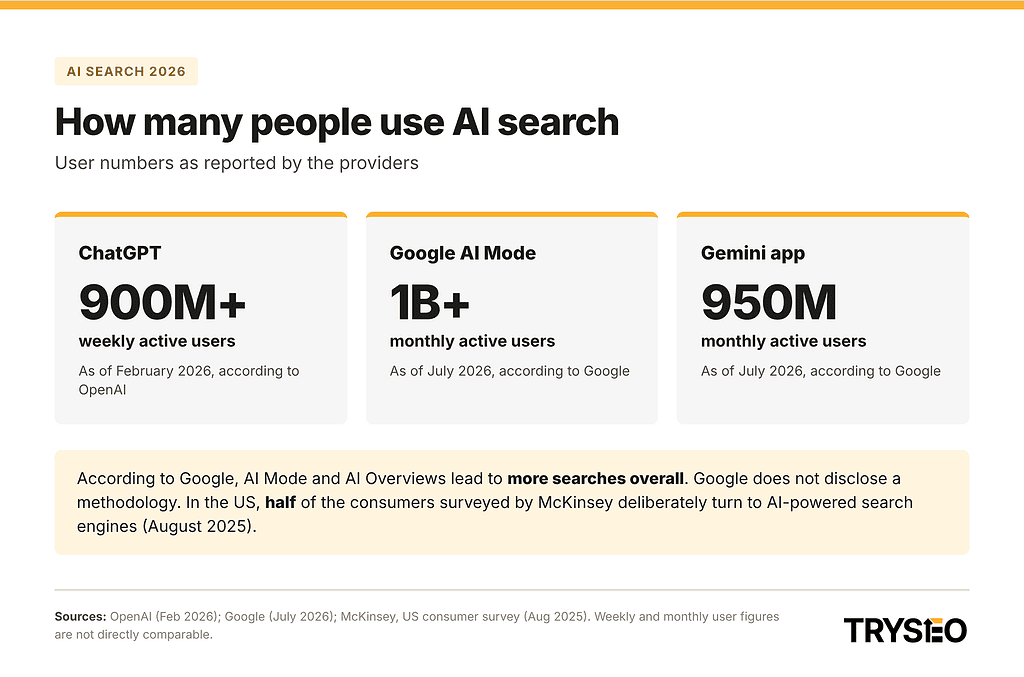
AI search is gaining traction, including in Germany. The major providers are reporting massive user numbers. According to OpenAI, ChatGPT had over 900 million weekly active users in February 2026. In July 2026, Google reported more than one billion monthly active users for AI Mode, and 950 million for the Gemini app.
According to Google, AI Mode and AI Overviews actually drive more search queries overall. Google does not disclose a methodology for this. In the US, according to an August 2025 McKinsey survey, half of surveyed consumers deliberately turn to AI-powered search engines.
Where an AI summary appears, users click less often. Pew Research analyzed browser data from 900 US adults from March 2025. With an AI summary present, they clicked on a traditional result in 8 percent of visits, compared to 15 percent without a summary. At the time, such summaries appeared in 18 percent of all searches.
According to an Ahrefs analysis from February 2026, the click-through rate for position 1 on keywords with an AI Overview is on average 58 percent lower. How you can track this impact on your website is explained in our guide to measuring zero-click searches.
Pew and McKinsey provide US data. For Germany, there are two recent surveys from Bitkom, one from spring 2025 with 1,005 respondents and one from autumn 2025:
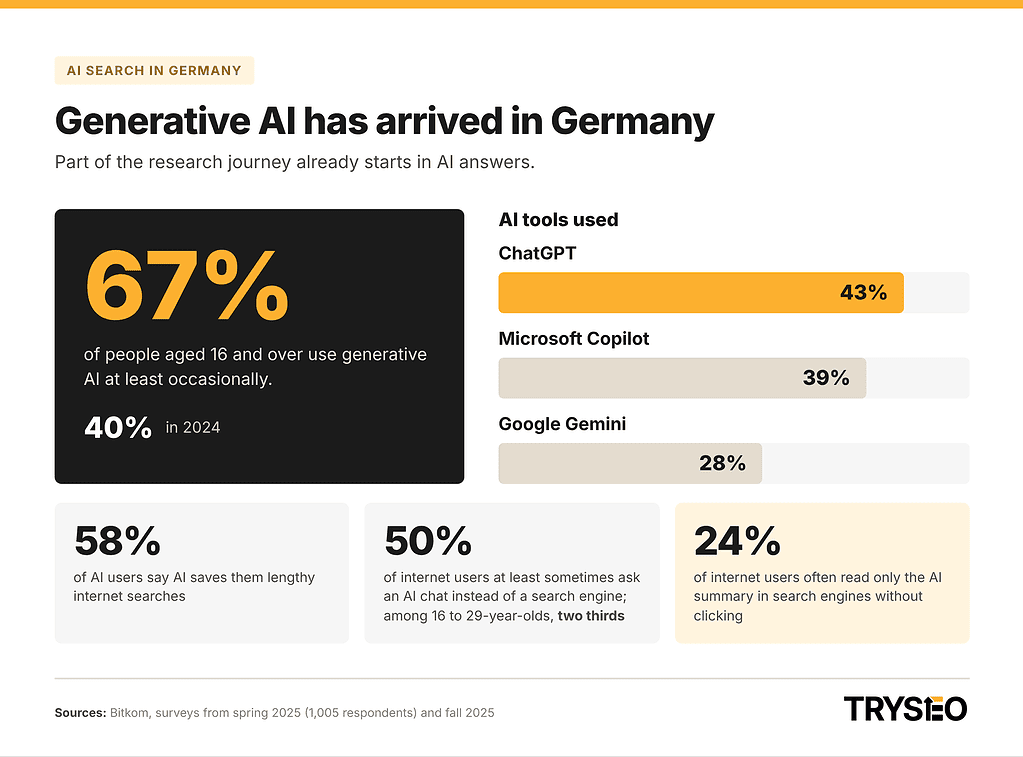
- 67 percent of people aged 16 and over use generative AI at least occasionally, up from 40 percent in 2024.
- ChatGPT is used by 43 percent, Microsoft Copilot by 39 percent, and Google Gemini by 28 percent of respondents.
- 58 percent of AI users say that AI saves them tedious web searches.
- Half of internet users consult an AI chat instead of a search engine at least sometimes; among 16- to 29-year-olds, it is two-thirds.
- 24 percent of internet users frequently only read the AI summary in search engines without clicking on any results.
For your website, this means: a portion of the user journey starts inside AI responses.
GEO from 2023 to 2026
From research paper to Search Console report took just under three years. The key milestones:
| Date | Event |
|---|---|
| November 16, 2023 | The paper “GEO: Generative Engine Optimization” is published on arXiv |
| May 14, 2024 | Google begins rolling out AI Overviews to all users in the US |
| October 31, 2024 | OpenAI launches ChatGPT search for Plus and Team users, and on February 5, 2025 for everyone without login |
| March 26, 2025 | AI Overviews launch in Germany for logged-in users aged 18 and older |
| October 8, 2025 | AI Mode (KI-Modus) launches in Germany, Austria, and Switzerland |
| February 2026 | Microsoft introduces the “AI Performance” report in Bing Webmaster Tools |
| May 15, 2026 | Google publishes its guide on generative AI search, updated on July 10, 2026 |
| June 3, 2026 | Google announces Search Console reports for generative AI search for a subset of websites |
| August 31, 2026 | Search Console reports become available to all websites worldwide |
What changed in 2025/2026
Generative Engine Optimization now has official documentation. Google and Microsoft outline how their AI features select content and how you can track it. What remains open is which tactics are provably effective.
Google takes an official stance
In May 2026, Google published its own guide on optimizing for generative AI search. The core message: optimizing for AI search is still SEO. According to Google, the following are explicitly not required:
- llms.txt files, which Google Search ignores
- breaking content into tiny pieces, known as chunking
- a dedicated writing style tailored exclusively for AI
- structured data or dedicated schema markup
We recommended this for a long time as well. For Google Search, the advice on structured data is outdated. Find out more about llms.txt in our post on the actual value of an llms.txt.
AI Mode launches in Germany
Since October 8, 2025, AI Mode has been available in the DACH region. On Google Germany, it is called KI-Modus. You can access it via the Google homepage, a tab in the search results, and the Google app. With AI Mode, query fan-out has arrived in German Google search.
Search Console displays AI search
Google Search Console now features dedicated reports for generative AI search. Since August 31, 2026, they have been available to all websites worldwide. The reports show impressions, but no clicks.
Microsoft has been testing the "AI Performance" report in Bing Webmaster Tools since February 2026. It shows how often Copilot and AI summaries in Bing cite a website. Find out which other metrics you can use to track GEO make sense in our dedicated article.
Research remains sparse
A review paper on arXiv from July 15, 2026 evaluated 45 studies on GEO published between November 2023 and July 2026. Its conclusion is sobering: None of the examined techniques show a stable, long-term effect across multiple platforms. Even the frequently cited gains from the original foundational paper only hold true under one condition according to the study: The source must already be present within the answer's context.
Important context: The paper is by a single author and is a preprint, meaning it has not yet been peer-reviewed.
The way the paper describes GEO is revealing. It views it as a multi-stage pipeline: First, the system decides whether to search at all, followed by crawling, retrieval, and ultimately citation selection. Many of these stages are completely opaque from the outside. According to the review, two factors have the most reliable impact: relevance to the query and the position of a source within the context window. Commercial measurements also reveal very few shared sources across platforms and massive volatility when the exact same prompt is queried again. Isolated quick fixes therefore yield little value. Anyone serious about GEO tracks it continuously across multiple systems.
In our own test in spring 2026, we published 25 AI-generated YouTube videos addressing typical buyer queries on a brand-new channel with zero subscribers. Following this, our share of voice jumped from 40 to 55 percent on ChatGPT and from 36 to 52 percent on Copilot. In Google AI Overviews, it stayed virtually flat, moving from 38 to 39 percent.
We only tracked the data for about a week and without a control group. The YouTube case study on AI visibility should therefore only be seen as an initial directional indicator.
From theory to execution
This page explains what GEO is. For actionable steps you can take right away, check out our guide on how to implement GEO step by step. There you'll find the building blocks, technical requirements, and a concrete roadmap to get started.
Frequently asked questions about GEO
What does the abbreviation GEO stand for?
GEO stands for Generative Engine Optimization. What it means: It refers to optimizing visibility within AI-generated responses. The acronym has nothing to do with the geographical or geological prefix "geo". It was coined in 2023 by a research paper on generative search engines. The English term is also standard in German-speaking markets.
What is the difference between SEO and GEO?
SEO aims for rankings, GEO for mentions. With SEO, you optimize your positions on the search engine results page (SERP) and traffic generated from clicks. With GEO, you work toward having AI models cite your content. For Google, both are integral parts of search engine optimization.
Will SEO be replaced by GEO in the future?
According to Google, SEO remains essential. AI features in Google Search are built upon the exact same underlying ranking and quality systems. Furthermore, an analysis by Fractl found that overall search demand has remained practically unchanged. GEO therefore complements SEO rather than replacing it.
Is GEO just hype?
Adoption is proven, but evidence of optimization efficacy remains thin. According to Bitkom, half of internet users in Germany use AI chats at least occasionally instead of a traditional search engine. However, a preprint review of 45 studies found no single GEO technique that produces consistent, reliable results across different platforms.
Google itself notes that you do not need a specialized writing style for AI. Reliable sources remain crucial: According to Bitkom, 42 percent of people using AI for search have already encountered false or hallucinated information.
Why is GEO important for B2B?
Because B2B buyers use AI to research vendors. According to a January 2026 Forrester study, 94 percent of B2B buyers leverage AI during the purchasing process. Gartner surveyed 645 B2B buyers in August and September 2025: 45 percent used generative AI during a recent purchase, primarily to evaluate vendors and products.
69 percent still prefer to validate AI-generated findings in direct conversations with sales reps. AI has also firmly arrived in mid-sized enterprises: According to a summer 2025 Bitkom survey, 36 percent of German companies with 20 or more employees actively deploy AI, up from 20 percent in 2024.
For complex products requiring explanation, this means: Whatever your sales engineers know belongs on your website.
How do you measure GEO success?
Through brand mentions and citations in AI responses. GEO requires its own set of dedicated metrics. Google Search Console reports impressions in AI Overviews and AI Mode. Bing Webmaster Tools tracks citations within Copilot.
We track this ourselves using the TRYSEO AI Visibility Tracker. It submits the same prompt set daily to six major AI systems, from ChatGPT to Copilot. In doing so, it tracks how frequently a brand and designated competitors are mentioned or cited as a source. Ultimately, what matters are the qualified inquiries generated. You can find an overview of relevant KPIs for GEO in our dedicated article.
Conclusion: Understand first, then decide
Generative Engine Optimization is demonstrably relevant and a natural evolution of SEO. AI search adoption is measurable, and Google's stance is unequivocal. In contrast, academic research on specific tactical optimizations is still in its infancy.
Keep in mind: What isn't written down cannot be cited by AI.
If you want to know where your company stands, take the GEO-Readiness Test. For implementation, we work as a GEO agency for technical B2B companies. Or contact us directly: We'll check how often AI systems mention you today. Then we'll tell you which step to tackle first.

