


Summary: Traffic channels beyond Google
- The volume of traditional search engines is expected to decline by 25% by 2026, as users increasingly shift to AI answer engines such as ChatGPT, Perplexity, and Claude (Gartner).
- Traffic diversification is now essential risk management. The volatility of algorithms and AI summaries makes single-channel strategies across major search engines fragile and unpredictable. A healthy traffic mix includes various sources such as organic traffic, YouTube, and social media platforms.
- Although AI platforms currently account for less than 1% of total web traffic, these visitors convert about 5 to 23 times better than users from traditional organic search traffic.
- LinkedIn remains the primary ecosystem for discovery. It generates 80% of all leads from social media platforms and serves as a high-quality “training source” for AI models.
- The average B2B buyer now interacts with 13 pieces of content across multiple channels before contacting a sales representative. Strategies focused solely on SEO or organic traffic are therefore outdated (Frisch 2021). Marketers are shifting their primary KPIs from “clicks” to “brand authority” (citations and mentions). Being a cited source in AI answers is the new ranking.
You have built visibility in Google search results over the years, and yet your click numbers are still declining? This is not because your marketing has gotten worse. It is due to changes in how people search.
Decision-makers now ask their questions in AI tools, get informed on LinkedIn, watch YouTube videos, or seek recommendations from communities. Often, they no longer click on classic search results at all. The future therefore belongs to brands that deliberately invest in multiple traffic channels in online marketing.
In this article, I will show you which traffic channels in B2B truly matter right now. You will also receive practical tips to help you implement them.
Why does traditional SEO fall short today?
Traditional SEO is no longer sufficient because search is no longer defined solely by keywords and rankings. For years, Google was the anchor of every traffic strategy, but AI search is fundamentally changing this model.
AI-powered search engines prioritize intent, context, real-time data, and trustworthy sources. Visibility now depends on structured data, authority signals, and content that answers questions directly—not just on pages that rank at the top.
Search engines are increasingly generating zero-click results, which reduces click-through rates to websites. After the introduction of AI search features, CTRs for many keywords fell by around 35% (Law 2025). Only about 1% of articles cited in AI overviews actually receive a click (Chapekis 2025).
This dynamic forces companies to rethink. We are seeing a shift from “Google-first” models to the so-called “Great Diversification” (Linehan 2025). In this environment, Generative Engine Optimization (GEO) expands classic SEO. The goal is to make your brand discoverable where AI, humans, and multi-channel search intersect. Diversification is strategic risk management.

Would you also like to optimize your company website for AI and become visible there?
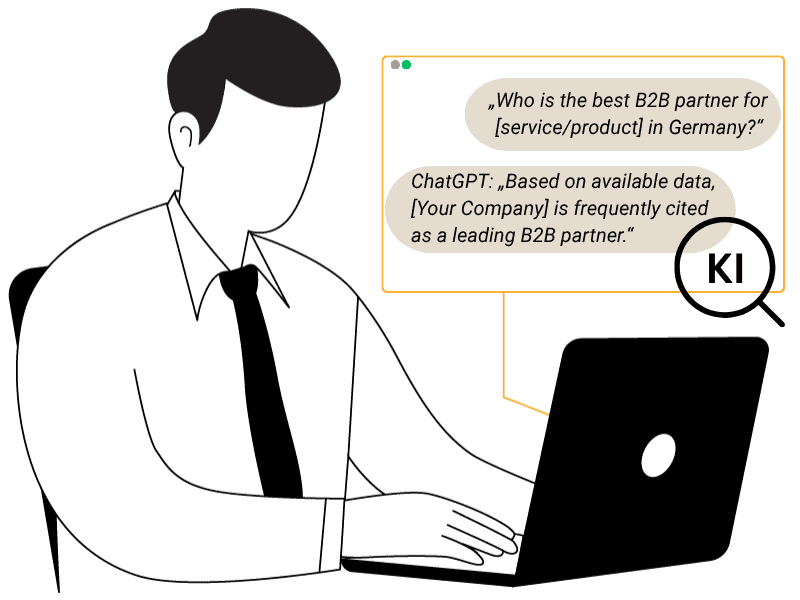
Learn more about our services!
Why is GEO important beyond traditional organic traffic?
GEO (Generative Engine Optimization) is crucial because AI-driven discovery delivers answers, entities, and recommendations—not just lists of links. With GEO measures, you ensure that your brand appears in a structured and trustworthy way when AI engines generate answers and decisions.
| Function | Traditional SEO | Generative Engine Optimization (GEO) |
|---|---|---|
| Primary goal | Ranking in position 1 on the search results pages | Being the “cited source” in AI answers |
| User intent | Keyword-based (e.g., “best CRM”) | Context-based (e.g., “Which CRM fits an agency with 50 employees?”) |
| Success metric | Click-through rate (CTR) | Citations & “share of model” |
| Content format | Long-form, keyword-dense blogs | Factual, structured data & technical FAQs |
| Visibility | List of blue links | Descriptive summaries |
Diversification amplifies the GEO effect by spreading your expertise across multiple surfaces that both AI and buyers value.
Build trust through new traffic channels beyond Google
Given unpredictable algorithms, traffic diversification is vital for long-term growth (Byra 2024). It creates stability, reduces risk, and establishes authority beyond classic content marketing channels.
Relying solely on Google—whether organically or via Google Ads—is no longer a sustainable strategy in an AI-driven world. Five trends are forcing brands to act:
- AI-driven search reduces organic clicks: Platforms such as ChatGPT, Bing AI, and Perplexity often deliver answers directly in the interface and bypass websites entirely (Khromova 2025).
- Algorithm volatility: Frequent Google updates can dramatically change search rankings overnight and put single-channel strategies at risk.
- Customer journey complexity: Modern buyers research across multiple touchpoints—LinkedIn, communities, industry publications, and email marketing—before they even perform a Google search.
- Resilience and control: Direct traffic, newsletters, and community engagement give brands control over their audience and reduce dependence on third-party platforms.
- Competitive advantage: Timely use of multiple traffic channels positions your brand as a trusted authority across several areas. It reaches buyers your competitors may overlook and helps generate leads efficiently.
In short: Activating additional traffic channels beyond Google ensures you remain visible, prove your authority, and retain control over your growth—regardless of changes in the search engine or search behavior.

How can LinkedIn increase reach beyond Google traffic?
LinkedIn now functions as the central professional search engine for decision-makers in the US, the UK, and the EU. The platform offers opportunities that go far beyond classic search engine marketing.
Targeted targeting for maximum decision-maker relevance
LinkedIn increases your reach by allowing you to target professionals based on verified identities. This includes criteria such as job title, industry, and company size. This enables you to reach the relevant decision-makers precisely—even if they are not actively looking for a solution at the moment.
Unlike Google’s intent-based model (pull marketing), LinkedIn enables proactive demand generation. With relationship-building tools such as InMail, you actively build relationships. Thought leadership content drives high-quality leads, which is especially critical in B2B environments with long sales cycles.
Why is LinkedIn indispensable for your B2B online marketing strategy?
- Precise targeting: Reach marketers and decision-makers directly by role, company size, and industry.
- High effectiveness: 84% of B2B marketers rate LinkedIn as their most effective organic channel for lead generation (Foster 2025).
- Diverse formats: LinkedIn articles, newsletters, and event promotions increase engagement without relying on search engine traffic.
How can you optimize LinkedIn for more traffic?
Publish structured, high-authority content. Highlight your expertise in a way that both potential buyers and AI-powered systems (such as Perplexity or Google Gemini) trust your content.
Your implementation checklist:
- Publish authority-driven POV (point of view) content with exclusive insights.
- Create save-worthy learning carousels and frameworks.
- Use LinkedIn articles to answer one specific customer question in depth per post.
- Start a newsletter for consistent, direct reach within your network.
- Optimize personal profiles and your company page for clear expertise.
Best practice: Align your content strategy precisely with the professional audience on LinkedIn. The optimal mix combines strategic thought leadership with solid product insights.

YouTube – an increasingly popular traffic source
YouTube has long since evolved beyond an entertainment platform. For many B2B decision-makers, it is the first port of call when it comes to engaging with complex topics. Studies by Google revealed that around 70% of B2B decision-makers watched videos on YouTube during the decision-making process.
This result is understandable—who would rather read a dry white paper when they can watch an easy-to-understand video instead? If you do not use this traffic channel, you will not appear in these companies’ decision-making process either.
What benefits do SMEs gain from YouTube as a traffic channel?
YouTube is considered the world’s second-largest search engine and belongs to Google. This increases the visibility of your content both on YouTube and on Google.
In a B2B context, videos are particularly effective because:
- complex topics are easier to understand visually.
- trust is built faster when people speak.
- long decision cycles require recurring touchpoints.
- product demos provide real insights.
- YouTube videos deliver evergreen traffic.
Another plus? Many SMEs underestimate the impact of YouTube videos, allowing you to secure a competitive advantage in the mid-market and position yourself as an expert. This, in turn, has a positive effect on visibility in AI giants.
YouTube as a strategic traffic lever
With YouTube, you have an effective lever to increase your visibility, because the platform helps you generate traffic in three ways:
- Search traffic within YouTube: B2B decision-makers actively search for solutions.
- Google integration: The videos also appear in organic search results.
- Recommendation algorithm: YouTube suggests relevant content to new audiences.
YouTube is particularly suitable for traffic diversification because it also works well in combination with other traffic channels. For example, embed the video in a blog post or edit shorter clips for LinkedIn.
What content performs particularly well on YouTube?
In the B2B segment, YouTube content that solves specific problems, explains complex topics clearly, supports decision-making, or provides real insights performs particularly well.
Depending on your goal, you can use one of these formats, among others:
| Format | Goal | Traffic impact | Examples |
|---|---|---|---|
| How-to videos | Solve specific problems | High search intent | Choosing CRM systems: step-by-step guideHow to calculate the ROI of your marketing campaigns |
| Explainer videos (basics) | Build topic understanding | Increase visibility | CRM explained simply: definition and how it worksWhat is ... ? |
| Deep-dive analyses | Show expertise | Build authority | Explain a strategic frameworkClassify a study and its significance |
| Case studies | Build trust | Closer to conversion | Present measurable resultsShare customer experiences |
| Comparisons | Support the decision phase | Purchase intent | Direct comparison of two systems or productsWho is solution A worth it for? |
| Webinar replays | Thought leadership | Long-term evergreen traffic | RecordingsLive webinars |
| Shorts | Scale reach | Boost the algorithm | 60-second tipsBrief topic overviewContent recycling |
Checklist: How do you optimize content for YouTube to generate more traffic?
- For your titles, consider search intent, spark users’ interest, and avoid clickbait.
- Structure your videos and use chapter markers for better orientation.
- Increase watch time with visualizations, pattern interrupts, and examples.
- Optimize the video description, use keywords, and add internal links.
- Keep the intro short and start with the core problem to reduce drop-off.
- Focus on SEO optimization, tags, and meta descriptions.
Best practice: Link each YouTube video to a thematically matching lead magnet and direct viewers to your website to turn reach into measurable traffic and qualified leads.
Why are trade publications interesting for traffic diversification?
Trade publications are cornerstones of credibility and trust with a highly specific audience. They influence purchasing decisions at a very early stage by shaping opinions long before prospects begin their active search.
Trust hubs as validation signals
Trade media act as trustworthy decision hubs where your potential buyers spend time every day. Content from established industry outlets provides valuable third-party credibility. These signals are more important than ever: modern AI systems prefer such authoritative outlets when selecting sources and cite them first.
What are the benefits of your presence in trade media?
- Early influence: Publications in reputable trade journals build trust and reach buyers before they use a search engine (Goren 2023).
- Peer validation: Active participation in professional communities strengthens your influence and provides the necessary validation from industry peers.
- E-E-A-T & AI relevance: Contributions in vertical outlets send the decisive “trust” signal (the “T” in E-E-A-T). This is the basic prerequisite for AI engines to classify your content as leading and link to it in their answers.
Best practice: Focus on co-creation. Sponsor jointly created articles and engage authentically in discussions. This diversified approach ensures your brand remains present across multiple discovery channels.
Pro tip for CMOs: Use specialized analytics tools to identify relevant keywords and trending topics early. This ensures that both human buyers and AI algorithms find and prioritize your content.
How can direct traffic (website traffic) strengthen brand control?
Direct traffic is the ultimate signal of a strong brand. It proves that users actively search for your company rather than discovering you by chance via intermediaries or search engines. This creates genuine recognition, deep trust, and long-term loyalty—completely independent of unpredictable search algorithms.
Generate direct traffic: email marketing and more give you full control over audience engagement
Direct traffic gives you maximum control over how your target audience interacts with your content. At a time when AI-driven search engines (SGE) are reducing clicks from traditional organic channels, this channel becomes your marketing lifeline.
But what counts as direct traffic?
- Prospects reach your website via a QR code.
- The customer enters the website URL directly.
- The user reaches the website because they saved it as a bookmark.
- Customers use links from PDFs or white papers.
- Customers click the link in an email newsletter.
The strategic benefits of direct traffic
Interactive formats such as email marketing and high-quality newsletters form the core pillars of your modern content marketing. They ensure recurring engagement (Jennings 2025).
Direct traffic means for you:
- Independence from algorithms: You are no longer dependent on the goodwill of Google or social media platforms.
- Ownership of first-party data: You collect valuable user data directly within your own ecosystem.
- Resistance to ranking fluctuations: Your reach remains stable even when third parties change their algorithms or competitors temporarily overtake you.
Best practice: Segment your email lists precisely by different buyer personas. Provide high-quality, exclusive content that offers real value and increases repeat visits. By creating content tailored exactly to the needs of specific customer segments, you maximize engagement and solidify your position as a market leader.
Would you also like to optimize your company website for AI and become visible there?
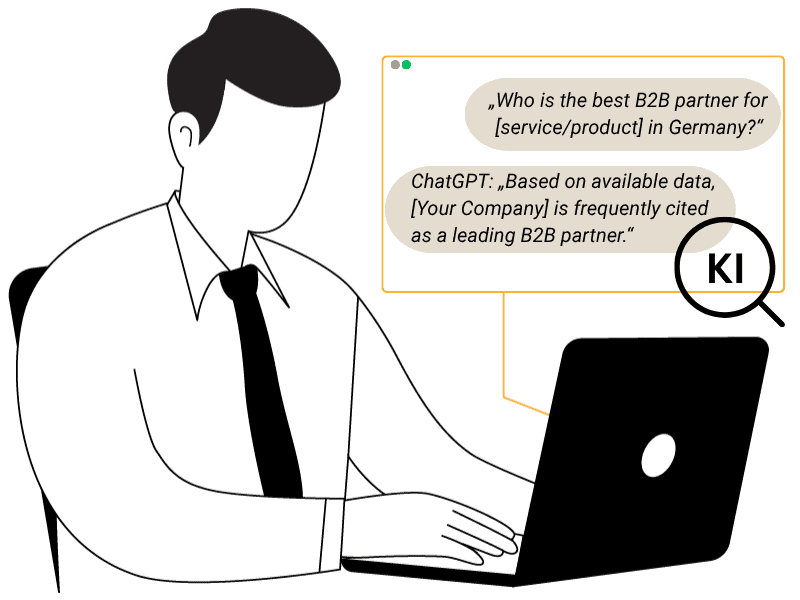
Learn more about our services!
How do communities drive influence and pipeline growth?
Communities build trust through continuous peer-to-peer engagement and the exchange of in-depth expertise. This influence directly impacts your pipeline growth: members evolve from passive observers to active advocates of your brand and ultimately to buyers.
Communities as “living knowledge graphs”
Public forums such as Reddit, niche communities, or private groups on Slack and Discord—these platforms are dynamic knowledge bases. Here, your buyers ask targeted questions every day and solve complex problems.
Use this ecosystem strategically for your goals:
- Answer real expert questions: Position yourself with well-founded answers to complex issues.
- Test topic ideas: Validate new content in the community before publishing it formally.
- Discover trends: Use discussions to identify topics for future GEO-optimized content (Generative Engine Optimization).
- Build authority: Active contributions sustainably strengthen trust within your peer group.
Early influence on the customer journey
Communities enable you to interact directly with potential buyers at a time when classic marketing often has not yet taken effect. This allows you to influence the purchase decision and the pipeline at a very early stage of the customer journey.
Especially important for your digital strategy: communities create a dynamic, semantic context. This is crucial for modern AI systems that synthesize recommendations and generate answers (Zhang 2025).
Best practice: Host regular Q&A sessions, offer technical deep dives, and moderate problem-solving threads. This not only boosts engagement but also actively influences your target audience’s decision-making.
The discovery phase: Why must your company keep a close eye on AI platforms and voice assistants?
Companies must act now: AI platforms and voice assistants increasingly deliver answers and recommendations directly—before a buyer even visits your website. Without a targeted presence in these systems, you risk losing touch with your target audience already in the discovery phase. This massively reduces your influence and your chances of effective demand generation.
Both systems have similarities and differences. AI platforms often provide detailed text-based answers, whereas voice assistants heavily condense and simplify responses. As a technological basis, both now mostly rely on AI systems, although an AI platform often involves more complex processes and multiple sources.
Although the function behind AI platforms is more autonomous than the reactive approach of voice assistants, you can choose a similar strategy for both to increase visibility.
The shift: From searching to being found
AI platforms such as ChatGPT, Perplexity, and Bing AI are rapidly becoming the primary discovery tools for B2B decision-makers. They increasingly skip traditional web search and run AI searches instead. The same applies to voice assistants, which are used somewhat less frequently in B2B.
According to current data (Oldshue 2025), 50% of buyers already begin their vendor research with AI chat tools instead of a classic Google search. This shift in user behavior requires a radical rethink of your marketing strategy. All the more important is that you provide citable content that AI platforms and voice assistants prefer.
GEO and the response to “zero-click” behavior
The increasing “zero-click” behavior—where users receive the answer directly on the results page without clicking a website—makes pure SEO strategies insufficient. Instead, you need a focus on GEO (Generative Engine Optimization):
- Structured data: Prepare your website with precise FAQs, schema markups, and technical specification tables. Only then can large language models (LLMs) capture and evaluate your data without errors.
- Expert verification: Invest in high-quality content verified by experts. AI systems prioritize information that is technically sound and deemed trustworthy.
- Semantic relevance: Optimize your content so it does not just target keywords, but explains complex relationships that AI systems can reliably deliver to users.
Your strategic advantage: When your brand appears as a verified source in the answers of LLMs, you secure a place in decision-makers’ relevant set—before the first click even happens.

Which content strategy do you use to optimize for AI?
- Structure content with clear definitions and logic.
- Use schema markups and FAQs for direct answers.
- Build an entity footprint (authors, linked citations).
- Aim not only to rank, but to appear in AI answers.
Best practice: Produce FAQs, technical tables, and research-backed content optimized for AI-powered search.
Prioritize and activate traffic channels beyond Google
Do you know the saying, “You cannot dance at two weddings at the same time”? With SEO, it is of course a bit different. Traffic diversification is more important than ever today. Nevertheless, you should not start with all channels at once, but gradually build a solid foundation for your success.
By prioritizing, you maximize impact while keeping your focus on project feasibility.
Which traffic channels should you prioritize?
Start with channels that show immediate impact, then add channels that build and strengthen trust over the long term. This creates momentum and increases complexity only gradually.
- LinkedIn: The fastest signal of your authority in the market.
- Direct traffic (email & newsletter): Your “owned audience” – maximum independence.
- Trade publications: External validation by trusted third parties.
- Communities: Long-term building of influence and trust.
- AI platforms: The sustainable layer for your brand’s future discovery.
Channel-to-content mapping: A strategy for different surfaces
What works on LinkedIn may not achieve the desired effect in communities or on YouTube (in some cases)—and vice versa. This does not mean you have to push different topics on each channel, but that you need to adapt the content.
| Channel | Content that works best |
|---|---|
| POV posts, carousels, frameworks | |
| Trade publications | Opinion pieces, benchmarks |
| Direct traffic | Newsletters, playbooks |
| Communities | Tactical answers, teardowns |
| AI platforms | FAQs, tables, definitions |
How can you successfully implement a diversified online marketing strategy?
Many marketing teams fear that five channels mean five times the effort. That is a misconception. Use the content atomization framework to implement traffic diversification in day-to-day work. It increases efficiency without increasing effort.
The more traffic channels you activate, the more the share of invisible influence factors grows in the decision-making process. For a successful diversified strategy, you should therefore also measure the dark funnel.
Scaling through content atomization
Content atomization means creating one strong core piece of content and then repurposing it into multiple smaller formats for different channels. Instead of starting from scratch each time, you use a core asset and turn it into several suitable variants.
- The core: Create a high-quality “asset,” e.g., a research report or a technical white paper.
- The segments: Break this core into 5 LinkedIn carousels, a guest article for a trade magazine, 3 newsletter editions, and a community thread.
- The result: Consistent brand authority across all channels with a single production unit.
Measuring the “dark funnel”
Traffic channels outside Google often suffer from attribution blindness. Much impact happens in private spaces such as Slack or DMs, which makes classic ROI tracking difficult. These invisible influence factors in the buying process are the “dark funnel”—i.e., all touchpoints your analytics tools cannot capture cleanly.
How to bring light into the dark:
- Self-reported attribution: Add a free-text field to your demo forms: “How did you hear about us?” You will be surprised how often users mention “LinkedIn” or “Slack,” while Google Analytics only shows “Direct.”
- Hybrid measurement: Combine classic UTM tracking with share of voice (SoV) metrics within AI engines. Regularly check whether your brand appears as a top entity in AI answers.
Checklist for successfully unlocking traffic channels
Planning to implement traffic diversification in practice? Our checklist will help you:
- Implement a multi-channel strategy that goes far beyond classic SEO.
- Use LinkedIn and trade media for targeted B2B visibility and lead generation.
- Establish direct engagement channels to minimize dependence on search traffic.
- Communities are your lever for trust and peer validation.
- Structured content and precise keywords are now the foundation for AI-driven search.
- Use YouTube strategically for topics that require explanation.
- Rely on content atomization to increase efficiency and keep effort low.
Conclusion: From rankings to brand resilience
AI-powered search, zero-click behavior, and fragmented customer journeys have fundamentally weakened the reliability of classic search engine optimization as the sole growth strategy.
To succeed in this new environment, a shift in thinking is essential: away from pure ranking optimization and toward building discoverability, authority, and presence across all digital touchpoints. GEO (Generative Engine Optimization) makes this shift tangible. It ensures your brand is structured, citable, and trustworthy—wherever buyers and AI systems search for answers.
The most resilient brands no longer depend on a single traffic source. They activate LinkedIn, trade publications, direct traffic, communities, YouTube, and AI platforms as part of a diversified visibility strategy. This approach does not replace SEO; it complements it and reduces dependence on individual platforms.
Diversifying your traffic is therefore not a nice-to-have, but a strategic necessity. Only then can you secure sustainable growth, stability, future-proofing, and relevance in the age of artificial intelligence.
TRYSEO implements exactly this shift. We align content, distribution, and measurement with resilience KPIs instead of clinging to volatile ranking positions. The result? Cross-platform visibility that reinforces itself—completely unaffected by individual algorithm changes.
FAQs: The most common questions about traffic channels beyond Google
Which traffic channels should SMEs use in addition to Google Ads and social media?
In addition to Google Ads and classic social media, SMEs should use newsletters, LinkedIn, YouTube, industry portals, and communities as alternatives. This increases visitor numbers, reaches more customers, and boosts brand awareness.
They place relevant messages in a targeted way, explain their offering clearly, and at the same time promote understanding of their services. This strengthens their market position and helps them earn more money in the long term.
Why is focusing solely on Google traffic risky today?
AI-driven search results and “zero-click” behavior lead to a significant decline in clicks on organic results—even with top-10 rankings. Relying solely on Google traffic therefore makes your business extremely vulnerable to algorithm updates and platform changes. Social ads cannot fully offset this uncertainty either, because you remain dependent on external platforms.
Which traffic channel beyond Google delivers the fastest B2B ROI?
LinkedIn typically delivers the fastest engagement by comparison. The best development and leverage comes from combining thought leadership content, newsletters, and targeted sponsored posts.
How do I measure the actual impact of communities?
Look beyond pure page views. Track engagement rates (posts, replies), referral traffic, and above all the qualitative impact on your sales pipeline through surveys (self-reported attribution).
What content works best for AI platforms?
Focus on structured, authoritative, and easily citable formats. These include technically clean FAQs, tables, definitions, and summaries of current research data.
How do I efficiently build direct traffic?
Use segmented email campaigns, exclusive newsletters, and high-quality gated content. The goal is to anchor your brand as a fixed bookmark in your target audience’s mind and encourage repeat visits.
Do SEO and SEA still play a role in traffic in the AI era?
Yes, SEO and SEA remain important measures in the traffic process when you integrate and expand them strategically within your content ecosystem. You must keep an eye on costs and revenue, avoid typical mistakes, and not ignore the downsides of pure Google dependence.
Would you also like to optimize your company website for AI and become visible there?
Learn more about our services!
References
- Byra, A. (2025). “Organic Traffic Diversification – Why Is It a Must in 2025?” LinkedIn: https://www.linkedin.com/pulse/organic-traffic-diversification-why-must-2025-anna-byra-du%C5%82acz–wqide/
- Chapekis, A.; Lieb, A. (2025). “Google Users Are Less Likely to Click on Links When an AI Summary Appears in the Results.” Pew Research Centre: https://www.pewresearch.org/short-reads/2025/07/22/google-users-are-less-likely-to-click-on-links-when-an-ai-summary-appears-in-the-results/
- Foster, C. (2025). “Why Is LinkedIn the Top B2B Marketing Platform for 2025?” B2B Daily: https://b2bdaily.com/martech/why-is-linkedin-the-top-b2b-marketing-platform-for-2025/
- Frisch, R. (2021). “Why It Should No Longer Take 13 Pieces of Content to Convert a Buyer.” RRO: https://www.marketingprofs.com/articles/2021/46283/why-it-should-no-longer-take-13-pieces-of-content-to-convert-a-buyer
- Gartner (2024). “Gartner Predicts Search Engine Volume Will Drop 25% by 2026, Due to AI Chatbots and Other Virtual Agents.” Gartner: https://www.gartner.com/en/newsroom/press-releases/2024-02-19-gartner-predicts-search-engine-volume-will-drop-25-percent-by-2026-due-to-ai-chatbots-and-other-virtual-agents
- Goren, M. (2023). “Leveraging Trade Publications to Build Online Awareness for Your B2B Brand.” Ten Twenty Marketing: https://10-twenty.ca/2023/03/31/leveraging-trade-publications-to-build-online-awareness-for-your-b2b-brand/
- Jennings, J. (2025). “6 Effective Re-Engagement Emails to Get Your Customers Back.” HubSpot: https://blog.hubspot.com/marketing/10-examples-of-effective-re-engagement-emails
- Khromova, Y. (2025). “ChatGPT vs Perplexity vs Google vs Bing: Which AI Search Engine Generates the Best Answers?” SE Ranking: https://seranking.com/blog/chatgpt-vs-perplexity-vs-google-vs-bing-comparison-research/
- Law, R.; Guan, X. (2025). “AI Overviews Reduce Clicks by 34.5%.” ahrefs blog: https://ahrefs.com/blog/ai-overviews-reduce-clicks/
- Linehan, L. (2025). "The Great Diversification: How 8 Companies Are Evolving Their SEO Strategies." ahrefs blog: https://ahrefs.com/blog/the-great-diversification/
- Oldshue, H. (2025). "90% of B2B Buyers Now Use ChatGPT for Purchasing Research: Complete 2025 Study." Superprompt: https://superprompt.com/blog/90-percent-b2b-buyers-use-chatgpt-purchasing-research-2025-study
- Zhang, Y.; Wang, X.; Hu, J.; Pan, Z.; Peng, Z.; Ma, X. (2025). "Designing AI-Infused Interactive Systems for Online Communities: A Systematic Literature Review." arXiv: https://arxiv.org/abs/2509.23309
- Google; Millward Brown Digital. (2014). "The Changing Face of B2B Marketing." Think with Google: https://www.thinkwithgoogle.com/_qs/documents/938/the-changing-face-b2b-marketing.pdf
