
Summary: Redefining Off-Page SEO for AI Search
- Off-page optimization improves authority and trust through activities outside your website.
- Strong off-page SEO increases rankings, referral traffic, brand credibility, and AI visibility.
- Modern strategies focus on backlinks, entity authority, digital PR, reviews, and community engagement.
- AI-driven search engines evaluate third-party trust signals and brand consistency across the web.
- Successful off-page SEO combines traditional SEO practices with Generative Engine Optimization (GEO).
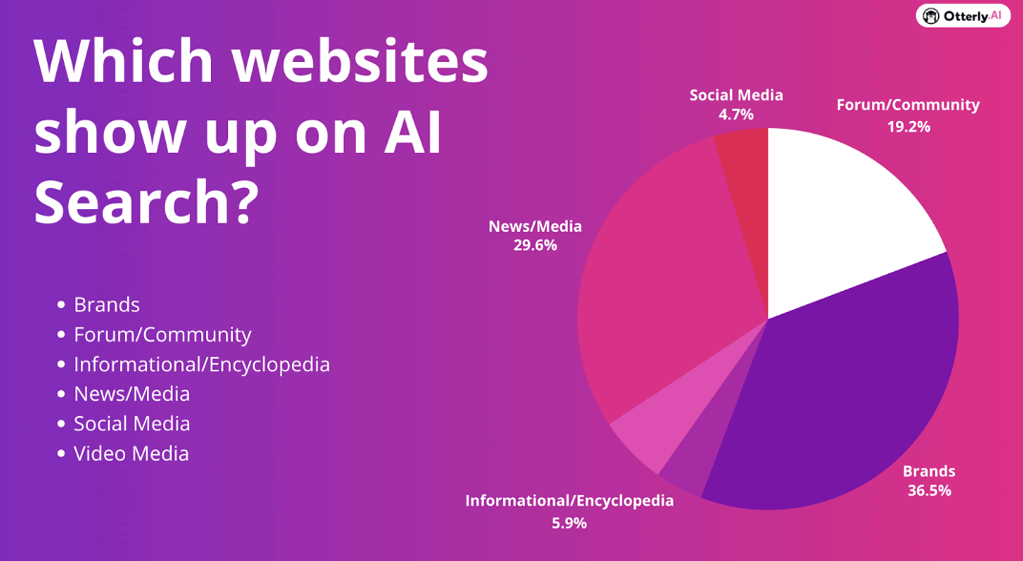
- Community-driven platforms now strongly influence AI visibility. Platforms like Reddit and Quora account for over 50% of citations across AI search systems.
“Today’s AI-search engines are answering machines rather than search engines. We have to take that into account in
our optimization strategies for LLMs and GenAI” Klaus-M. Schremser, co-founder Otterly.AI
This change is also redefining off-page optimization strategies.
Consumers are now using ChatGPT, Gemini, Copilot, and Perplexity. Even in Google, we have AI Overviews or AI Mode. People are also scrolling social media platforms such as TikTok, YouTube, Reddit, LinkedIn, and Instagram.
So, if your brand/product is not visible across these platforms,it may become invisible to potential buyers.
Off-page SEO is therefore no longer only about earning backlinks. It is about building authority and trust.
AI systems evaluate brand mentions, reviews, citations, community discussions, and third-party trust signals to decide which brands deserve to appear in generated answers.
In this guide, we’ll highlight the off-page SEO tactics. You will also get to know the practices you can adopt to strengthen visibility in both traditional search results and AI responses.
What is Off-Page Optimization?
Off-page optimization is a part of Search Engine Optimization (SEO) and is also called off-site SEO. It focuses on improving a website's ranking and authority through activities outside your own website.
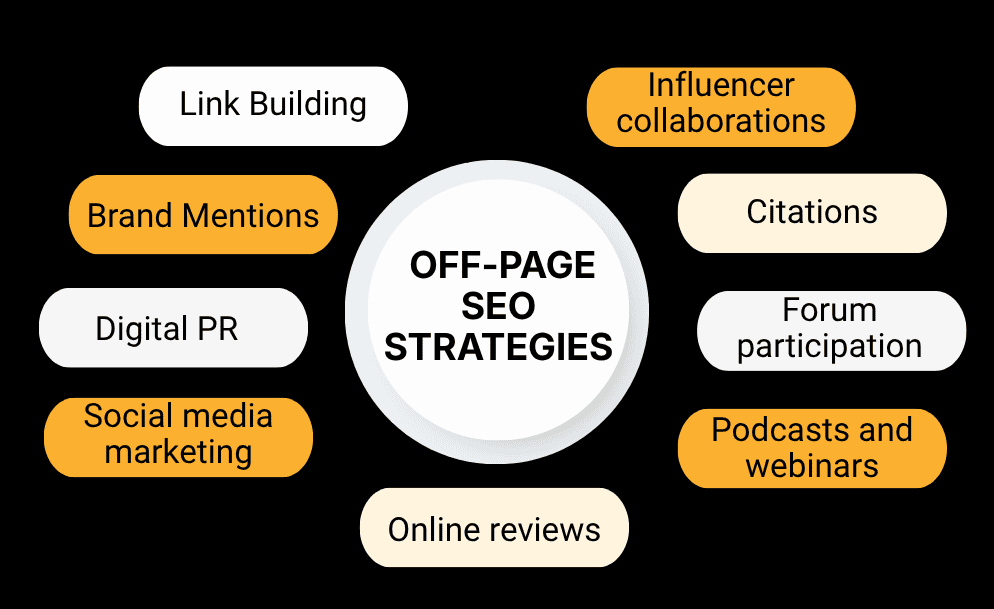
Common off-page SEO strategies include citations, link-building, brand mentions and use of social media platforms to build authority and credibility. This increases your chance to rank on search engine result pages (SERPs) and AI responses.
Common off-page SEO strategies include:
- Link building
- Brand mentions
- Citations
- Digital PR
- Social media marketing
- Online reviews
- Influencer collaborations
- Forum participation
- Podcast and webinar appearances
These activities help search engines understand that your brand is trusted, relevant, and authoritative within your industry.
Modern off-page optimization supports visibility beyond standard rankings. Users increasingly rely on platforms like ChatGPT, Google Gemini, and Perplexity, brands need strong external authority signals to appear in AI esponses.
Would you also like to optimize your company website for AI and become visible there?

Find out more about our services!
Off-Page Optimization and Answer Optimization
Users receive direct answers from AI Overviews, ChatGPT, Perplexity, and Gemini. This makes answer optimization a critical part of off-page SEO.
AI systems do not simply crawl pages. They analyze entities, evaluate credibility, and summarize information from sources they trust. That means your brand’s visibility depends heavily on external trust signals.
Off-page optimization supports answer optimization by helping AI systems understand:
- What your brand represents?
- What topics you specialize in?
- Whether trusted sources mention your company
- How consistently your expertise appears online?
For example, if your company is regularly mentioned in industry publications, Reddit discussions, and podcasts, AI systems are more likely to associate your brand with expertise in that subject area.
This is why modern SEO strategies increasingly focus on:
- Brand mentions instead of only backlinks
- Entity association
- Community engagement
- Original research
- Expert-led content
- Digital PR
The brands most visible in AI-generated search experiences are usually the brands with the strongest authority across the web.
Why is Off-page Optimization Important for SEO?
Off-page optimization helps search engines evaluate whether your website deserves visibility.
Search engines use off-page signals as trust indicators. Every quality mention, citation, review, or inbound link acts like a recommendation for your brand.
Without strong off-page SEO, even well-optimized websites struggle to compete in highly competitive industries.
Off-page optimization improves:
- Domain authority
- Organic rankings
- Brand credibility
- Referral traffic
- Search visibility
- AI-generated visibility
- EEAT
According to Backlinko’s Google ranking factors study, pages ranking in the top positions on Google tend to have significantly more high-quality referring domains than lower-ranking pages (Dean 2025).
Google increasingly prioritizes EEAT and off-page SEO directly supports these signals.
For example:
- A mention in a respected industry publication strengthens authority.
- Positive reviews improve trust signals.
- Expert interviews and podcasts strengthen expertise perception.
- Active participation in relevant communities improves topical relevance.
Modern off-page SEO also affects how AI systems understand your brand.
AI-driven search engines evaluate:
- Brand consistency
- Third-party validation
- Semantic relationships
- Contextual mentions
- Public sentiment
What is the Difference Between Off-Page and On-Page Optimization?
Off-page SEO and on-page SEO work together, but they focus on different areas of optimization.
| Factor | On-Page SEO | Off-Page SEO |
|---|---|---|
| Definition | Optimizations done on your website | External authority-building activities |
| Main Goal | Improve relevance and content clarity | Build trust, authority, and reputation |
| Control | Fully controlled | Partially controlled |
| Key Activities | Keywords, content, internal links, UX | Links, PR, mentions, social, reviews |
| AI Impact | Helps understanding of content | Helps trust and citation decisions |
What are the Key Components of Off-page SEO?
Modern off-page SEO includes several interconnected components that help strengthen visibility and credibility across platforms.
Here are some important components of off-page SEO that work best for both search engines and AI systems.
Link Building
Link building remains one of the strongest ranking signals in SEO.
However, modern link building focuses on:
- Relevance
- Editorial quality
- Context Authority
- Natural acquisition
A few high-quality links from trusted industry websites are far more valuable than hundreds of low-quality links.
Ahrefs research shows that over 90% of pages receive no organic traffic from Google, often because they lack strong backlinks (Soulo 2023). However, Peham (2025) discusses that ChaGPT does not rely on backlinks, but earning relevant and quality links increases the chances of your content appearing in AI responses.
Search engines now evaluate semantic relationships between linked entities rather than simply counting backlinks. Therefore, a few quality links can do the work.
Brand Mentions
Brand mentions are references to your business, products, services, or executives across the web, even when they do not include a direct hyperlink to your website.
There are three types of brand mentions: linked, unlinked, and AI mentions. Linked mentions include a link to a website, unlinked is without a link, and AI mention is apperance of your brand in an AI response.
Brand mentions help search engines and AI systems understand your authority. Even unlinked mentions can improve visibility because search engines recognize them as implied trust signals.
Brand mentions can appear in:
- news articles
- blog posts
- podcasts
- Reddit discussions
- industry forums
- reviews
- social media conversations
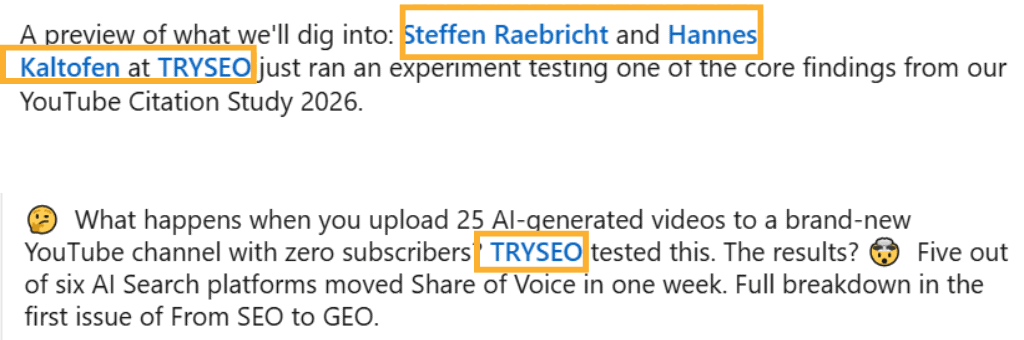
For instance, this is the brand mention of TRYSEO that appeared on LinkedIn posts.
Consistent mentions across authoritative websites strengthen:
- Entity recognition
- Topical relevance
- Industry authority
Google’s Search Quality Guidelines show that search engines can track brand mentions, understand whether they are positive or negative, and use them as ranking signals.
When a brand or website is regularly mentioned alongside certain topics or keywords, search engines recognize these connections. This helps them understand your expertise in those topics.
You can read about how to monitor brand mentions in ChatGPT in a guide by Linehan.
Content Marketing
Content marketing is the approach to attract the desired audience through relevant and high-quality content.
High-quality content supports off-page SEO when it earns shares, mentions, and citations.
Effective off-page content strategies include:
- Guest articles
- Research reports
- Expert commentary
- Data-driven studies
- Infographics
- Video marketing
According to a 2025 report by Content Marketing Institute, more than 70% marketers said that content marketing helped in generating leads by reducing customer support costs (Rose 2025). AI systems also prioritize original insights and unique data.
Read the case study on how TRYSEO drives massive organic traffic through high-quality content.
Social Media Marketing
Social media marketing involves the use of social platforms like Instagram, TikTok, Facebook, and LinkedIn to build brand awareness and engage communities to drive sales.
Social media helps distribute content and amplify visibility. While social signals are not direct ranking factors, strong engagement increases:
- Brand exposure
- Content reach
- Referral traffic
- Link opportunities
Platforms like LinkedIn, Reddit, TikTok, and YouTube also influence how AI systems understand brand popularity and expertise. Content on social media, including your business profiles, audience engagement, and user-generated content (UGC) acts as a strong trust and authority signal.
UGC is especially valuable because it reflects real customer experiences rather than direct brand messaging. Search engines and AI systems increasingly analyze these interactions to evaluate:
- brand credibility
- audience trust
- engagement quality
- market relevance
For example:
- Consistent discussions about your brand on Reddit can strengthen topical authority
- High engagement on LinkedIn can reinforce executive expertise
- Customer reviews and tagged content on Instagram or TikTok can improve trust perception
AI-driven search systems also learn from engagement patterns across social platforms. Frequent mentions, discussions, and interactions help AI models associate your brand with expertise and popularity within a specific niche.
Reddit discussions often appear in ChatGPT citations because they contain authentic user experiences and continuously updated conversational data.
Moore (2025) analyzed more than 144,000 AI citations and found that 27% of ChatGPT research comes from Reddit. Similarly, Otterly.AI analyzed more than 1 million AI citations across ChatGPT, Perplexity, and Google AI Overviews and found that Reddit and Quora gain more than 50% citations (Peham 2026).
Modern off-page SEO, therefore, treats social media not only as a promotion channel but also as an authority-building system that supports both traditional SEO and GEO.
Reviews and Reputation Management
Reviews impact both local SEO and brand trust.
Positive reviews on platforms like Google Business Profile, Yelp, and industry review sites help strengthen credibility signals.
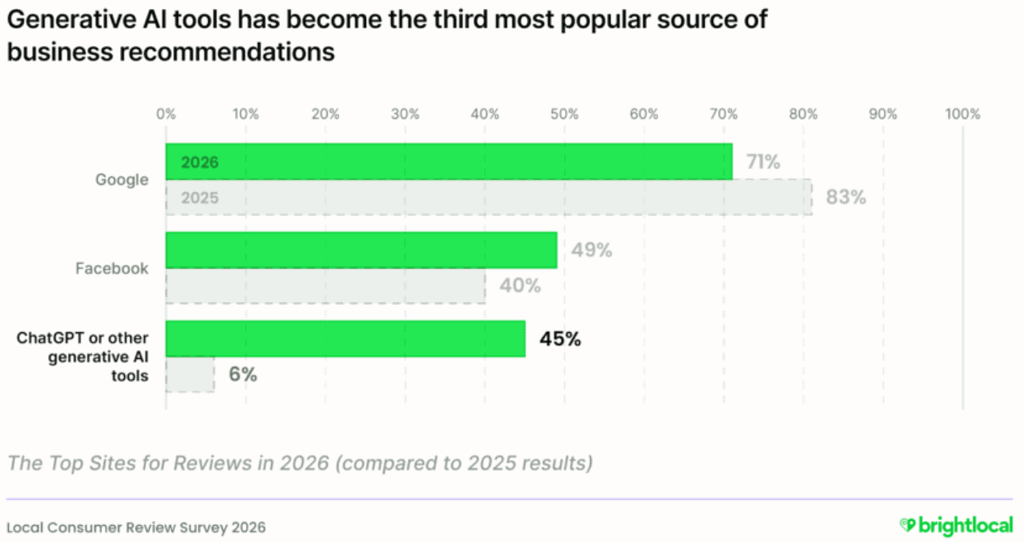
According to the BrightLocal consumer review survey, 97% consumers regularly read online reviews before choosing a local business (Murphy 2026).
Review sentiment also influences how AI systems evaluate trustworthiness.
What are Off-Page SEO Strategies to Improve Search and AI Visibility?
Off-page SEO strategies improve visibility by strengthening authority signals across the web.
Search engines and AI systems use these external signals to determine:
- Which brands are trustworthy
- Which websites deserve rankings
- Which sources should appear in AI-generated answers
Improving Search Rankings
Inbound links and trusted mentions help improve:
- Keyword rankings
- Domain authority
- Organic traffic
- SERP visibility
Search engines interpret quality references as signals of credibility and relevance.
Strengthening Entity Recognition
Repeated mentions across trusted platforms help AI systems associate your brand with specific topics.
For example:
- A cybersecurity brand repeatedly mentioned in ransomware discussions gains topical authority in cybersecurity.
- A healthcare brand frequently cited in clinical discussions gains stronger medical relevance.
This strengthens entity association.
Increasing AI Citations
In AI searches, citations are critical. The sources cited by AI search engines can strongly shape their answers and may be easier to influence.
AI systems prioritize sources that consistently appear in authoritative contexts.
Brands with strong off-page visibility are more likely to appear in AI search. Aggarwal et al. analyzed more than 10,000 prompts and found that content containing quotes and numbers is more likely to be included in AI search results. It increases the position-adjusted word count to 30-40% (Aggarwal 2024). In simple terms, this means visibility of your brand increases with quotes and numbers.
You can optimize your content around these strategies to increase your brand visibility in AI responses.
- Create Original, Citation-Worthy Content: Publish high-quality content that includes unique insights, original research, expert opinions, statistics, and data-driven findings. AI systems are more likely to cite content that provides clear informational value and evidence.
- Structure Content for AI Readability: Organize content with clear headings, concise answers, bullet points, FAQs, and logical sections. Well-structured content is easier for AI systems to extract, summarize, and reference in generated responses.
- Build Strong Entity Authority: Focus on establishing your brand as a recognized entity within a specific topic or industry rather than targeting isolated keywords. Consistent topical associations help AI systems understand your expertise and relevance.
- Use Schema Markup and Structured Data: Implement Schema.org and JSON-LD markup to help AI systems better understand your content type, products, reviews, FAQs, and organization details. Structured data improves machine readability and indexing.
- Publish Clear Answers to Real User Questions: Create content around common prompts, conversational searches, and audience questions. AI systems often prefer pages that directly answer specific queries in simple language.
Building Brand Trust
Community platforms such as Reddit, Quora, Discord groups, Slack communities, and niche forums have become major authority signals for building brand trust.
- Reviews
- Expert commentary
- Media mentions
- Community engagement
- Third-party validation
Trust is now a major factor in ranking and AI evaluation.
Here's a list of strategies that you can use to build trust in AI search;
- Participate in Relevant Communities: Engage in relevant subreddits and online communities by answering questions, sharing insights, and contributing valuable discussions without excessive promotion. Genuine participation helps build trust and authority.
- Publish Valuable Content: Share high-quality content such as case studies, research findings, tutorials, and best practices related to your industry. Educational and data-driven content positions your brand as a credible source of expertise.
- Host AMA (Ask Me Anything) Sessions: Organize AMA sessions in relevant communities to answer questions, discuss industry topics, and share insights. Interactive discussions encourage engagement and strengthen community relationships.
- Showcase Real-World Use Cases and Success Stories: Highlight how businesses or individuals benefit from your products or services through case studies and practical examples. Demonstrating real-world applications helps establish credibility and trust.
- Engage Naturally Without Overpromotion: Contribute to discussions in a helpful and authentic way rather than constantly pushing your products. Communities respond better to brands that focus on providing value first.
- Collaborate With Influencers and Active Community Members: Partner with respected community contributors or influencers who can introduce your brand organically. Providing early access to products or features can encourage authentic reviews and discussions.
At TRYSEO, we use a community-first authority model that combines digital PR, Reddit visibility, and entity optimization to strengthen AI citations.
Our framework demonstrates how modern off-page SEO and GEO work together to improve AI visibility. In a recent case study, TRYSEO succeeded in increasing Tenios AI visibility from 7% to over 50% within three months by combining structured data, Reddit and Quora engagement, entity-focused content optimization, and strategic brand mentions across trusted platforms.
How to Measure Off-Page SEO Success?
You can measure off-page SEO with referral traffic, referring domains, backlink quality, brand searches, rankings, and review growth. These numbers tell you whether your authority is increasing.
Key metrics to measure include;
- Backlink Profile Health: Search engines treat backlinks as signals of trust and authority. Instead of focusing only on link quantity, evaluate link quality, relevance, diversity, anchor text, and freshness using tools like Google Search Console or Ahrefs Site Explorer.
- Search Visibility and Organic Rankings: Off-page SEO plays a major role in improving search rankings. Monitor keyword positions, organic traffic, impressions, and SERP visibility to measure long-term performance.
- Brand Mentions and Share of Voice: Brand mentions, even without direct links, help strengthen authority and trust signals associated with E-E-A-T (Experience, Expertise, Authoritativeness, and Trustworthiness). Track how often your brand is discussed across websites, media platforms, and online communities.
- Referral Traffic and Brand Reputation: Off-page optimization also influences how users discover and interact with your brand. Monitor referral traffic, user engagement, conversions, reviews, and online sentiment to evaluate the real impact of your off-page efforts. Use Google Analytics to check the quality of traffic coming from third-party sites or guest posts.
Meanwhile, a strong AI visibility measurement stack should answer these questions:
- Are authoritative sites linking to us?
- Are communities and forums mentioning us?
- Are AI systems citing or summarizing our content?
- How often does your brand appear in AI responses?
Tools to measure Off-Page SEO
There are several tools that can track the success of off-page SEO.
Backlink and Authority Tracking Tools
- Ahrefs: Tracks backlink profiles, new and lost links, and domain authority.
- Semrush: Provides backlink analytics, outreach monitoring, and competitor backlink gap analysis.
- Moz: Measures Domain Authority (DA), Page Authority (PA), and identifies spammy links.
Free Link and Traffic Analytics Tools
- Google Search Console: Tracks external backlinks, search visibility, and organic click-through rates.
- Google Analytics 4: Measures referral traffic, user behavior, and conversions from off-page campaigns.
Digital PR and Brand Mention Tools
- BuzzStream: Helps manage outreach campaigns and monitor brand mentions.
- Google Alerts: Tracks brand mentions and online discussions in real time.
Tools to Measure Off-Page SEO for AI Platforms
Measuring off-page SEO for AI platforms involves tracking how often your brand is cited, referenced, and surfaced in AI-generated answers.
Key tools include:
- Ahrefs Brand Radar: Monitors brand visibility, AI citations, and mentions across generative search platforms.
- Rankscale.ai: Tracks brand citations and visibility across AI search engines by keywords, regions, and platforms.
- Semrush: Analyzes backlinks, digital PR performance, and competitor authority to strengthen overall off-page SEO.
- Moz Link Explorer: Measures Domain Authority (DA) and Page Authority (PA), which influence trust and citation potential in AI-driven search systems.
Key Takeaways
- Off-page optimization strengthens your website’s authority, trust, and visibility through external signals such as backlinks, mentions, reviews, and digital PR.
- Modern off-page SEO now supports both traditional search rankings and AI visibility across platforms like OpenAI, Google, and Perplexity AI.
- Brand mentions, entity recognition, community discussions, and expert-led content are becoming as important as backlinks.
- AI systems prioritize brands that consistently appear across trusted websites, forums, podcasts, reviews, and industry discussions.
- Measuring off-page SEO requires tracking backlinks, referral traffic, brand mentions, rankings, reviews, and AI citations together.
Conclusion: Off-Page SEO in the AI World
Off-page SEO has changed from ranking to recommendations. In the AI search, visibility depends on whether search engines and AI systems recognize your brand as a trusted authority across the web.
AI search engines and social media platforms shape how users discover information, compare solutions, and make buying decisions. Brands that consistently appear across trusted discussions, citations, reviews, and expert content are far more likely to surface in AI-generated answers.
This is the foundation of the TRYSEO methodology. We at TRYSEO combine traditional SEO with GEO to earn visibility in search engines and AI answers. TRYSEO has a two-level system built around human insight and AI.
TRYSEO approaches off-page SEO as a broader authority-building system that combines entity optimization, structured content, digital PR, community visibility, and AI-readable trust signals. The goal is not only to improve organic traffic, but to ensure AI systems can confidently recognize, understand, and cite your brand across the buyer journey.
As AI search continues to shift from “links” to “answers,” the brands that win will be those with the strongest digital authority systems. New off-page SEO strategies, therefore, require traditional SEO and GEO to stay visible in AI recommendations.
FAQs
- Are backlinks still important in SEO?
Yes. Backlinks remain one of the strongest ranking signals. However, modern SEO prioritizes: relevance, editorial quality, topical authority, natural acquisition, and contextual relevance. A few high-quality backlinks are usually more valuable than hundreds of low-quality links. - Do brand mentions help SEO without links?
Yes. Search engines and AI systems can recognize unlinked brand mentions as implied trust signals. Mentions across news sites, podcasts, forums, Reddit, LinkedIn, and industry publications help improve entity recognition and AI visibility. - Does social media affect SEO rankings?
Social media is not a direct ranking factor, but it indirectly supports SEO by increasing content visibility, engagement, and brand mentions. - What is GEO in off-page SEO?
Generative Engine Optimization (GEO) focuses on improving visibility in AI-generated search experiences. GEO helps brands appear in AI Overviews and AI responses. - Can small businesses benefit from off-page SEO?
Yes. Off-page SEO is especially valuable for small businesses because it helps build credibility and visibility without relying only on large advertising budgets. Local citations, customer reviews, guest articles, community engagement, and niche industry mentions can help small businesses compete with larger brands in both traditional search and AI-generated search experiences. - How long does it take to see results from off-page SEO?
Off-page SEO is a long-term strategy, and results usually take several weeks to months, depending on competition, industry authority, and the quality of your efforts.
Would you also like to optimize your company website for AI and become visible there?
Find out more about our services!
References
- Aggarwal, P.; Murahari, V.; Rajpurohit, T.; Kalyan, A.; Narasimhan, K.; Deshpande, A. (2023). “GEO: Generative Engine Optimization.” arXiv: https://arxiv.org/abs/2311.09735
- Dean, B. (2025). “Google’s 200 Ranking Factors: The Complete List.” Backlinko: https://backlinko.com/google-ranking-factors
- Dunne, L.; Moore, B. (2025). “AI SEO in 2025: Why 99% of Reddit's Influence on ChatGPT Answers Is Invisible.” Discovered: https://discoveredlabs.com/research/reddit-chatgpt-influence-2025
- Murphy, R. (2026). “Local Consumer Review Survey 2026: Star Ratings Keep Rising, Old Reviews Don’t Cut It.” BrightLocal: https://www.brightlocal.com/research/local-consumer-review-survey/
- Peham, T. (2025). “How Do I Appear in ChatGPT Results?” Otterly.AI: https://otterly.ai/blog/how-do-i-appear-in-chatgpt-results/
- Peham, T. (2026). “The AI Citation Economy: What 1+ Million Data Points Reveal About Visibility in 2026.” Otterly.AI: https://otterly.ai/blog/the-ai-citations-report-2026/
- Rose, R. (2025). “9 Takeaways and Insights From the 2026 B2B Content and Marketing Trends Report.” Content Marketing Institute: https://contentmarketinginstitute.com/b2b-research/b2b-content-marketing-trends-research
- Soulo, T. (2023). “96.55% of Content Gets No Traffic From Google. Here’s How to Be in the Other 3.45%.” Ahrefs Blog: https://ahrefs.com/blog/search-traffic-study/
- Thomas Peham (2026). “The AI Citation Economy: What 1+ Million Data Points Reveal About Visibility in 2026.” Otterly.AI Blog: https://otterly.ai/blog/the-ai-citations-report-2026/

