


In short: How to improve your Google ranking
- Improving your Google ranking starts in the Google Search Console: The pattern of impressions, clicks, and position determines the first lever.
- Position moves most significantly when a page answers the search intent more completely than the pages before it; Google Search Central does not specify a word count for this.
- Two of your own pages for the same search query share signals; the overlap of their search result pages determines whether they should be merged.
- On pages two and three, authority is the deciding factor; according to Google Search Central, purchased links violate spam policies.
- An AI Overview ranks first for the search query "improve Google ranking" (our own measurements, details in the AI search section); according to Google, the same levers apply to the citation within it as to the ranking.
Diagnosis with Search Console: Why isn't your page ranking?
The Google Search Console performance report shows you the cause in four numbers: impressions, clicks, click-through rate, and average position.
- According to Google Search Console Help, an impression counts when a user has seen a link to your page in Google search results.
- The click-through rate is clicks divided by impressions.
- The position is an average across all searches; only your best result counts per search.
Filter the report for one page and one search query, then read the pattern; the Performance Report Help describes the filters. More on working with the tool can be found in Using Google Search Console for SEO work.
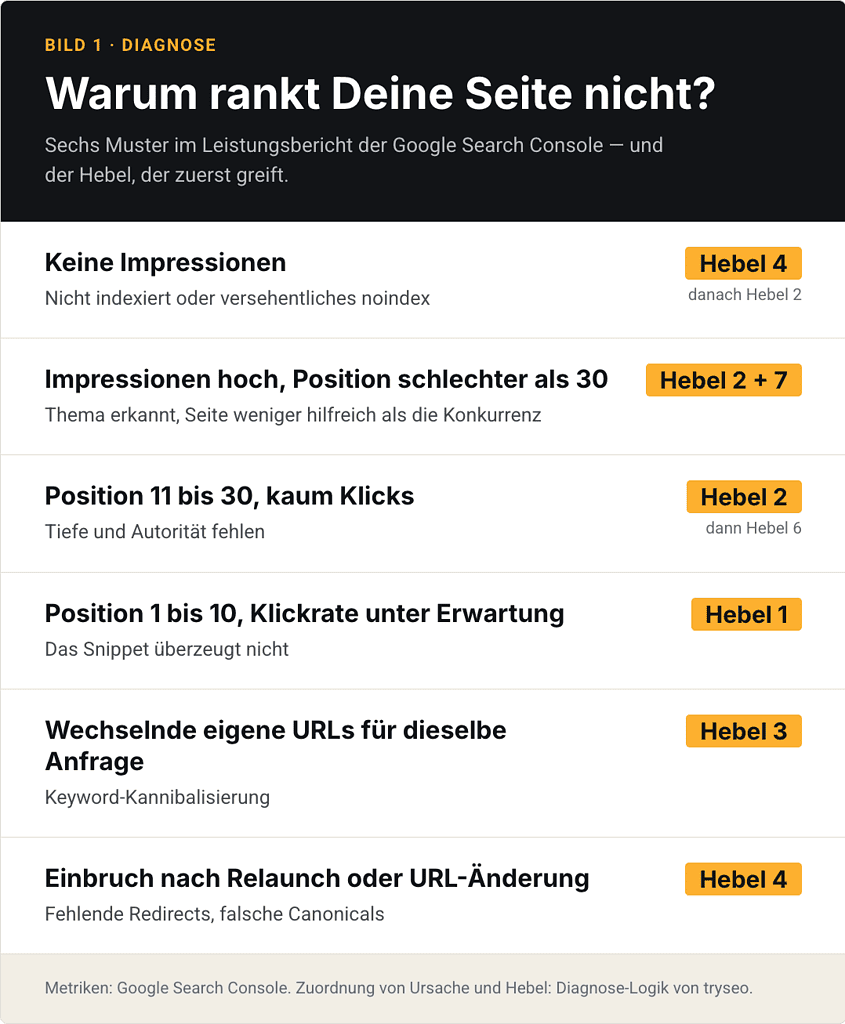
Six patterns from our project work: Google provides the metrics; the assignment to cause and lever is our diagnostic logic.
| Pattern in the performance report | Cause (our assignment) | First lever |
|---|---|---|
| No impressions | Not indexed, accidental noindex (Google Search Central) | Lever 4, then Lever 2 |
| High impressions, position worse than 30 | Topic recognized, page less helpful than competition (Google Search Central) | Lever 2 and 7 |
| Position 11 to 30, hardly any clicks | Depth and authority are missing | Lever 2, then Lever 6 |
| Position 1 to 10, click-through rate below expectations | Snippet is not convincing | Lever 1 |
| Changing own URLs for the same query | Keyword cannibalization (empirical value) | Lever 3 |
| Drop after relaunch or URL change | Missing redirects, wrong canonicals (Google Search Central) | Lever 4 |
Case study: 330,000 impressions, 3 clicks, position 46 to 77
One of our own pages on this topic is a textbook case for Pattern 2. In the 90 days leading up to September 7, 2026, it reached 38,017 impressions, 0 clicks, and position 69.2; over 16 months, it reached 330,613 impressions and 3 clicks (Google Search Console, Property tryseo.de, Search type Web, retrieved September 9, 2026). No month averaged better than position 46; the September value of 77 is based on six days.
Impressions without clicks on pages 5 to 8 are a position problem. The snippet does not play a role there yet. Despite a revision in early 2026, the position fell from 49.2 in April to 76.6 in September (Google Search Console, monthly values, period as above); the consequences are described under Lever 7.
What influences the Google ranking?
Three areas determine how Google categorizes a page: content, technology, and backlinks. According to Google Search Central, the core ranking systems evaluate whether a page is helpful, reliable, and people-first. Search engine optimization (SEO) means optimizing the website for Google in all three areas. You can find the catalog of ranking factors under Google Ranking Factors.
Note: Content decides if your page answers the question. Technology decides if Google can read it. Backlinks decide if Google believes it.
Lever 1: Title and snippet decide the click on page 1
A snippet does not improve your position. From page 1 onwards, however, it decides whether impressions turn into clicks. Therefore, the most famous of all SEO tips—the better title—is the first lever for Pattern 4 and the last for Pattern 2.
Google generates the title link automatically and recreates it according to Google Search Central if the title element is incomplete, outdated, or unsuitable. According to the documentation on snippets, the snippet is primarily created from the page content; Google uses the meta description if it describes the page more accurately.
Google recommends descriptive, concise titles without keyword stuffing, unique per page (Google Search Central, SEO Starter Guide); Google does not specify a character count. For your search result, this means:
- The exact search phrase is at the front, followed by the page's promise.
- No outdated year. The old title of this page carried "[2024]", a competitor on the same results page on September 5, 2026, carried "2026" (Ahrefs SERP snapshot).
- The meta description states the specific benefit of the page.
The "magic square" comes from our project work: main keyword in meta title, meta description, H1, and first paragraph. Google does not explicitly support such a rule; it organizes your work. Details under Snippet Optimization.
Lever 2: Meet the search intent and prioritize by query potential
The position is moved most strongly by a page that meets exactly one search intent and answers the question more completely than the current top 10. Google asks in the helpful content guidelines whether a page provides a substantial, complete description of the topic and goes beyond the obvious. A word count is not part of this: Google has no preferred length, and according to the SEO Starter Guide, length alone does not play a role in ranking.
Reading search intent from the search results page
The search results page shows what kind of page Google expects: guide, product page, or comparison. The questions under "People also ask" are your completeness check. Semantic coverage beats keyword density: Google's language systems understand pages without the exact terms, and unnatural repetition of search terms is keyword stuffing according to the spam policies.
Query potential over search volume
In B2B, the query potential of a keyword counts more than its search volume. Example machining (Ahrefs Keywords Explorer, country Germany, retrieved September 9, 2026): "cnc milling" has around 800 search queries per month at around $1 cost-per-click, "cnc milling contract manufacturing" only around 70, but around $8. Advertisers pay eight times as much because they expect an order behind this query. More on this in Long-tail keywords in AI search.
This is exactly how we worked in 2024 for Nexova, a fiduciary provider in the Swiss market: a blog as a knowledge center for informative questions plus landing pages for keywords with transactional intent. Result according to our case study 2300 percent growth in B2B: over 2300 percent more organic traffic within one year; qualified inquiries grew similarly, according to the case study, without a specific number. Keyword research as a process is described in SEO Keyword Analysis.
Lever 3: Don't let your pages rank against each other
Two of your own pages for the same search query share signals and take turns in the ranking; in the end, neither ranks stably. This is keyword cannibalization. Google does not define the term; the classification comes from our project work. The mechanism is proven: Google Search Central recommends consolidating signals from similar pages onto one URL, via redirect or rel=canonical.
The search results page decides whether one or two URLs are correct. If Google shows largely the same results for two keywords, they belong on one page; if there is hardly any overlap, Google wants to see two pages. Our SERP Overlap Tool measures this overlap for free; the method is explained in SERP Overlap Analysis. More in Cover 2 keywords with one page or separate subpage?.
The solution: merge and permanently redirect the weaker URL, or separate the pages so that each serves its own intention.
Internal links then control which page should rank. According to Google Search Central, every page that is intended to rank needs at least one internal link; good anchor text is descriptive, concise, and relevant. From our experience, internal anchors may carry the target phrase literally; Google does not distinguish between internal and external in the anchor text rule.
Lever 4: Clean up the technology before adding more content
In our experience, technology rarely lifts a page from position 30 to position 5. However, technical errors prevent the other levers from taking effect. That's why the checklist is mandatory before any content update, whether your website runs on WordPress or another system.
Technical Google optimization: the checklist
Two groups, one crawl with the Screaming Frog SEO Spider: free up to 500 URLs, the license costs £199 per year according to the Screaming Frog pricing page (as of September 9, 2026). The overview is provided by Technical SEO.
Group 1: Indexing and status, i.e., everything that prevents Google from reading the page:
- Indexability of every important page, no accidental noindex; details under Index website with Google
- Reasons in the "Page indexing" report of the GSC, such as 404 or redirect (Google Search Console Help)
- 4xx and 5xx status codes as well as 3xx redirect chains
- Canonical tags (specifying the preferred URL) pointing to the correct URL
- Permanent redirects for changed URLs; implementation under Redirects and SEO
Group 2: On-page hygiene. Google can read these pages, but the signals are diluted or duplicated:
- Duplicate or missing titles, H1s, and descriptions
- Images without alt text and images in original size
- Orphaned pages without an internal link
Core Web Vitals instead of the three-second rule
Google measures the loading experience with three values, the Core Web Vitals: LCP (loading time of the largest visible element) up to 2.5 seconds, INP (interaction to next paint) up to 200 milliseconds, and CLS (cumulative layout shift) up to 0.1 are considered good according to web.dev. Measurement is at the 75th percentile, so three out of four visits must reach the value (web.dev, thresholds).
Google explicitly recommends good values for success in search according to Google Search Central, without specifying the strength of the signal. Details in Core Web Vitals: INP replaces FID.
According to Introduction to structured data, Schema Markup—i.e., structured data—helps Google understand content; it does not guarantee a rich result, i.e., an enhanced search result. For a company website, Organization, Article, Breadcrumb, and for locations, Local Business are the relevant types from the Search Gallery.
FAQ markup no longer generates a rich result since May 7, 2026 (Google Search Central changelog). Google recommends JSON-LD and testing with the Rich Results Test; more under structured data.
Lever 5: Improve Google ranking for free with business profile, directories, and company data
Three things only cost time and are missing on many company websites: a well-maintained Google Business Profile, entries in the major directories, and identical company data everywhere.
The first building block for every company with a location is the Google Business Profile. According to Google Business Profile Help, Google determines local ranking based on relevance, distance, and prominence. Complete and correct information increases the chance of local visibility, positive reviews can improve local ranking, and according to Google, it cannot be bought. Anyone who wants to improve their Google Maps ranking works on the profile: Optimize Google Business Profile.
Directory entries are the second building block:
- Yellow pages
- The phone book
- 11880
- MyCity
In our experience, these links are usually marked as nofollow, which means they are permissible according to Google's spam policies but are not an editorial recommendation. Their value lies in consistency: according to Business Profile guidelines, Google requires the exact company name, the correct address, and a reachable phone number for the profile. The same information belongs identically in every directory and on your website.
From our project work, this NAP consistency (Name, Address, Phone) is the prerequisite for Google and AI systems to recognize your company as an entity, i.e., as a uniquely identifiable business.
Lever 6: Build authority: Backlinks and brand signals that Google and AI systems read
On pages 2 and 3, authority is the deciding factor: a few topically relevant links and consistent mentions of your brand move more than many purchased links. Backlinks are a recommendation signal for Google; PageRank, the system behind it, has been one of the core ranking systems since Google's launch according to the Guide to Google's ranking systems.
Buying or selling links to manipulate rankings is link spam according to spam policies; affected pages may rank worse or disappear entirely.
Feasible ways in link building for a tech SME that wants to increase its ranking from page 2:
- Specialist articles in the industry media that your customers read
- Contributions on association pages
- Partner and supplier pages that mention references
- Own data or tools that others cite
Why backlinks continue to count is explained under How important are backlinks for SEO?.
Brand signals are the second level for a better ranking. With Experience, Expertise, Authoritativeness, and Trustworthiness (E-E-A-T) in the helpful content guidelines, Google describes how quality raters and ranking signals recognize helpful content; trust is the most important aspect. E-E-A-T is not a single ranking factor; Google's systems work with a mix of signals that fit these aspects.
From our project work, we observe that brands with consistent mentions in specialist media, directories, and forums appear more frequently in AI answers. This is an observation without a documented rule behind it. More under Brand signals and AI visibility.
Lever 7: Update existing content before writing new content
In our experience, a page with an impression history has an advantage over a new URL. However, it can only be moved with a real rebuild. You can find candidates in the GSC: pages with impressions, position 11 to 40, and a downward trend.
This is how we proceed when we optimize a ranking this way:
- Check search intent against the current search results page.
- Rebuild structure: core statement first, readers' questions as headings.
- Replace outdated numbers, tool names, and screenshots.
- Keep URL; a redirect is only necessary in the event of a merger (Google Search Central on redirects).
- Only update the publication date if there is a real change.
Our negative example from the diagnosis shows what happens without a rebuild: the revision in early 2026 left the structure and core statement of the page unchanged; the position then fell further month after month, with zero clicks in each month (Google Search Console, see case study). According to the guide to ranking systems, Google's freshness systems show fresher content for queries where users expect up-to-dateness; a new date over old text is not a lever.
How AI search changes the ranking goal: being ranked and being cited
An AI Overview ranks at position 1 for the search query "improve Google ranking"; anyone who improves their ranking today is simultaneously competing for the citation within it. We measured this twice in September 2026: on September 5 via Ahrefs SERP snapshot with sitelinks to three domains, on September 9 in our own measurement (n8n scrape) with four cited domains, including two different ones than four days earlier.
According to Google Search Central, there are no additional requirements for AI Overviews and AI Mode (in Google Germany: KI-Modus, available in Germany, Austria, and Switzerland since October 8, 2025, according to Google).
According to the guide to optimizing for generative AI features, the generative functions are based on the core ranking systems of search; therefore, SEO best practices continue to apply, supplemented by own expert perspectives beyond general knowledge.
From our work, the form in particular makes a page citable (more on this in the guide LLM Search: Visibility in AI Answers):
- one statement per paragraph
- question headings with the answer in the first sentence
- tables for comparisons and assignments
- sources mentioned and linked within the sentence
Our client Spreadshop shows that the same levers move both. The starting point was a print-on-demand platform with pages at an average position of 23.88. Measures included new landing pages, technical SEO, digital PR, and community seeding. Result: position 9.04 and plus 355 percent impressions in the Search Console in a three-month period year-over-year. All figures are in the case study Spreadshop: Ranked by Google, cited by AI.
At the same time, the Share of Voice—i.e., the share of mentions compared to the observed competitor set—in ChatGPT, Perplexity, Copilot, and Google AI Overviews rose from around 1 percent in October 2025 to over 30 percent in January 2026 (Source: same case study).
An llms.txt file does not belong on this lever list. According to Google Search Central (guide to optimizing for generative AI features, mythbusting section), Google does not use it; it has neither a positive nor a negative effect on visibility or ranking.
None of the four answer engine providers (AI search systems) we checked explains in its crawler documentation that it reads the file (as of September 9, 2026): OpenAI, Anthropic, and Perplexity name robots.txt as a control means, Microsoft for Bing and Copilot additionally names XML sitemaps and IndexNow.
Creating it costs nothing, but you shouldn't expect anything from it; time belongs in citable content. Classification under Do I need an llms.txt?, the objection "Is Google still worth it?" is answered by Is SEO still relevant?, the overall framework by our pillar What is GEO?.
How to recognize that the levers are working
Whether the measures increase the ranking is first shown in the average position and impressions per search query, then in clicks. Traffic is the latest metric.
Compare two periods of equal length in the GSC, filtered by page and search query. The position per query says more than the average across all queries because new impressions for niche topics pull the latter down.
Since August 31, 2026, according to Google Search Console Help, the Search Console also shows a report on performance in generative AI features worldwide: impressions from AI Overviews and AI Mode by page, country, device, and date, without clicks. How to check positions is explained in Check my website ranking, and which metrics are suitable for AI search in Zero-Click Search: Share of Voice and Non-Click Visibility.
Conclusion: Improving Google ranking means cause before measure
Anyone who knows the pattern from the Search Console needs two or three of the seven levers first. A page with impressions at position 60 needs levers 2 and 7; a new snippet won't help it yet. A page at position 8 with a weak click-through rate needs lever 1 and otherwise peace and quiet. Two of your own pages alternating need lever 3. The order results from the findings.
If you have the findings and cannot manage the implementation internally, that is the point where our SEO consulting comes in.
Frequently asked questions about improving Google ranking
How do you move up on Google?
By first checking in the Google Search Console why your page is where it is, and then pulling the appropriate lever. Without impressions, it's due to indexing; on page 3 and deeper, it's due to depth and authority; on page 1 with few clicks, it's due to the snippet.
Can you buy Google ranking?
No, organic Google ranking cannot be bought. Purchased links are link spam according to Google's spam policies; affected pages may rank worse or disappear, and according to Google Search Central, no one can guarantee position 1. Google Ads buys a paid placement above the organic results; the organic ranking remains unaffected by this.
What does it cost to improve Google ranking?
Many of the most effective levers cost no money; the price is time. Search Console, Business Profile, and updating existing content cost nothing. What you pay for are the hours you spend finding out where to click and which lever works for your pattern. An agency knows this, saves exactly those hours, and sets the levers that apply to your findings.
How long does it take for Google ranking to improve?
According to documentation on core updates, Google specifies a range of a few days to several months for recovery after a core update. For individual SEO measures, Google's documentation does not specify a duration; the previous statement "four months to one year" is no longer there. How to recognize progress early is explained in the section on measuring.
How do I improve my Google Maps ranking?
Through a complete Google Business Profile, because Google determines local ranking based on relevance, distance, and prominence (Google Business Profile Help). Complete information and positive reviews count. This is how it's done: Optimize Google Business Profile.
Why isn't my page ranking even though the content is good?
Because "good" is relative for Google: according to Google, the core ranking systems evaluate whether a page is helpful, reliable, and people-first, and in competition, the page that fulfills this better wins. At position 30 and worse, depth is missing; on pages 2 and 3, authority is missing; and if two of your pages appear alternately, they are cannibalizing each other.
If you want to go through your findings with someone who sees these patterns daily: Write your own SEO success story. We'll look at your numbers and tell you which lever comes first.

